
Fibonacci's Octopus: Spiral Curves and Geometric Sequences via Similarity Transf
Loading the math board and drawing, please wait…
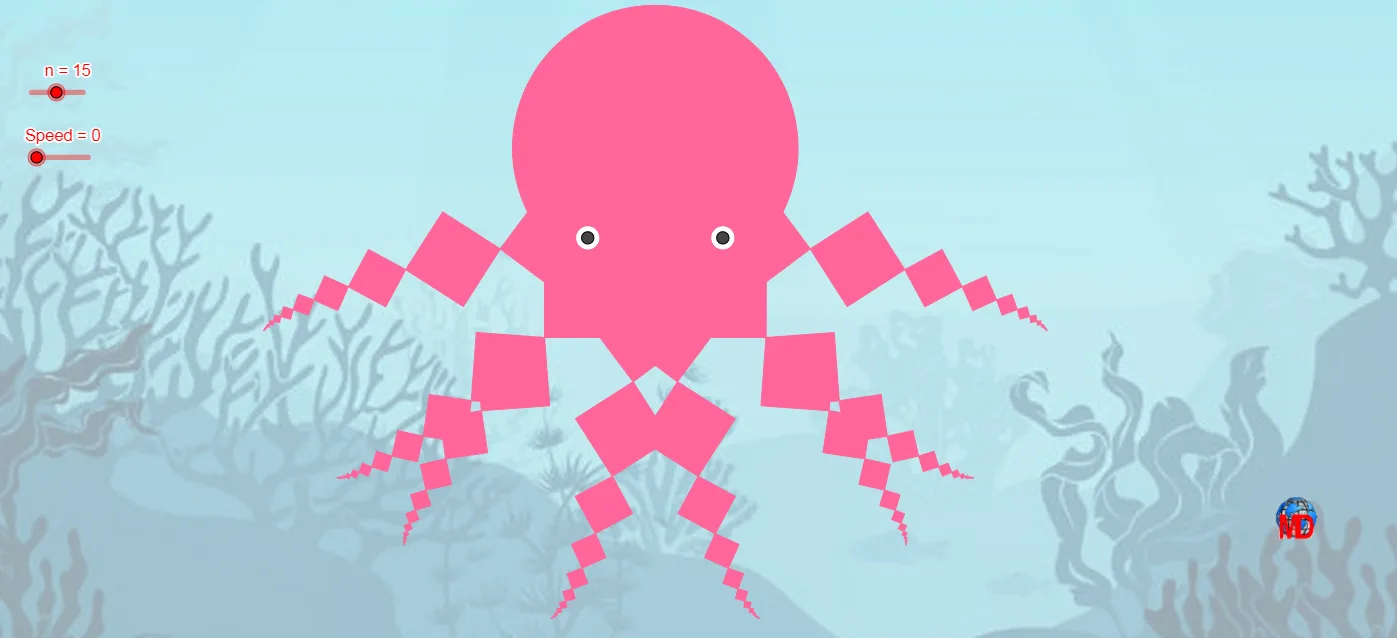
This GeoGebra example constructs a complex geometric figure called 'Fibonacci's Octopus', demonstrating the generation of spiral curves and polygon sequences driven by the Fibonacci sequence. The core mathematical concepts include similarity transformations, geometric transformations, curve sketching, line segments, parallelograms, rhombi, and linear functions. The construction utilizes a variety of GeoGebra commands such as CircleArc, Point, Circle, Sequence, CurveCartesian, Line, Mirror, Semicircle, and CircumcircleArc, involving numerous objects like E, q, n, ϕ, c, A, z_1, etc., to create dynamic spiral structures through parameter control. This example is suitable for high school and above students to explore the combination of Fibonacci numbers with geometric transformations, and can serve as a teaching case for mathematical modeling or computer-aided geometric design, helping to understand the application of similarity transformations in generating complex figures.
GeoGebra Commands & Parameters
CircleArc((1, 1), ((1 + ί) * (1 - ί / ϕ)), ((1 + ί) * (1 + ί / ϕ))) → cPoint(c) → ACircle((ϕ * (1 + ί)), sqrt(2)) → ePoint(e) → BCircleArc(C + (1, 1), C + ((1 + ί) * (1 + ί / ϕ)), C + ((1 + ί) * (1 - ί / ϕ))) → dCircle(C + (ϕ * (1 + ί)), sqrt(2)) → fSequence(C - ((1 + ί) * (1 - q^(j)) / (1 - q)), j, 0, n) → l1Point(d) → AAPoint(f) → BBSequence(E + ((-(-1 + ί)) * (1 - q^(j)) / (1 - q)), j, 0, n) → l5Sequence(Polygon[l5(k), l5(k) + (l5(k + 1) - l5(k)) / (1 + ί), 4], k, 1, Length[l5] - 1) → l6CurveCartesian(x(C) + real(((-1 - ί) * (1 - q^(t)) / (1 - q))), y(C) + imaginary(((-1 - ί) * (1 - q^(t)) / (1 - q))), t, 0, n) → bCurveCartesian(x(E) + real(((1 - ί) * (1 - q^(t)) / (1 - q))), y(E) + imaginary(((1 - ί) * (1 - q^(t)) / (1 - q))), t, 0, n) → hLine(E, yAxis) → gMirror(l6, g) → l6'Mirror(h, g) → h'Sequence(Polygon[l1(k), l1(k) + (l1(k + 1) - l1(k)) / (1 + ί), 4], k, 1, Length[l1] - 1) → l2Mirror(l2, g) → l2'Mirror(b, g) → b'Sequence(C + (-1.2, -2.75) + ((0.5 + ί) * (1 - (2 * q^(j))) / (1 - q)) - 0, j, 1, n) → l3Sequence(Polygon[l3(k), l3(k) + (l3(k + 1) - l3(k)) / (1 + ί), 4], k, 1, Length[l3] - 1) → l4Line(E, D) → lMirror(h, l) → h'_{1}Mirror(l6, l) → l6'_{1}Mirror(h'_{1}, g) → aMirror(l6'_{1}, g) → l7Line(E, F) → mMirror(b', m) → b''Mirror(l2', m) → l2''Mirror(l2'', g) → l2'''Mirror(b'', g) → b'''Semicircle(H, G) → kCircumcircleArc(G - (0.2, 0.2), K, H + (0.2, -0.2)) → sCircumcircleArc(N, M, O) → tCircle(J, 0.1) → rCircle(I, 0.1) → p
AI Drawing Prompt Reference
Create a complex geometric figure called 'Fibonacci Octopus', featuring spiral curves and polygon sequences based on the Fibonacci sequence. Start by drawing two arcs and circles, then generate a series of similar polygons using parameters, and create dynamic spiral structures through mirroring and parametric curves.
The prompt above was compiled from the original drawing commands and is for reference only.