
Cylinder x Cylinder Intersection Curve
Loading the math board and drawing, please wait…
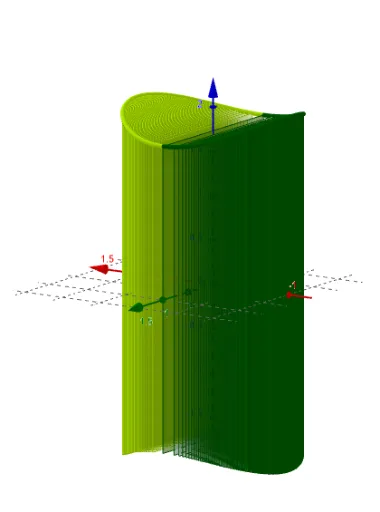
This example demonstrates the intersection curve formed by two cylinders in 3D space. It involves core mathematical concepts such as solid geometry, coordinate geometry, and parametric equations. The construction uses the CurveCartesian and Sequence commands to plot the curve, with objects like Ez1, Ez2, a, b, c, d, Wandab, Wandcd, l1, l3, j, A, l5, l4. It is suitable for high school and above students to learn about spatial geometry and curve properties.
GeoGebra Commands & Parameters
CurveCartesian((sqrt(1 - t^(2)), t, sqrt(4 - t^(2))), t, -1, 1) → aCurveCartesian((sqrt(1 - t^(2)), t, (-sqrt(4 - t^(2)))), t, -1, 1) → bCurveCartesian(((-sqrt(1 - t^(2))), t, sqrt(4 - t^(2))), t, -1, 1) → cCurveCartesian(((-sqrt(1 - t^(2))), t, (-sqrt(4 - t^(2)))), t, -1, 1) → dSequence(Segment[(sqrt(1 - k^(2)), k, sqrt(4 - k^(2))), (sqrt(1 - k^(2)), k, (-sqrt(4 - k^(2))))], k, -1, 1, 0.05) → WandabSequence(Segment[((-sqrt(1 - k^(2))), k, sqrt(4 - k^(2))), ((-sqrt(1 - k^(2))), k, (-sqrt(4 - k^(2))))], k, -1, 1, 0.05) → WandcdSequence(Segment[(sqrt(1 - k^(2)), k, sqrt(4 - k^(2))), (sqrt(1 - k^(2)), k, (-sqrt(4 - k^(2))))], k, -1, -0.85, 0.005) → l1Sequence(Polygon[(sqrt(1 - k^(2)), k, sqrt(4 - k^(2))), (sqrt(1 - k^(2)), k, (-sqrt(4 - k^(2)))), ((-sqrt(1 - k^(2))), k, (-sqrt(4 - k^(2)))), ((-sqrt(1 - k^(2))), k, sqrt(4 - k^(2)))], k, -1, 1, 0.1) → l3Sequence(Polygon[(sqrt(1 - t^(2)), t, sqrt(4 - t^(2))), (sqrt(1 - t^(2)), (-t), sqrt(4 - t^(2))), (sqrt(1 - t^(2)), (-t), (-sqrt(4 - t^(2)))), (sqrt(1 - t^(2)), t, (-sqrt(4 - t^(2))))], t, -1, 1, 0.01) → l5Sequence(Polygon[((-sqrt(1 - t^(2))), t, sqrt(4 - t^(2))), ((-sqrt(1 - t^(2))), (-t), sqrt(4 - t^(2))), ((-sqrt(1 - t^(2))), (-t), (-sqrt(4 - t^(2)))), ((-sqrt(1 - t^(2))), t, (-sqrt(4 - t^(2))))], t, -1, 1, 0.01) → l4
AI Drawing Prompt Reference
Draw the intersection curve of two cylinders, one with radius 1 and height 2 along the positive x-axis, and the other with radius 2 and height 2 along the negative x-axis. Use parametric equations to plot the intersection curve and represent the surrounding area with segments and polygons to observe the intersection points with the cylinders.
The prompt above was compiled from the original drawing commands and is for reference only.