
Gabriel Horn
Loading the math board and drawing, please wait…
In collections
geometriadinamica.es
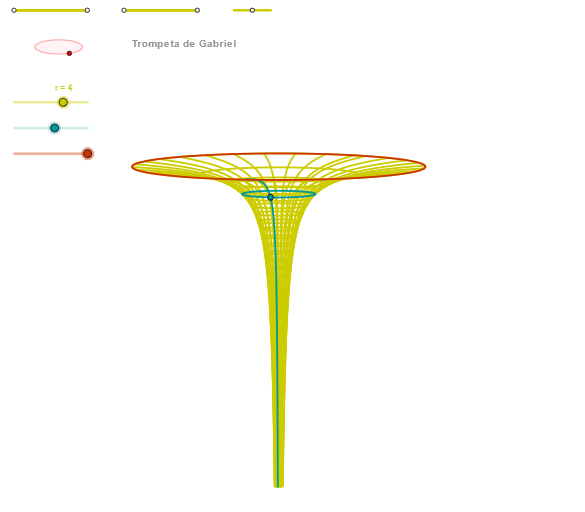
This example demonstrates the Gabriel Horn, a fascinating three-dimensional geometric shape formed by the intersection of a paraboloid and a cylindrical surface. Key math concepts include solid geometry, coordinate geometry, rotational solids, parametric equations, curves, and surfaces. Construction highlights involve commands like Segment, Point, OrthogonalLine, Circle, Intersect, Ellipse, Angle, CurveCartesian, and Sequence from GeoGebra, emphasizing parametric representation and 3D visualization. Suitable for high school and advanced students studying 3D geometry, coordinate geometry, and parametric equations, as well as mathematical modeling and visualization education.
GeoGebra Commands & Parameters
Segment(Q5, Q6) → p5Point(p5) → P5Segment(Q3, Q4) → p2Point(p2) → P3Segment(P3, Q4) → p4Point(p4) → P4Segment(Q1, Q2) → p1Point(p1) → P1Segment(P1, Q2) → p3Point(p3) → P2OrthogonalLine(C, xAxis) → zz2Circle(C, 0.62) → zz0Intersect(zz0, zz2, 1) → ZZ4Intersect(zz0, zz2, 2) → ZZ3Ellipse(ZZ3, ZZ4, 0.65) → zElipse2Point(zElipse2) → ZIntersect(zElipse2, zz2) → ZZ7, ZZ8Angle(ZZ8, C, Z) → zAngIncOrthogonalLine(C, yAxis) → zz1Intersect(zz0, zz1, 2) → ZZ2Intersect(zz0, zz1, 1) → ZZ1Ellipse(ZZ1, ZZ2, 0.65) → zElipse1Point(zElipse1) → XYIntersect(zElipse1, zz1) → ZZ5, ZZ6Angle(ZZ6, C, XY) → zAngRotSegment(ZZ5, ZZ6) → zz4Segment(ZZ7, ZZ8) → zz3Intersect(zElipse2, zElipse1, 1) → zPunto1Intersect(zElipse2, zElipse1, 4) → zPunto2Segment(zPunto1, zPunto2) → zSeg2CurveCartesian((r / 4 * (((1 / v * cos(α)) * sin(zAngRot)) + ((1 / v * sin(α)) * cos(zAngRot)))), (r / 4 * ((((-1 / v * cos(α)) * cos(zAngRot)) * sin(zAngInc)) + (((1 / v * sin(α)) * sin(zAngRot)) * sin(zAngInc)) + ((v + 4) * cos(zAngInc)))), v, v1, v2) → curva2Sequence(CurveCartesian[(r / 4 * (((1 / v * cos(u)) * sin(zAngRot)) + ((1 / v * sin(u)) * cos(zAngRot)))), (r / 4 * ((((-1 / v * cos(u)) * cos(zAngRot)) * sin(zAngInc)) + (((1 / v * sin(u)) * sin(zAngRot)) * sin(zAngInc)) + ((v + 4) * cos(zAngInc)))), u, u1, u2], v, v1, v2, paso) → list2CurveCartesian((r / 4 * (((1 / -1 * cos(u)) * sin(zAngRot)) + ((1 / -1 * sin(u)) * cos(zAngRot)))), (r / 4 * ((((-1 / -1 * cos(u)) * cos(zAngRot)) * sin(zAngInc)) + (((1 / -1 * sin(u)) * sin(zAngRot)) * sin(zAngInc)) + ((-1 + 4) * cos(zAngInc)))), u, u1, u2) → curva1CurveCartesian((r / 4 * (((1 / β * cos(u)) * sin(zAngRot)) + ((1 / β * sin(u)) * cos(zAngRot)))), (r / 4 * ((((-1 / β * cos(u)) * cos(zAngRot)) * sin(zAngInc)) + (((1 / β * sin(u)) * sin(zAngRot)) * sin(zAngInc)) + ((β + 4) * cos(zAngInc)))), u, u1, u2) → a1Sequence(CurveCartesian[(r / 4 * (((1 / v * cos(u)) * sin(zAngRot)) + ((1 / v * sin(u)) * cos(zAngRot)))), (r / 4 * ((((-1 / v * cos(u)) * cos(zAngRot)) * sin(zAngInc)) + (((1 / v * sin(u)) * sin(zAngRot)) * sin(zAngInc)) + ((v + 4) * cos(zAngInc)))), v, v1, v2], u, u1, u2, paso) → list1
AI Drawing Prompt Reference
Draw a three-dimensional Gabriel's Horn shape formed by the intersection of a paraboloid and a cylindrical surface. Start by constructing two perpendicular reference segments with points on them, then create auxiliary circles and ellipses. Use the intersection points of ellipses with perpendicular lines to determine rotation angles. Finally, generate a series of parametric curves arranged in a grid pattern to form the horn-like surface, showing a symmetric rotational solid with clear outlines and internal structure.
The prompt above was compiled from the original drawing commands and is for reference only.