
Coordinate Geometry Proof: Diagonals of a Rectangle are Congruent
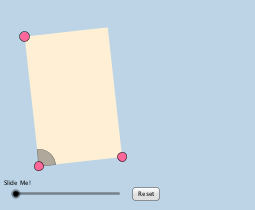
Loading the math board and drawing, please wait…
In collections
Expressing Geometric Properties with Equations (GPE) Cluster
Unit 7: Polygons and Quadrilaterals
Quadrilaterals
Coordinate Geometry Proof Prompts
① This example demonstrates, through coordinate geometry, that the diagonals of a rectangle are congruent (equal in length). ② Core mathematical concepts include properties of rectangles, diagonal segments, congruent triangles, distance formula in coordinates, and logical proof structure. ③ Construction highlights: using GeoGebra commands such as Segment, Slope, OrthogonalLine, Point, Ray, Line, Intersect, Circle, Dilate, Vector, CircleSector, Translate, Rotate, Polygon, and Angle to build a rectangle and its diagonals, then measure and compare diagonal lengths to verify congruence. ④ Suitable for upper middle school or high school students learning coordinate geometry proofs, and useful for teachers as an interactive demonstration to illustrate rigorous geometric reasoning.
GeoGebra Commands & Parameters
Segment(A, B) → aSlope(a) → cOrthogonalLine(A, a) → ePoint(e) → CRay(A, C) → dPoint(d) → DSegment(A, D) → fLine(D, a) → gLine(B, f) → hIntersect(g, h) → ESegment(D, E) → iSegment(E, B) → jCircle(A, (0.2 * Min[f, i])) → kIntersect(k, f) → G,Intersect(k, a, 1) → HDilate(A, If[0 < l ≤ 1, 1 - l, 0], B) → A'Vector(A, A') → uCircleSector(A, H, G) → pTranslate(p, u) → p'Rotate(p', If[1 < l ≤ 2, ((l - 1) * π / 2), 1.5707963267948966], B) → p''Dilate(B, If[2 < l ≤ 3, 3 - l, 0], E) → B'Vector(B, B') → vTranslate(p'', v) → p'''Rotate(p''', If[3 < l ≤ 4, ((l - 3) * π / 2), 1.5707963267948966], E) → qDilate(E, If[4 < l ≤ 5, 5 - l, 0], D) → E'Vector(E, E') → wTranslate(q, w) → q'Rotate(q', If[5 < l ≤ 6, ((l - 5) * π / 2), 1.5707963267948966], D) → q''Dilate(D, If[6 < l ≤ 7, 7 - l, 0], B) → D'Vector(D, D') → mSegment(D, D') → nDilate(A, If[7 < l ≤ 8, 8 - l, 0], E) → A'_1Segment(A, A'_1) → sPolygon(A, B, E, D) → poly1, a_1, b_1, e_1, d_1Dilate(A, If[16 < l ≤ 17, 17 - l, 0], E) → A'_2Dilate(A, If[16 < l ≤ 17, 17 - l, 0], B) → A'_3Dilate(A, If[16 < l ≤ 17, 17 - l, 0], D) → A'_4Vector(A, A'_3) → u_1Vector(A, A'_2) → v_1Vector(A, A'_4) → w_1Dilate(A, If[18 < l ≤ 19, 19 - l, 0], E) → A'_5Dilate(A, If[18 < l ≤ 19, 19 - l, 0], D) → A'_6Dilate(A, If[18 < l ≤ 19, 19 - l, 0], B) → A'_7Vector(A, A'_7) → i_1Vector(A, A'_5) → j_1Vector(A, A'_6) → l_1Dilate(D, If[8 < l < 9, 9 - l, 0], E) → D'_1Vector(D, D'_1) → rTranslate(D, r) → D'_2Translate(D', r) → D''Segment(D'_2, D'') → n'Angle(A, D, B) → βRotate(D'_2, If[9 < l ≤ 10, ((-2 * (l - 9)) * β), (-2 * β)], E) → LRotate(D'', If[9 < l ≤ 10, ((-2 * (l - 9)) * β), (-2 * β)], E) → D'''Segment(L, D''') → n''