
Converse of Isosceles Triangle Theorem (II): Equiangular Implies Equilateral
Loading the math board and drawing, please wait…
In collections
Congruence (CO) Cluster
Congruence (Vol 2)
CCSS High School: Geometry (Congruence) Volume 2
CCSS High School: Geometry (Congruence) Volume 2
CCSS High School: Geometry (Congruence) Volume 2
Geometry (Congruence) Volume 2
CCSS High School: Geometry (Congruence) Volume 2
CCSS High School: Geometry (Congruence) Volume 2
CCSS High School: Geometry (Congruence) Volume 2
CCSS High School: Geometry (Congruence) Volume 2
CCSS High School: Geometry (Congruence) Volume 2
CCSS High School: Geometry (Congruence) Volume 2
CCSS High School: Geometry (Congruence) Volume 2
Gail LeBlancCCSS High School: Geometry (Congruence) Volume 2
CCSS High School: Geometry (Congruence) Volume 2
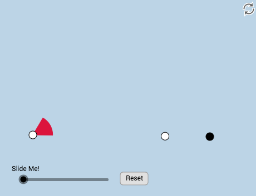
① This dynamic GeoGebra example illustrates a fundamental property of triangles: if a triangle is equiangular (all three angles equal), then it must be equilateral (all three sides equal), demonstrating the converse of the isosceles triangle theorem. ② Core mathematical concepts include the triangle angle sum theorem, the relationship between equal angles and equal sides, and the logical structure of converse theorems in geometry. ③ Construction highlights: based on the construction summary, the example uses GeoGebra commands such as Line, Ray, Point, Rotate, Angle, Circle, Intersect, Segment, CircleSector, Polygon, Dilate, Vector, and Translate. It constructs auxiliary circles, rotates angles, and translates segments to dynamically show how side lengths become equal when angles are equal, accompanied by guiding questions. ④ This resource is suitable for upper middle school or high school geometry classes, useful for exploring triangle properties, understanding proof of converse theorems, and serving as an interactive geometry teaching material.
GeoGebra Commands & Parameters
Line(A, B) → fRay(A, B) → gPoint(g) → CRotate(C, π / 3, A) → C'Angle(C, A, C') → αRotate(A, (-(π / 3)), C) → A'Angle(A', C, A) → βCircle(A, C) → cCircle(C, A) → dIntersect(c, d, 1) → DSegment(A, D) → hSegment(A, C) → iSegment(C, D) → jCircle(A, (0.15 * i)) → eIntersect(e, h, 1) → EIntersect(e, i, 1) → FCircleSector(A, F, E) → kPolygon(A, C, D) → poly1, d_1, a_1, c_1Dilate(A, If[0 < a ≤ 1, 1 - a, 0], C) → A'_1Segment(A, A'_1) → lDilate(A, If[1 < a ≤ 2, 2 - a, 0], C) → A'_2Vector(A, A'_2) → uTranslate(k, u) → k'Rotate(k', If[2 < a ≤ 3, (((a - 2) * 2) * π / 3), (2 * π / 3)], C) → k''Dilate(C, If[3 < a ≤ 4, 4 - a, 0], D) → C'_1Vector(C, C'_1) → vTranslate(k'', v) → k'''Rotate(k''', If[4 < a ≤ 5, (((a - 4) * 2) * π / 3), (2 * π / 3)], D) → pDilate(D, If[5 < a ≤ 6, 6 - a, 0], A) → D'Dilate(D, If[5 < a ≤ 6, 6 - a, 0], C) → D'_1Segment(D, D') → mSegment(D, D'_1) → nRotate(A, If[6.5 < a ≤ 7.5, ((a - 6.5) * π / 3), π / 3], A) → A'_3Rotate(A'_1, If[6.5 < a ≤ 7.5, ((a - 6.5) * π / 3), π / 3], A) → GSegment(A'_3, G) → l'Rotate(A, If[7.5 < a ≤ 8.5, ((-(a - 7.5)) * π / 3), ((-π)) / 3], C) → A'_4Rotate(A'_1, If[7.5 < a ≤ 8.5, ((-(a - 7.5)) * π / 3), ((-π)) / 3], C) → HSegment(A'_4, H) → l'_1
AI Drawing Prompt Reference
Create a dynamic illustration showing that an equiangular triangle is equilateral. Start by drawing a line segment and extending it as a ray. Mark a point on the ray, then rotate this point around the endpoint of the line segment by 60 degrees to get another point. Draw circles centered at these two points and find their intersection point to form the third vertex of the triangle. Connect the three vertices to form a triangle, highlighting that all angles are equal. Use a slider to dynamically adjust the triangle's size and rotation, observing how the side lengths change with the angles, proving that an equiangular triangle is equilateral.
The prompt above was compiled from the original drawing commands and is for reference only.