
Contour of Saddle Surface in Axonometry 3
Loading the math board and drawing, please wait…
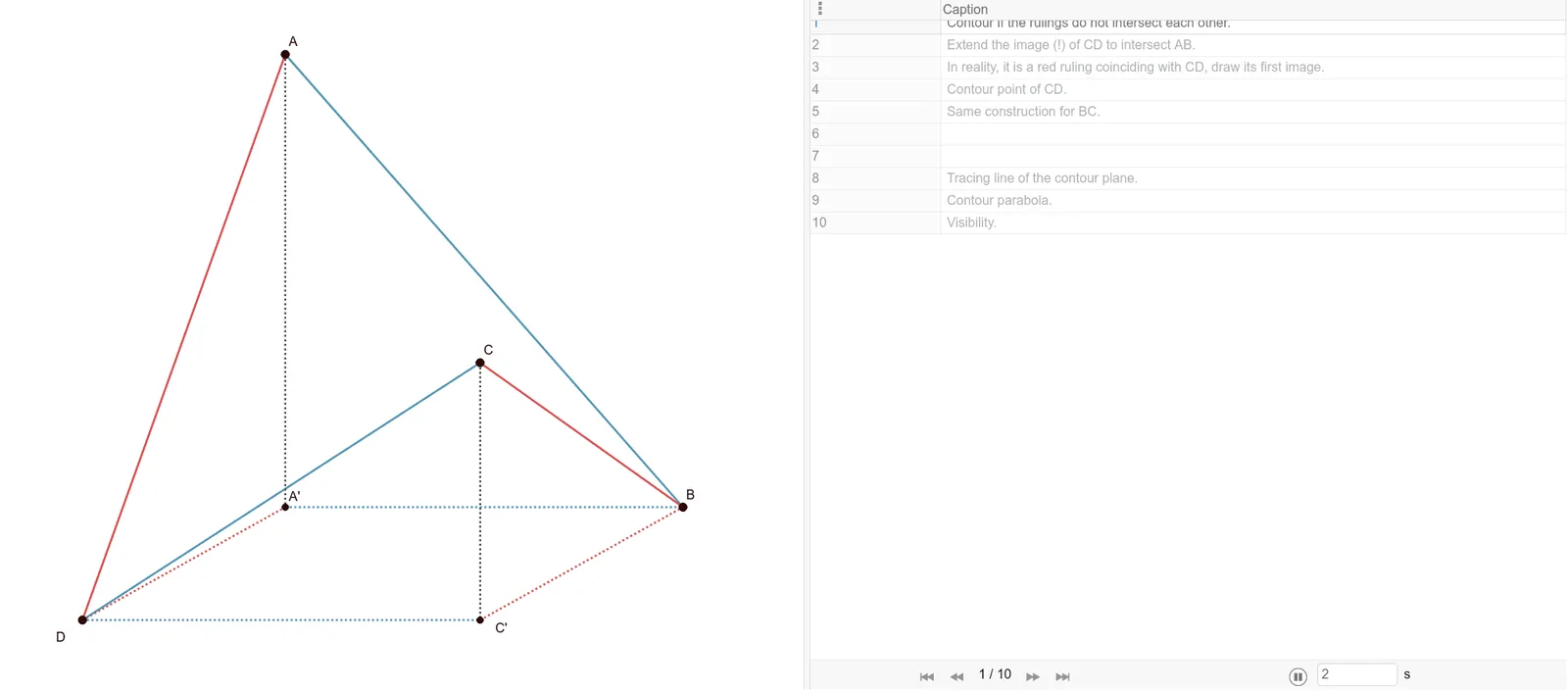
This example demonstrates the contour lines of a saddle surface in axonometric projection. It involves core mathematical concepts such as surfaces, continuity, parabolas, random variables, and spheres. The construction utilizes Geogebra commands/objects like Segment, Line, Intersect, OrthogonalLine, Point, Vector, Translate, Locus, and Polygon. It is suitable for high school students and educators studying spatial geometry and projection transformations.
GeoGebra Commands & Parameters
Segment(D, A') → fSegment(A', B) → gLine(B, f) → hLine(D, g) → iIntersect(h, i) → C'Segment(D, C') → jSegment(C', B) → kOrthogonalLine(A', g) → lOrthogonalLine(C', j) → mPoint(l) → APoint(m) → CSegment(A, A') → nSegment(C, C') → pSegment(D, A) → qSegment(A, B) → rSegment(B, C) → sSegment(C, D) → tLine(D, C) → s_2Intersect(s_2, r) → ESegment(C, E) → aLine(E, n) → bIntersect(g, b) → GLine(B, j) → eLine(G, k) → i_1Intersect(j, i_1) → ISegment(G, I) → j_1Segment(E, G) → f_1Line(I, n) → l_1Intersect(t, l_1) → KSegment(K, I) → q_1Segment(K, I) → n_1Line(C, B) → cIntersect(c, q) → FSegment(C, F) → dOrthogonalLine(F, g) → g_1Intersect(g_1, f) → HSegment(F, H) → h_1Vector(A', H) → uTranslate(A', u) → A''Translate(B, u) → B'Segment(A'', B') → g'OrthogonalLine(B', g) → k_1Intersect(s, k_1) → JSegment(J, B') → m_1Segment(I, B') → n_kPoint(n_k) → LLine(L, j_1) → p_1Intersect(p_1, j) → MIntersect(g, p_1) → NIntersect(p, p_1) → OIntersect(p, n) → PLine(M, n) → t_1Line(N, t_1) → a_1Intersect(t, t_1) → QIntersect(a_1, r) → RSegment(Q, R) → c_1Line(L, t_1) → d_1Intersect(c_1, d_1) → SLocus(S, L) → ponthalmaz1Segment(D, C) → r_1Segment(C, B) → s_1Segment(A, D) → b_1Intersect(r_1, b_1) → TIntersect(r_1, s_1) → UPoint(r_1) → VSegment(A, B) → e_1Polygon(A, D, U, B) → q1, a_2, d_2, u_1, b_2Point(ponthalmaz1) → WPoint(ponthalmaz1) → ZPoint(ponthalmaz1) → A_1Point(ponthalmaz1) → B_1Point(ponthalmaz1) → C_1Point(ponthalmaz1) → D_1Point(ponthalmaz1) → E_1Point(ponthalmaz1) → F_1Point(ponthalmaz1) → G_1Point(ponthalmaz1) → H_1Point(ponthalmaz1) → I_1Point(ponthalmaz1) → J_1Polygon(U, K, G_1, H_1, I_1, J_1, J, W, Z, A_1, B_1, C_1, D_1, E_1, F_1) → poligon1, u_2, l_2, m_2, n_2, p_2, q_2, j_3, k_2, w, z_1, f_2, g_2, h_2, i_2, j_2