
Construction and Properties of the Steiner Point
Loading the math board and drawing, please wait…
In collections
Besondere Punkte/Special Points
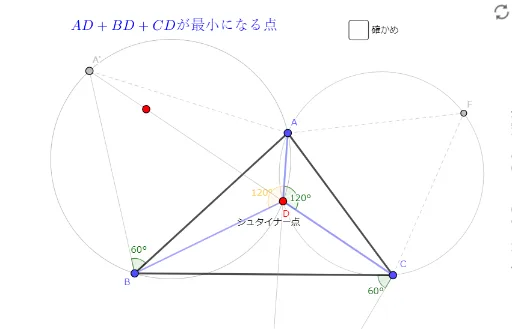
①This example demonstrates how to construct the Steiner point of a triangle through geometric steps, revealing its relationships with the triangle's sides, circumcircle, and reflections. ②Core mathematical concepts include the definition of the Steiner point, mirror reflection (axial symmetry), the connection between hyperbolas and right triangles, and angle/segment ratio properties. ③Construction highlights: based on the summary, GeoGebra commands such as Segment, Rotate, Angle, Intersect, Polygon, and Circle are used to build triangle ABC, reflected points A', B', D', auxiliary circles, lines, and angle markers, finally intersecting to locate the Steiner point. ④Suitable for high school and above students or math enthusiasts to explore special point constructions, reflection transformations in geometry, and precise dynamic geometry software techniques.
GeoGebra Commands & Parameters
Segment(A, B) → fSegment(B, C) → gSegment(C, A) → hRotate(A, 60°, B) → A'Angle(A, B, A') → αSegment(A', C) → iSegment(A', B) → jRotate(B, 60°, C) → B'Angle(B, C, B') → βSegment(C, B') → kSegment(A, B') → lIntersect(i, l) → DAngle(C, D, A) → γSegment(B, D) → mAngle(A, D, B) → δSegment(A, D) → nSegment(D, C) → pRotate(D, 60°, B) → D'Angle(D, B, D') → ζPolygon(B, A, 3) → poly1, s, t, a, EPolygon(A, C, 3) → poly2, b, c, d, FCircle(F, A, C) → eCircle(A', B, A) → c_1Segment(A, F) → qSegment(A', A) → rSegment(C, F) → f_1Rotate(G, 60°, B) → G'Angle(G, B, G') → εSegment(B, G) → g_1Segment(A, G) → h_1Segment(G, C) → i_1Segment(G', G) → j_1Segment(A', G') → k_1Segment(G', B) → l_1