
Steiner Circle in a Complete Quadrilateral: Perpendicular Bisector Lemma
Loading the math board and drawing, please wait…
In collections
Besondere Punkte/Special Points
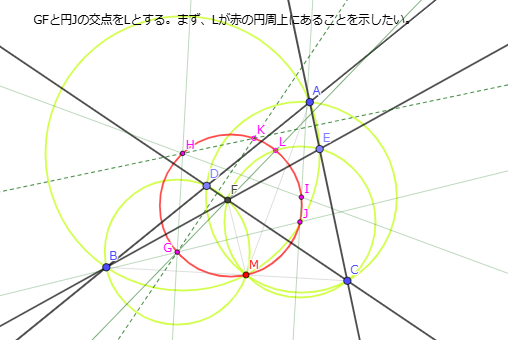
This example demonstrates a key property of the Steiner circle for a complete quadrilateral: it proves that the perpendicular bisectors of the segments AE and DF intersect the corresponding Steiner circle, revealing a geometric invariant on the circle. The construction centers on concepts such as complete quadrilaterals, perpendicular bisectors, circumcircles/Steiner circles, intersection points of lines and circles, and angle-distance relationships typically justified via similar triangles. In GeoGebra, the setup uses Line to draw the relevant lines, Point to define vertices and intersection points, Intersect to compute intersections, and Circle to construct the required circles. LineBisector is used to build the perpendicular bisectors (for AE and DF), Segment clarifies segment-based relationships, and Angle is used to track or verify critical angle constraints. The objects include the given points A, B, C, D and the constructed bisectors and circles (e.g., line bisector objects and circle objects), enabling a clear proof-oriented visualization. Suitable for high-school advanced geometry, contest preparation, and learners studying circle properties and synthetic reasoning.
GeoGebra Commands & Parameters
Line(A, B) → fPoint(f) → DLine(C, D) → gLine(A, C) → hPoint(h) → ELine(B, E) → iIntersect(g, i) → FCircle(B, F, D) → cCircle(F, E, C) → dIntersect(c, d, 2) → MCircle(B, E, A) → eCircle(A, D, C) → kSegment(B, M) → jSegment(M, C) → lSegment(M, F) → mSegment(A, M) → nLineBisector(j) → pLineBisector(l) → qLineBisector(m) → rLineBisector(n) → sIntersect(p, r) → GIntersect(s, p) → HIntersect(q, s) → IIntersect(q, r) → JCircle(G, M, J) → tLineBisector(D, F) → aLineBisector(A, E) → bIntersect(a, b) → KLine(G, F) → f_1Intersect(d, f_1, 2) → LSegment(M, L) → g_1Segment(E, M) → h_1Angle(F, L, M) → αAngle(F, E, M) → βSegment(H, M) → i_1Angle(j, p) → ηAngle(G, H, M) → γSegment(H, L) → j_1Segment(L, E) → k_1Segment(G, M) → l_1Angle(M, L, E) → δAngle(M, F, E) → εIntersect(p, j) → NAngle(N, G, M) → θAngle(B, F, M) → ιAngle(M, G, H) → ζ
AI Drawing Prompt Reference
Draw the Steiner circle of a complete quadrilateral ABCD, including points A, B, C, D, and their diagonal intersection points E and F. Construct the perpendicular bisectors of AE and DF, which intersect the Steiner circle at points G and H. Then, construct the perpendicular bisectors of BE and AF, which intersect at point K. Finally, use these perpendicular bisectors and intersection points to construct the line segments and angle relationships that intersect the Steiner circle.
The prompt above was compiled from the original drawing commands and is for reference only.