
Steiner Circle via Perpendicular Bisector Intersection in a Complete Quadrilater
Loading the math board and drawing, please wait…
In collections
Besondere Punkte/Special Points
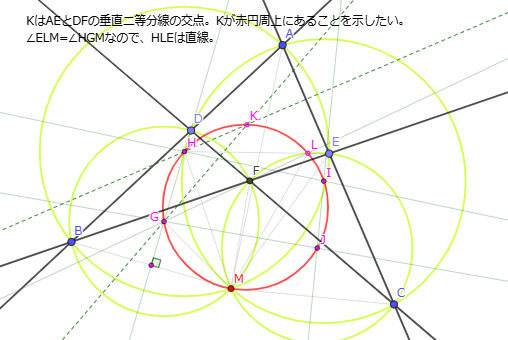
This example demonstrates a classical geometric fact: for a complete quadrilateral, the intersection point of the perpendicular bisectors of opposite sides lies on the Steiner circumcircle. The key concepts are complete quadrilaterals (with their characteristic structure), perpendicular bisectors and their equal-distance property, and circle/point intersection constructions that reveal an invariant—co-circularity on the Steiner circle. Construction, as reflected in the GeoGebra command summary, uses Line and Point to define the lines and vertices, LineBisector to build the perpendicular bisectors of opposite sides, Intersect to compute their intersection (and other necessary intersection points), and Circle to construct the Steiner circle and verify that the computed intersection point lies on it. Segment and Angle support the configuration/annotation of relationships. Suitable for secondary-school geometry, olympiad-style geometry study, and GeoGebra-based instruction focused on invariant geometry and common-circle properties.
GeoGebra Commands & Parameters
Line(A, B) → fPoint(f) → DLine(C, D) → gLine(A, C) → hPoint(h) → ELine(B, E) → iIntersect(g, i) → FCircle(B, F, D) → cCircle(F, E, C) → dIntersect(c, d, 2) → MCircle(B, E, A) → eCircle(A, D, C) → kSegment(B, M) → jSegment(M, C) → lSegment(M, F) → mSegment(A, M) → nLineBisector(j) → pLineBisector(l) → qLineBisector(m) → rLineBisector(n) → sIntersect(p, r) → GIntersect(s, p) → HIntersect(q, s) → IIntersect(q, r) → JCircle(G, M, J) → tLineBisector(D, F) → aLineBisector(A, E) → bIntersect(a, b) → KLine(G, F) → f_1Intersect(d, f_1, 2) → LSegment(M, L) → g_1Segment(E, M) → h_1Segment(H, M) → i_1Angle(j, p) → ηSegment(H, L) → j_1Segment(L, E) → k_1Segment(G, M) → l_1Intersect(p, j) → NAngle(h, b) → αIntersect(h, b) → OAngle(E, H, O) → βAngle(E, B, A) → γAngle(a, g) → ζAngle(F, G, K) → θAngle(H, K, G) → ιAngle(H, L, G) → κ
AI Drawing Prompt Reference
Construct a complete-quadrilateral configuration with four given vertices so that opposite sides are well defined. Draw the perpendicular bisectors of two opposite sides and find their intersection point. Construct two circles determined by triples of existing points: one circle using the perpendicular-bisector intersection together with two corresponding vertices, and another circle using the other relevant intersection together with two corresponding vertices. Compute the intersection point of these two circles. Add supporting segments between the key points to visualize the relations, and draw a few angles between the constructed lines (such as involving the bisectors and the lines through the intersection points) to highlight the key geometric positions and the co-circular relationship involving the intersection point.
The prompt above was compiled from the original drawing commands and is for reference only.