
Constructing a Cut Ellipse Surface via Rotation and Partitioning
Loading the math board and drawing, please wait…
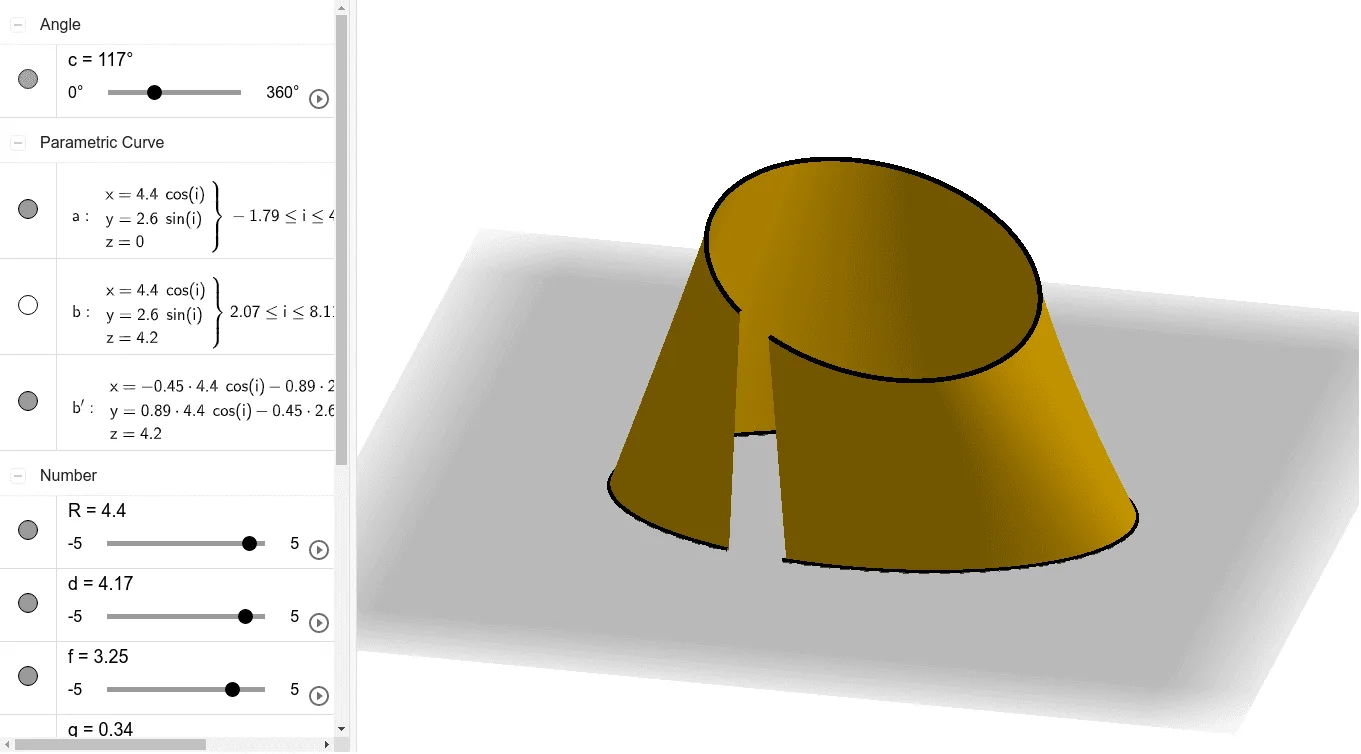
This example demonstrates how to build an “elliptical surface” by starting from an ellipse-related curve, rotating it to form a 3D surface, and then cutting/partitioning that surface to reveal structured, fractal-like patterns. The key mathematics includes ellipse/curve modeling in Cartesian (or parametric-like) form, surface generation by revolving a curve, geometric cutting to obtain intersection regions, and the role of function/transform parameters in producing different structural outcomes (closely aligned with the iterative intuition behind fractal geometry). Construction is driven by GeoGebra commands and objects: Surface to create the surface; CurveCartesian to define the generating curve in Cartesian coordinates (e.g., objects like f and d); and Rotate to revolve/transform parts of the configuration into a 3D surface (objects such as r, R, w, v, c). Finally, additional constructed objects (including pairs like b and b' plus other intermediate elements) are used to perform the cut/partitioning of the surface, producing visible subdivided bands and sectional shapes. Suitable for high school to early university geometry lessons, especially for students learning coordinate geometry, 3D surface modeling, and dynamic/interactive geometry construction.
GeoGebra Commands & Parameters
Surface(t, (1.27 + (4.96 * t)) / 3.56, k, t, -2, 2, k, 0, 5) → wSurface(t, (-1.37 + (4.75 * t)) / 2.16, k, t, -2, 2, k, 0, 5) → vCurveCartesian((R * cos(i)), (r * sin(i)), 4.2, i, (0.66 * π), (2.58 * π)) → bRotate(b, c, zAxis) → b'CurveCartesian((R * cos(i)), (r * sin(i)), 0, i, (-0.569 * π), (1.357 * π)) → aSurface((v * a(t + g)) + ((1 - v) * b'(t + d)), v, 0, 1, t, d, (f * π)) → e
AI Drawing Prompt Reference
Create a 3D cut elliptical surface generated from ellipse-related curves. First construct two parametric surfaces in 3D using a parameter t to control their shapes and vertical placement, treating them as two components for later mixing/partitioning. Next draw a planar curve defined in Cartesian-like form using constants R and r with an angular parameter i (using cosine and sine), then rotate this curve around the z-axis to obtain a paired, transformed curve. Build another similar curve at a different z level using the same R, r structure. Finally, define the main surface as a weighted combination that depends on t, blending the rotated curve and the other component via a function-like parameter (including scaling by constants such as f·π). The result should show structured, banded sectional patterns.
The prompt above was compiled from the original drawing commands and is for reference only.