
Cone and Cylinder Intersection with Perpendicular Axes
Loading the math board and drawing, please wait…
In collections
intersection: surface-surface, curve-curve
intersection: surface-surface, curve-curve
intersection: surface-surface, curve-curve
intersection: surface-surface, curve-curve
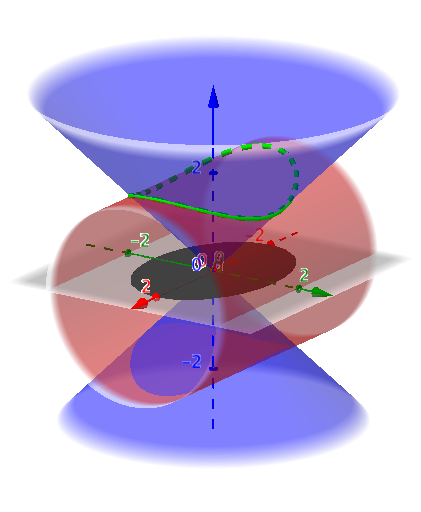
This GeoGebra example demonstrates the intersection curve between a right circular cone and a right circular cylinder whose axes are perpendicular in three-dimensional space. It covers core concepts in solid geometry, including quadric surfaces, spatial curve intersections, parametric representations, and Cartesian coordinate constructions. The construction relies on the GeoGebra CurveCartesian command together with objects a, b, c, and d to define and plot the relevant parametric curves and surface boundaries, producing a clear visualization of the intersection of two solids of revolution. Suitable for senior high school and university STEM students, it serves as a teaching aid for spatial imagination, analytic geometry, and parametric equation demonstrations.
GeoGebra Commands & Parameters
CurveCartesian((2 * cos(t)), (sqrt(2) * sin(t)), sqrt((4 * cos(t)^(2)) + (2 * sin(t)^(2))), t, 0, (2 * π)) → c
AI Drawing Prompt Reference
Draw a right circular cone and a right circular cylinder in 3D with their axes perpendicular to each other, showing the intersection curve of the two solids of revolution. First create a cone with its vertex at the origin and axis along the z‑axis, base radius 2. Then create a cylinder whose axis lies along the x‑axis with radius √2. Finally plot the space curve given parametrically by x = 2 cos t, y = √2 sin t, z = √(4 cos² t + 2 sin² t) for t from 0 to 2π, so the curve runs along the intersection of the cone and cylinder surfaces.
The prompt above was compiled from the original drawing commands and is for reference only.