
Coding the Normal Distribution: Visualizing Probability with Inverse Functions
Loading the math board and drawing, please wait…
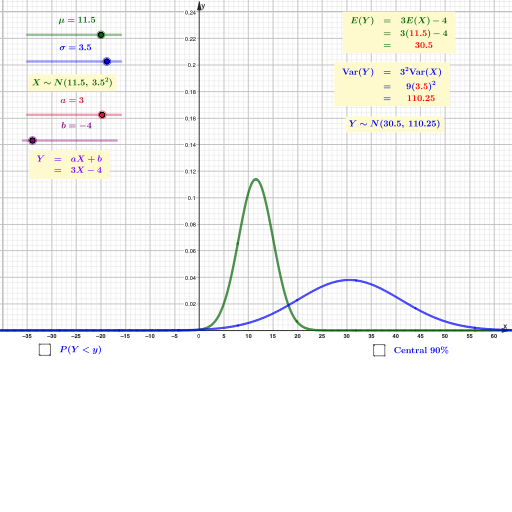
This example demonstrates how to use GeoGebra’s programming-style commands to connect the normal distribution’s density, cumulative probability, and quantile values in a single interactive visualization. The key ideas are the normal distribution parameters (mean μ and standard deviation σ), the probability density function, the cumulative distribution function (CDF), and especially the inverse CDF (InverseNormal) for mapping a probability level to the corresponding x-value (a quantile). Construction highlights extracted from the GeoGebra summary include using If for piecewise/conditional logic, Integral to compute cumulative probability via area under the curve, and InverseNormal to derive the quantile from a given probability. The setup uses parameter objects and interval endpoints, along with text/label objects to annotate critical values such as probability regions and quantile markers. Suitable for high school to undergraduate probability & statistics lessons, workshops, and math-in-code explorations focusing on CDF/inverse-CDF relationships and interactive graphing.
GeoGebra Commands & Parameters
If(b < 0, "-", "+") → text6Integral(g, -1000, h) → dInverseNormal(E_y, sqrt(V_y), (l + 1) / 2) → iInverseNormal(E_y, sqrt(V_y), (1 - l) / 2) → jIntegral(g, j, i) → k
AI Drawing Prompt Reference
Draw a normal distribution curve with adjustable mean and standard deviation. Shade the area under the curve between two symmetric quantile points on the x-axis, representing a cumulative probability region. Label the mean, standard deviation, the probability value, and the quantile coordinates. The graph should illustrate the relationship between density, cumulative probability, and quantiles.
The prompt above was compiled from the original drawing commands and is for reference only.