
Chasing Segments on a Cube
Loading the math board and drawing, please wait…
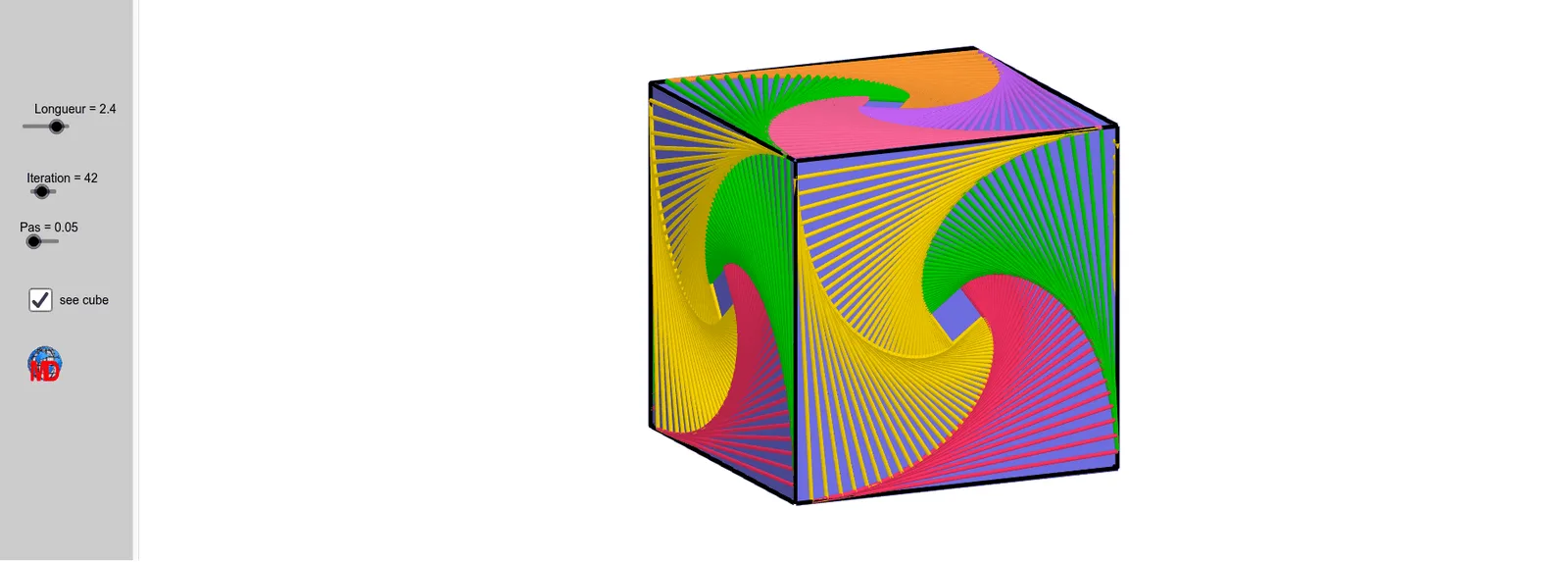
This example demonstrates the dynamic changes of chasing segments on a cube. Key mathematical concepts include geometric transformations, vectors, and loci. Using GeoGebra commands such as Vector, Polygon, Sequence, Line, and Rotate, a series of chasing segments can be constructed. Suitable for high school and above students to learn about geometric transformations and loci.
GeoGebra Commands & Parameters
Vector((1, 0)) → uMidpoint(A, C) → OPolygon(A, B, C, D) → poly1, a, b, c, dSequence(Rotate[Dilate[A, r^(n), O], (n * α), O], n, 1, Iteration) → L2Sequence(Rotate[Dilate[B, r^(n), O], (n * α), O], n, 1, Iteration) → L3Sequence(Rotate[Dilate[C, r^(n), O], (n * α), O], n, 1, Iteration) → L4Sequence(Rotate[Dilate[D, r^(n), O], (n * α), O], n, 1, Iteration) → L5Vector((0, 1)) → vSequence(Segment[Rotate[Dilate[A, r^(n - 1), O], ((n - 1) * α), O], Rotate[Dilate[A + (Pas * u), r^(n - 1), O], ((n - 1) * α), O]], n, 1, Iteration) → L6Sequence(Segment[Rotate[Dilate[B, r^(n - 1), O], ((n - 1) * α), O], Rotate[Dilate[B + (Pas * v), r^(n - 1), O], ((n - 1) * α), O]], n, 1, Iteration) → L7Sequence(Segment[Rotate[Dilate[C, r^(n - 1), O], ((n - 1) * α), O], Rotate[Dilate[C - (Pas * u), r^(n - 1), O], ((n - 1) * α), O]], n, 1, Iteration) → L8Sequence(Segment[Rotate[Dilate[D, r^(n - 1), O], ((n - 1) * α), O], Rotate[Dilate[D - (Pas * v), r^(n - 1), O], ((n - 1) * α), O]], n, 1, Iteration) → L9Sequence(Polygon[Rotate[Dilate[A, r^(n), O], (n * α), O], Rotate[Dilate[B, r^(n), O], (n * α), O], Rotate[Dilate[C, r^(n), O], (n * α), O], Rotate[Dilate[D, r^(n), O], (n * α), O]], n, 1, Iteration, 2) → L1Sequence(Polygon[Element[L4, i], Element[L5, i], Element[L5, i + 1], Element[L4, i]], i, 1, Length[L4], 2) → liste1Sequence(Polygon[Element[L5, i], Element[L2, i], Element[L2, i + 1], Element[L5, i]], i, 1, Length[L4], 2) → liste2Sequence(Polygon[Element[L2, i], Element[L3, i], Element[L3, i + 1], Element[L2, i]], i, 1, Length[L2], 2) → liste3Sequence(Polygon[Element[L3, i], Element[L4, i], Element[L4, i + 1], Element[L3, i]], i, 1, Length[L4], 2) → liste4Line(A, B) → fRotate(liste1, 90°, f) → liste1'Rotate(liste2, 90°, f) → liste2'Rotate(liste3, 90°, f) → liste3'Rotate(liste4, 90°, f) → liste4'Midpoint(A, C) → ELine(E, zAxis) → gSequence(Rotate[liste1', i, g], i, 0, (2 * π), (2 * π / 4)) → l1Sequence(Rotate[liste2', i, g], i, 0, (2 * π), (2 * π / 4)) → l2Sequence(Rotate[liste3', i, g], i, 0, (2 * π), (2 * π / 4)) → l3Sequence(Rotate[liste4', i, g], i, 0, (2 * π), (2 * π / 4)) → l4Point(Circle[B, Distance[A, B], Segment[A, B]]) → FCube(A, B, F) → e, G, faceFGKJ, faceHIJK, arêteAG, arêteAB, arêteBF, arêteFG, arêteAH, arêteGK, arêteHK, arêteHI, H, arêteBI, arêteIJ, arêteFJ, arêteJK, I, J, K, faceABFG, faceAGKH, faceABIH, faceBFJILine(H, I) → hRotate(liste1', 90°, h) → liste1''Rotate(liste2', 90°, h) → liste2''Rotate(liste3', 90°, h) → liste3''Rotate(liste4', 90°, h) → liste4''Segment(I, J) → jSegment(J, K) → kSegment(H, I) → lPoint(arêteAB) → LSegment(H, L) → mIntersect(arêteAB, arêteBF) → MSegment(L, M) → nSegment(I, M) → pPoint(arêteFJ) → NSegment(M, N) → qSegment(J, N) → sSegment(G, N) → tSegment(L, G) → f_1Segment(K, G) → g_1Segment(K, H) → h_1
AI Drawing Prompt Reference
Draw a cube with four vertices A, B, C, and D, and their midpoint O. Construct a series of chasing segments by rotating and scaling around the edges and faces of the cube. Finally, rotate these segments 90 degrees around the cube's diagonal and specific edges to form a complex geometric pattern.
The prompt above was compiled from the original drawing commands and is for reference only.