
Catenary
Loading the math board and drawing, please wait…
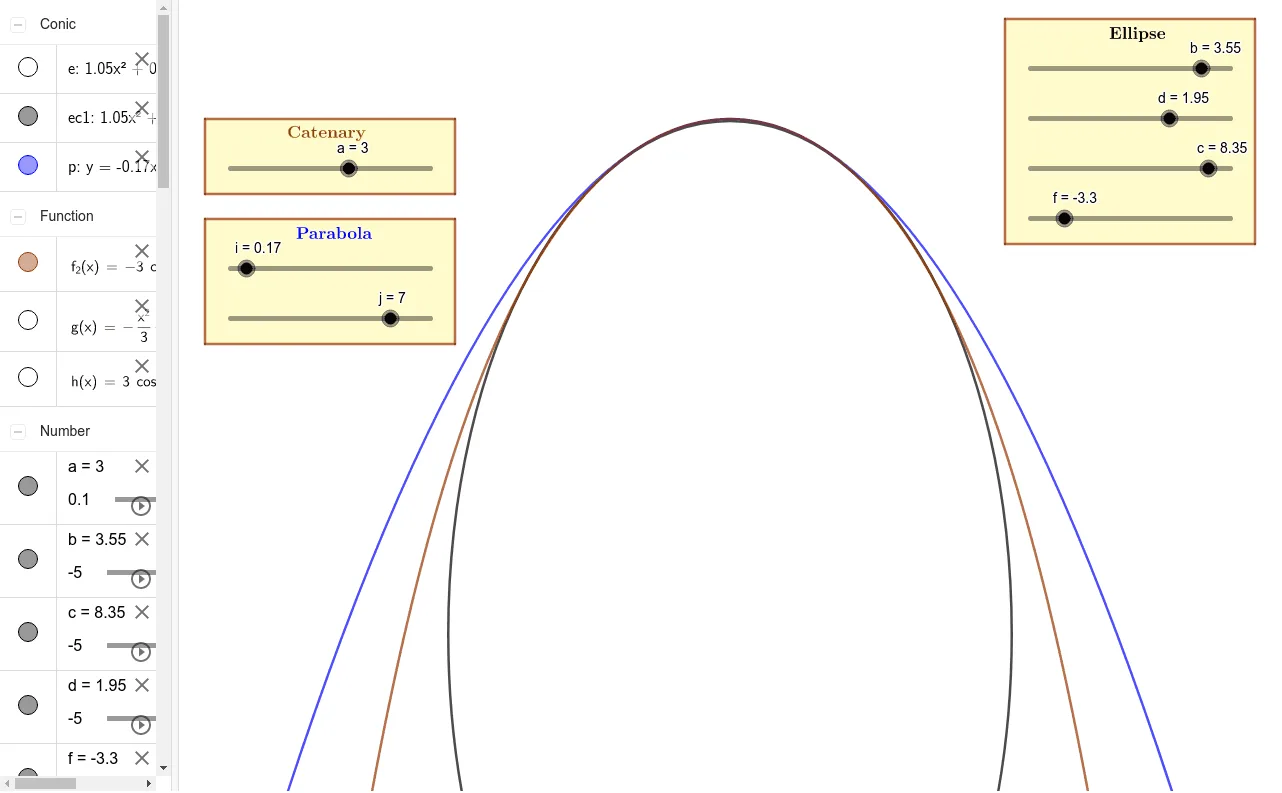
This example demonstrates the catenary shape, which is the form taken by a flexible chain or cable suspended from two points under the influence of gravity. It is a hyperbolic cosine function. Using GeoGebra commands like Polygon, the catenary can be constructed. Suitable for high school and above students to learn calculus and coordinate geometry.
GeoGebra Commands & Parameters
Polygon(A, B, C, D) → c1, a_1, b_1, c_1, d_1Polygon(E, F, G, H) → c2, e_1, f_1, g_1, h_1Polygon(I, J, K, L) → c3, i_1, j_1, k, lPolygon(I, L, K, J) → c4, i_2, l_1, k_1, j_2Polygon(E, F, G, H) → c5, e_2, f_3, g_2, h_2Polygon(A, B, C, D) → c6, a_2, b_2, c_2, d_2
AI Drawing Prompt Reference
Draw a catenary curve shaped like a hyperbolic cosine function. Construct two sets of quadrilaterals, each with four vertices, forming upper and lower boundaries. One set is connected in clockwise order, the other counterclockwise, creating a symmetric catenary outline. Then add two more identical quadrilateral sets on the left and right sides to enhance the three-dimensional effect. The overall figure consists of multiple quadrilaterals assembled to show the natural sagging shape of a chain under gravity, suitable for demonstrating calculus and coordinate geometry concepts.
The prompt above was compiled from the original drawing commands and is for reference only.