
Associated Solids: Construction of Cylinders, Cones, and Prisms via Transformati
Loading the math board and drawing, please wait…
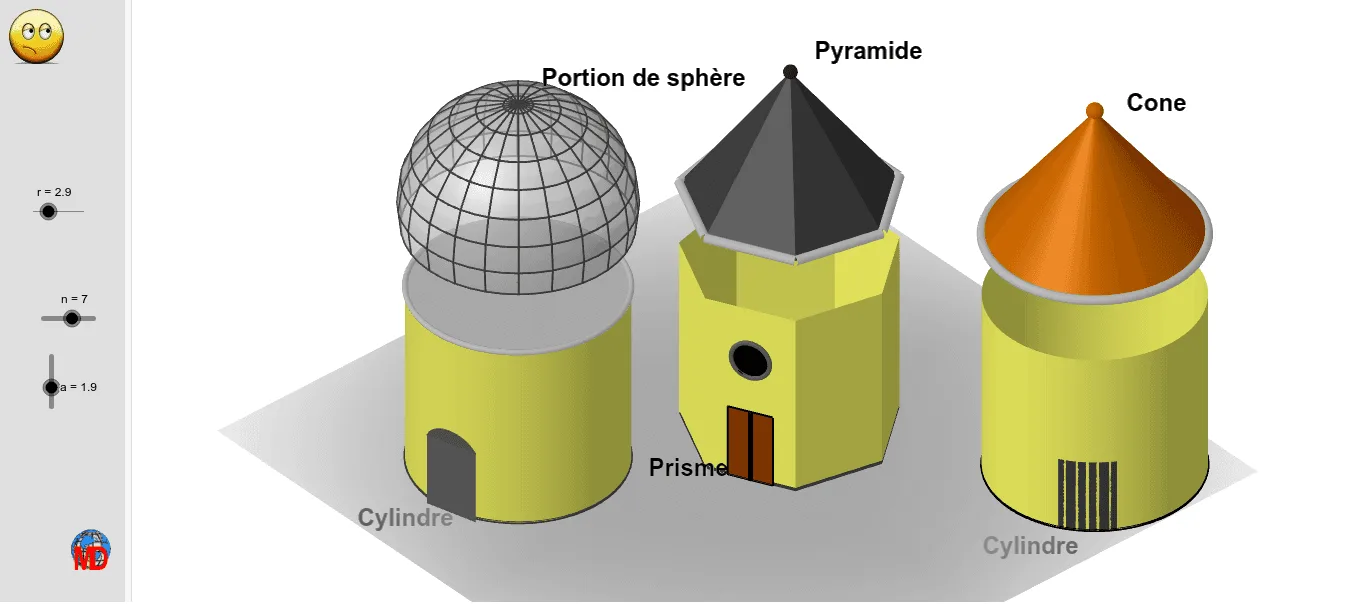
① This example demonstrates how to combine multiple 3D solids—cylinders, cones, and prisms—into an associated composite using rotations, translations, and reflections, showing the dynamic construction of geometric bodies in space. ② Core mathematical concepts include solid geometry (basic solids like cylinders, cones, prisms), spatial transformations (rotation, translation, reflection), and positional relationships among points, lines, and planes. ③ Construction highlights: from the construction summary, commands such as Line, Point, Sequence, Polygon, Ray, Midpoint, Segment, Circle, Mirror, Cylinder, Cone, Rotate, Surface, Prism, CircumcircleArc, and Translate are used, with many objects (a, H, I, l, J, r, n, l1, l2, etc.) defined. Sequences generate point sets, polygons and circles are drawn, then solids are created via Cylinder, Cone, and Prism commands, and finally combined using Rotate and Mirror. ④ Suitable for high school or early college solid geometry teaching, mathematical modeling, or dynamic geometry demonstrations, helping students intuitively understand the construction and transformation of 3D shapes.
GeoGebra Commands & Parameters
Line(H, I) → lPoint(l) → JSequence((x(H) + (r * cos(i)), y(H) + (r * sin(i)), z(H)), i, 0, (2 * π), (2 * π / n)) → l1Sequence((x(J) + (r * cos(i)), y(J) + (r * sin(i)), z(J)), i, 0, (2 * π), (2 * π / n)) → l2Point(l1) → KPoint(l1) → LPoint(l2) → MPoint(l2) → NPolygon(K, L, M, N) → q1, k_1, l_1, m, n_1Sequence(Rotate[q1, i, l], i, 0, t, (2 * π / n)) → l3Ray(J, O) → pSequence((x(P) + (r * cos(i)), y(P) + (r * sin(i)), z(P)), i, 0, (2 * π), (2 * π / n)) → l4Line(P, A) → fPoint(f) → BPoint(l4) → CPoint(l4) → DPolygon(Element[l4, 1], Element[l4, 2], B) → t1, g, h, iSequence(Rotate[t1, i, f], i, 0, t, (2 * π / n)) → l5Polygon(l1) → poly1Midpoint(Element[l1, 1], Element[l1, 2]) → EMidpoint(E, Element[l1, 1]) → FMidpoint(E, Element[l1, 2]) → GPolygon(F, Q, R, G) → q2, f_1, q, r_1, g_1Midpoint(Q, R) → SSegment(S, E) → jMidpoint(T, S) → ULine(V, U) → kCircle(U, Distance[H, J] / 10, k) → cCircle(U, Distance[H, J] / 10, k) → dLine(W, zAxis) → sMirror(B_1, W) → C_1Circle(B_1, A_1, C_1) → eCylinder(e, Distance[W, Z]) → b, c_1, oMirror(F_1, D_1) → H_1Circle(F_1, G_1, H_1) → d_1Cone(d_1, Distance[D_1, E_1]) → u, e_1, vPolygon(l4) → poly2Rotate(B_1, 30°, W) → I_1Rotate(B_1, 60°, W) → J_1Segment(K_1, I_1) → h_1Surface(h_1, 30°, s) → wMirror(P_1, L_1) → Q_1Polygon(N_1, Q_1, O_1, P_1) → q3, i_1, q_1, o_1, p_1Prism(q3, Distance[H, J]) → a_1, R_1, arête1, arête4, arête2, arête3, arête5, arête7, arête8, arête6, S_1, T_1, U_1, face2, face4, face3, face1, face5Surface(x(V_1) + ((rr * cos(i)) * cos(j)), y(V_1) + ((rr * cos(i)) * sin(j)), z(V_1) + (rr * sin(i)) + 0.75, i, 0, (2.15 * π / 2), j, 0, (2 * π)) → b_1Circle(P_1, N_1, Q_1) → s_1Cylinder(s_1, Distance[H, J]) → j_1, t_1, m_1Rotate(N_1, 30°, L_1) → W_1Rotate(N_1, 30°, L_1) → C_2Rotate(A_2, 15°, L_1) → D_2CircumcircleArc(A_2, E_2, B_2) → c_2Polygon(A_2, N_1, C_2, B_2) → q4, a_2, f_2, g_2, b_2Translate(q4, Vector[D_2, D_2]) → q4'Translate(q4, Vector[D_2, D_2 + (0.2, 0)]) → q4'_1Translate(c_2, Vector[D_2, D_2 + (0.2, 0)]) → d_2
AI Drawing Prompt Reference
Construct a composite 3D solid in space, combining cylinders, cones, and prisms around a central axis. Start by taking two points on an axis line, generate circular point sets around each, connect corresponding points to form quadrilaterals, and rotate these around the axis to create prism sides. Then, on another line, take a point, generate a circular point set, form triangles with an axis point, and rotate to make a cone. Use circular point sets to form polygonal bases, construct midpoints and auxiliary lines, draw circles, and extrude them into cylinders. Finally, combine all parts via rotations, reflections, and translations to show the associated solids.
The prompt above was compiled from the original drawing commands and is for reference only.