
Truncated icosidodecahedron (V=120) from a biscribed pentakis dodecahedron via t
Loading the math board and drawing, please wait…
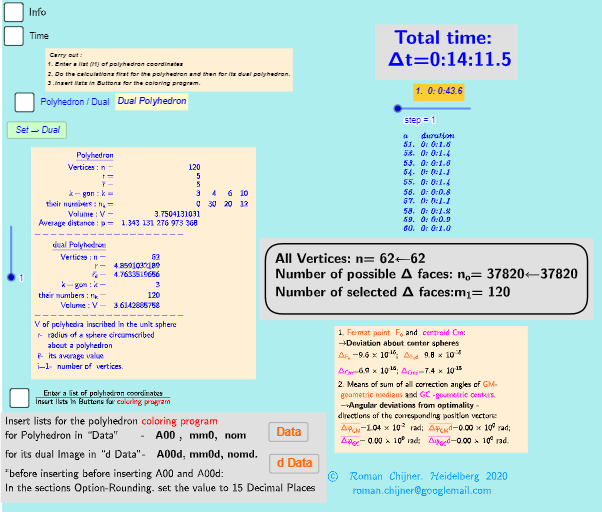
This example demonstrates a controlled construction of a truncated icosidodecahedron with vertex count V=120, obtained from a biscribed pentakis dodecahedron under a specific rule: trisecting its 4th-order segments. It connects the geometric truncation/vertex-structure transformation of polyhedra to a parameterized, segment-based splitting scheme, updating both the shape and associated volume quantities. Key math concepts include polyhedral truncation, discrete segment trisection, and computing/aggregating volume-related measures (including comparisons to a sphere volume) to quantify the resulting configuration. Construction relies on GeoGebra commands such as Text (labels), Sum (accumulating segment contributions), If (conditional selection for parameters/segments), Length (measuring edge/segment lengths), Sequence and Div (generating and discretizing parameter sets), Element/IndexOf/First (extracting specific elements by index), TableText (presenting computed values), and Max (boundary/selection logic), together with objects like mm5, m01, p, A00, i, r, Volsphere, Vol, Vol_r, and Volsphere_d. Suitable for advanced high school to early university use in solid geometry, geometric modeling, and data-driven visualization of polyhedral transformations.
GeoGebra Commands & Parameters
Text("" + p) → txt_pSum(Flatten[Sequence[Append[Sequence[Element[txt_p, i], i, m01(k), m02(k)], " "], k, 1, 5]]) → txtUm1If(bu0, A00, A00d) → A00_0Length(A00_0) → nLength(l2) → läl2Sequence(sgn(Determinant[{Element[A00_0, i1] - Element[A00_0, j], Element[A00_0, i2] - Element[A00_0, j], Element[A00_0, i3] - Element[A00_0, j]}]), j, 1, n) → l01Length(A00d) → zzzSum(Zip[(T * F), T, SysTimeAkt1, F, {1, 1000, 60000, 3600000, 86400000}]) → TimeAbs1Sum(Zip[(T * F), T, SysTimeAkt2, F, {1, 1000, 60000, 3600000, 86400000}]) → TimeAbs2Div(TimeRelab, 3600) → HDiv(TimeRelab - (H * 3600), 60) → MElement(ZwZeit, step) → text10TableText({Append["a duration", Last[ZwZeit, Min[10, Length[ZwZeit]]]]}, "v") → text2cLength(A00) → lm1If(Length[Unique[l01 \ {0}]] ≟ 1, 7, -7) → a7Sum(Zip[(T * F), T, SysTimeAkt0, F, {1, 1000, 60000, 3600000, 86400000}]) → TimeAbs0Div(TimeRelab0, 3600) → H0Div(TimeRelab0 - (H0 * 3600), 60) → M0Text("" + (TimeRelab0 - (H0 * 3600) - (M0 * 60))) → S0aText("" + (TimeRelab - (H * 3600) - (M * 60))) → SIndexOf(".", S) → indexIndexOf(".", S0a) → indexaFirst(S, index + 1) → txtSFirst(S0a, indexa + 1) → txtS0aIf(bu0, " ", "d") → txtbuoMax(Length[A00], Length[A00d]) → maxläElement(A00, 24) → m11TableText({{"\underline{Polyhedron}"}, Append["Vertices: n=", {Length[A00]}], Append["r=", {r}], Append["\bar{r}=", {r_m}], Append["k-gon : k=", mm5a], Append["their\; numbers: n_k=", mm7a], Append["Volume: V=", {Vol_r}], Append["Average\; distance: p=", {txtUm1}]}, "hr ") → text7TableText({{"\underline{dual\;Polyhedron}"}, Append["Vertices: n=", {Length[A00d]}], Append["r=", {r_d}], Append[" \bar{r_d}= ", {r_md}], Append["k-gon : k=", mm5ad], Append["their\; numbers: n_k=", mm7ad], Append["Volume: V=", {Vold_r}]}, "hr ") → text20
AI Drawing Prompt Reference
Draw a truncated icosidodecahedron with 120 vertices, derived from a biscribed pentakis dodecahedron by trisecting its fourth-order segments. Show the polyhedron's truncation transformation, including vertices, edges, and faces, and label volume, average distance, and other computed values. Construct the base polyhedron first, then split segments according to the rule, update vertex positions, and finally display volume comparisons with a sphere.
The prompt above was compiled from the original drawing commands and is for reference only.