
Area with Unit Squares
Loading the math board and drawing, please wait…
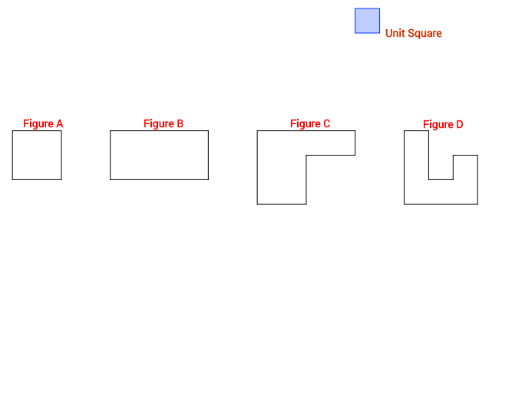
This example demonstrates how to measure the area of irregular shapes using a single unit square. Key math concepts include area, unit square, geometric measurement, arithmetic mean, continuity, geometric transformations, and standard deviation. It is constructed using GeoGebra commands like Polygon and Segment, involving objects such as A, B, C, D, poly1, a, b, c, d, text1, E, F, e, G, f, H, g, h, I, J, i, K, j, L, k, l, M, N, m, O, n, P, p, Q, q, R, r, s, S, T. Suitable for middle school students and above to explore geometric area calculation, transformations, and probability & statistics concepts.
GeoGebra Commands & Parameters
Polygon(A, B, C, D) → poly1, a, b, c, dSegment(E, F) → eSegment(F, G) → fSegment(G, H) → gSegment(H, E) → hSegment(I, J) → iSegment(J, K) → jSegment(K, L) → kSegment(L, I) → lSegment(M, N) → mSegment(N, O) → nSegment(O, P) → pSegment(P, Q) → qSegment(Q, R) → rSegment(R, M) → sSegment(S, T) → tSegment(T, U) → a_1Segment(U, V) → b_1Segment(V, W) → c_1Segment(W, Z) → d_1Segment(Z, A_1) → e_1Segment(A_1, B_1) → f_1Segment(B_1, S) → g_1