
Area of Trapezium (Proof using Parallelogram)
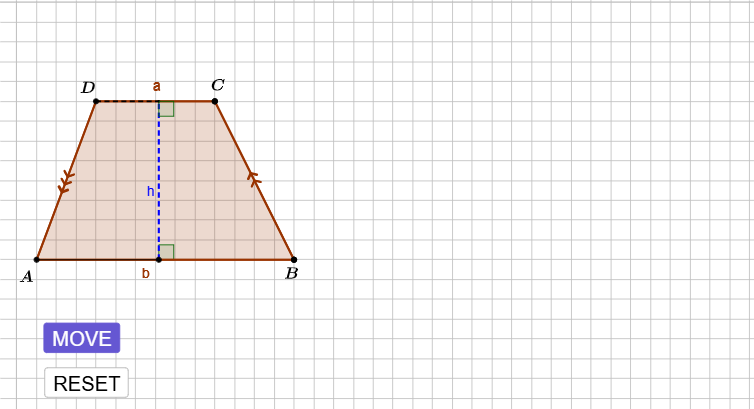
Loading the math board and drawing, please wait…
① This GeoGebra example demonstrates a visual proof of the trapezium area formula by transforming the trapezium into an equivalent parallelogram, showing that the area equals half the product of the height and the sum of the parallel sides. ② Core mathematical concepts include trapezium (trapezoid), parallelogram, area formula, geometric transformations (rotation and translation), and congruent triangles. ③ Construction highlights: using GeoGebra commands such as Line, Point, Segment, Vector, Polygon, Angle, Circle, Rotate, Midpoint, and Translate, the trapezium ABCD is constructed with auxiliary lines; rotation and translation are applied to form a parallelogram, and midpoints, vectors, and angles are used to verify the area relationship. ④ Suitable for middle school geometry classes, especially for students learning area derivation and geometric transformations, and for teachers demonstrating the proof interactively.
GeoGebra Commands & Parameters
Line(A, xAxis) → kPoint(k) → BLine(A, B) → a_1Point(a_1) → ESegment(E, F) → eVector(V1, V2) → uLine(D, xAxis) → lPoint(l) → CPolygon(A, B, C, D) → poly1, a, b, c, dAngle(a, e) → αCircle(W_o, sqrt(8)) → gPoint(g) → W_{2o}Point(g) → W_{1o}Point(g) → W_nCircle(W_o, sqrt(4)) → fRotate(K_o, δ, W_o) → KLine(C, D) → c_1Line(E, F) → b_1Line(W_o, W_n) → w_iAngle(K, W_o, W_n) → βRotate(W_{1o}, (-β), W_o) → W_1Rotate(W_{2o}, (-β), W_o) → W_2Midpoint(E, F) → M_{EF}Midpoint(A, C) → M_{AC}Rotate(D, (-β), M_{AC}) → D'Rotate(C, (-β), M_{AC}) → C'_1Rotate(B, (-β), M_{AC}) → B'_1Rotate(A, (-β), M_{AC}) → A'_1Polygon(A'_1, B'_1, C'_1, D') → poly1', a1, b1, c1, d1Translate(A'_1, u) → GTranslate(B'_1, u) → HTranslate(C'_1, u) → ITranslate(D', u) → D''Polygon(G, H, I, D'') → poly1'', a2, b2, c2, d2Segment(D, F) → jAngle(C, F, E) → γSegment(A, E) → m