
Area of Abnormal Shapes: Lesson 3
Loading the math board and drawing, please wait…
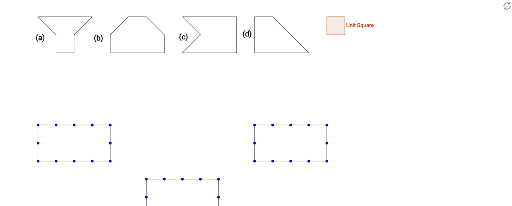
This example demonstrates how to calculate the area of shapes with diagonals and provides an opportunity for students to create their own unique shapes and find their areas. Key math concepts include area calculation and geometric construction. It uses commands like Polygon and Segment in GeoGebra. Suitable for middle school and above students.
GeoGebra Commands & Parameters
Polygon(A, B, C, D) → poly1, a, b, c, dSegment(K, L) → kSegment(L, M) → lSegment(M, N) → mSegment(N, O) → nSegment(O, P) → pSegment(P, K) → qSegment(Q, R) → rSegment(R, S) → sSegment(S, T) → tSegment(T, U) → a_1Segment(U, Q) → b_1Segment(V, W) → c_1Segment(W, Z) → d_1Segment(Z, A_1) → e_1Segment(A_1, B_1) → f_1Segment(B_1, C_1) → g_1Segment(C_1, V) → h_1Segment(E, F) → eSegment(F, G) → fSegment(G, H) → gSegment(H, I) → hSegment(I, J) → iSegment(J, E) → jSegment(F_1, G_1) → k_1Segment(G_1, H_1) → l_1Segment(H_1, I_1) → m_1Segment(I_1, J_1) → n_1Segment(J_1, K_1) → p_1Segment(K_1, L_1) → q_1Segment(L_1, M_1) → r_1Segment(M_1, N_1) → s_1Segment(N_1, O_1) → t_1Segment(O_1, D_1) → a_2Segment(R_1, S_1) → d_2Segment(S_1, T_1) → e_2Segment(T_1, U_1) → f_2Segment(U_1, V_1) → g_2Segment(V_1, W_1) → h_2Segment(W_1, Z_1) → i_2Segment(Z_1, A_2) → j_2Segment(A_2, P_1) → k_2Segment(D_2, E_2) → n_2Segment(E_2, F_2) → p_2Segment(F_2, G_2) → q_2Segment(G_2, H_2) → r_2Segment(H_2, I_2) → s_2Segment(I_2, J_2) → t_2Segment(J_2, K_2) → a_3Segment(K_2, B_2) → b_3Segment(D_1, E_1) → i_1Segment(E_1, L_2) → j_1Segment(L_2, M_2) → c_3Segment(M_2, F_1) → d_3Segment(P_1, Q_1) → b_2Segment(Q_1, N_2) → c_2Segment(N_2, O_2) → e_3Segment(O_2, R_1) → f_3Segment(B_2, C_2) → l_2Segment(C_2, P_2) → m_2Segment(P_2, Q_2) → g_3Segment(Q_2, D_2) → h_3