
Approximating Volumes of Solids of Revolutions
Loading the math board and drawing, please wait…
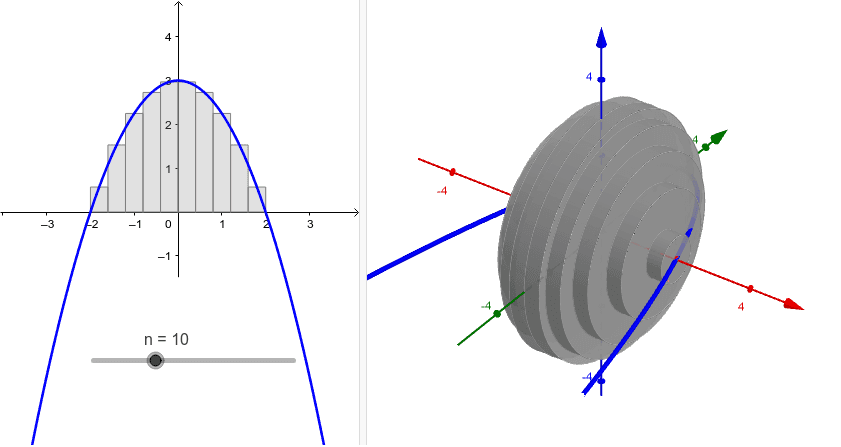
This example demonstrates how to approximate the volume of solids of revolution using the rectangle sum method. Key math concepts include volume calculation in calculus, function graphs, and rotational solids. Construction highlights involve GeoGebra commands/objects like RectangleSum, Sequence, Polygon, and Surface as noted; suitable for high school and above learning calculus and geometric volume calculations.
GeoGebra Commands & Parameters
RectangleSum(f, -2, 2, n, 0.5) → aSequence(Cylinder[(-2 + (4 * k / n), 0), (-2 + (4 * (k + 1) / n), 0), f((-2 + (4 * k / n) - 2 + (4 * (k + 1) / n)) / 2)], k, 0, n - 1) → list1Polygon((-100, -1.5), (100, -1.5), (0, -100)) → poly1, c, d, eSurface(t, (f(t) * cos(u)), (f(t) * sin(u)), t, -2, 2, u, 0, 6.283185307179586) → b
AI Drawing Prompt Reference
Create a 3D plot showing a function curve revolved around the x-axis to form a solid of revolution, with a semi-transparent sequence of cylinders approximating its volume. Divide the interval from -2 to 2 into equal subintervals, and for each subinterval generate a cylinder whose radius equals the function value at the midpoint, with height equal to the subinterval length. Arrange these cylinders side by side to form a stepped approximation. Also include a horizontal polygon plane below the solid as a reference base, and keep the original function curve visible as a contour line. This visualizes the rectangle sum method for computing volumes of revolution.
The prompt above was compiled from the original drawing commands and is for reference only.