
Animation 275: Geometric Construction of Ellipse, Angles, and Probability Statis
Loading the math board and drawing, please wait…
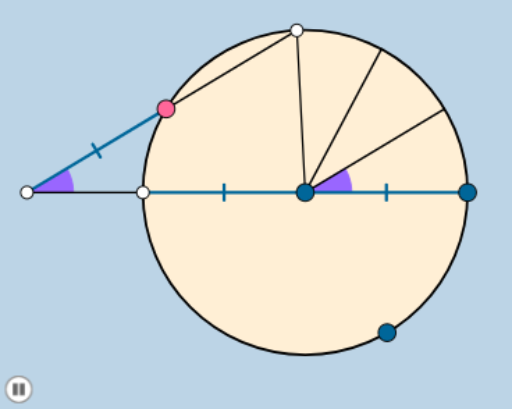
This GeoGebra example demonstrates a dynamic geometric construction involving an ellipse, circles, angles, vectors, and elements of probability and statistics. The core mathematical concepts include properties of ellipses, angle rotation, vector translation and scaling, and the geometric representation of statistical characteristics. The construction uses commands such as Circle, Point, Line, Intersect, CircleArc, Segment, Rotate, Angle, Ray, Dilate, Vector, Translate, Min, and CircleSector to build the figure. Numerous objects (A, B, c, C, f, D, d, e, g, h, C', α, j, k, p, F, q, H, I, a, C'_1, i, I', l, m, E, D', n, H', r, F', s, β, C'_2, γ, G, δ, t, b, f_1) are used to create a complex interactive animation. Suitable for high school and above, this example helps students visualize the interplay between ellipse geometry, angle transformations, and probabilistic concepts, and serves as a resource for teachers creating interactive math lessons.
GeoGebra Commands & Parameters
Circle(A, B) → cPoint(c) → CLine(A, C) → fIntersect(c, f, 2) → DCircleArc(A, C, D) → dCircleArc(A, D, C) → eSegment(A, C) → gCircle(D, g) → hRotate(C, (3 * π / 4), A) → C'Angle(C, A, C') → αRay(A, C') → jCircleArc(A, C, C') → kCircleArc(A, C', D) → pPoint(p) → FCircle(F, g) → qIntersect(q, f) → H, IDilate(C, If[0 < a ≤ 1, 1 - a, 0], A) → C'_1Segment(C, C'_1) → iDilate(I, If[1 < a ≤ 2, 2 - a, 0], D) → I'Segment(A, I') → lRay(H, F) → mIntersect(k, m, 1) → EDilate(D, If[2 < a ≤ 3, 3 - a, 0], H) → D'Segment(D, D') → nDilate(H, If[3 < a ≤ 4, 4 - a, 0], F) → H'Segment(H, H') → rDilate(F, If[4 < a ≤ 5, 5 - a, 0], E) → F'Segment(F, F') → sAngle(C, A, E) → βRotate(C, β / 3, A) → C'_2Angle(C, A, C'_2) → γRotate(C'_2, β / 3, A) → GAngle(C'_2, A, G) → δRay(A, G) → tRay(A, C'_2) → bRay(A, E) → f_1Angle(C, H, E) → εRotate(A, If[5 < a ≤ 6, ((a - 5) * ε), ε], D) → A'Rotate(I', If[5 < a ≤ 6, ((a - 5) * ε), ε], D) → I''Segment(A', I'') → l'Dilate(D, If[6 < a ≤ 7, 7 - a, 0], H) → D'_1Vector(D, D'_1) → uTranslate(A', u) → A''Translate(I'', u) → I'''Segment(A'', I''') → l''Segment(H, D) → g_1Min(g_1, Distance[A, C]) → oCircle(A, (0.4 * o)) → c_1Dilate(A, If[7 < a ≤ 8, 8 - a, 0], E) → A'_1Dilate(A, If[7 < a ≤ 8, 8 - a, 0], G) → A'_2Dilate(A, If[7 < a ≤ 8, 8 - a, 0], C'_2) → A'_3Segment(A, A'_1) → h_1Segment(A, A'_2) → i_1Segment(A, A'_3) → j_1Segment(A, E) → k_1Segment(A, G) → l_1Intersect(c_1, k_1, 1) → JIntersect(c_1, l_1, 1) → KCircleSector(A, K, J) → d_1Rotate(d_1, If[9 < a ≤ 10, ((-(a - 9)) * ε), (-ε)], A) → e_1Rotate(e_1, If[11 < a ≤ 12, ((-(a - 11)) * ε), (-ε)], A) → p_1Dilate(A, If[13 < a ≤ 14, 14 - a, 0], H) → A'_4Vector(A, A'_4) → vTranslate(p_1, v) → q_1