
Relativity in Rhombus Symmetry and Probability Dynamics
Loading the math board and drawing, please wait…
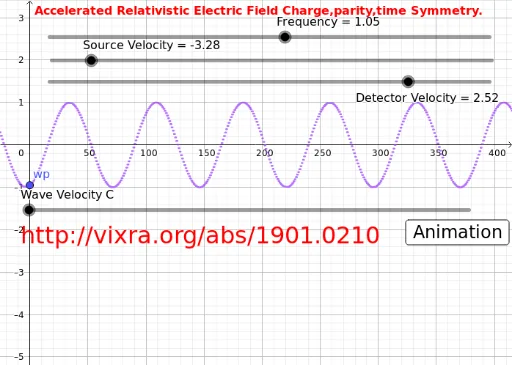
This GeoGebra example dynamically illustrates a geometric model related to relativity, featuring rhombus symmetry, probability distributions, and linear equations. The core shape is a rhombus whose vertices and edges are controlled by objects such as sv, freq, dv, ev, SCR, wv, and wp, with an animation slider driving changes. The construction uses commands to define variables, frequency distributions, vector operations, and text labels (text1 to text5) to present spacetime transformations or probabilistic interpretations in relativity. Suitable for high school to university students, it helps explore symmetry, geometric transformations, and probability statistics, and serves as interdisciplinary material linking mathematics to physics.
GeoGebra Commands & Parameters
Numeric sv(-3.28)Numeric freq(1.0535)Numeric dv(2.52)Numeric ev(-4)SCR(x) = cos(((ev + sv + (floor(x) * freq)) * π / 2) - ((ev + dv + floor(x)) * π / 2))Numeric wv(0)(wv, cos(((ev + sv + (floor(wv) * freq)) * π / 2) - ((ev + dv + floor(wv)) * π / 2)))
AI Drawing Prompt Reference
Draw a dynamic geometric model featuring a rhombus whose vertices and edges are controlled by multiple parameters and change with an animation slider, demonstrating rhombus symmetry. The model includes probability distributions and linear equations, using rhombus symmetry, geometric transformations, and probability statistics to illustrate spacetime transformations or probabilistic interpretations in relativity, suitable for high school to university students to explore symmetry, geometric transformations, and probability statistics.
The prompt above was compiled from the original drawing commands and is for reference only.