
Animation 110: Quadrilateral Transformation
Loading the math board and drawing, please wait…
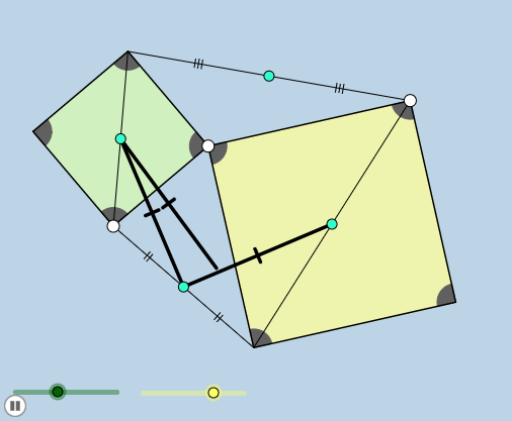
This example demonstrates the transformation process of a quadrilateral, including translation, rotation, and dilation. Key mathematical concepts include geometric transformations, symmetry, and continuity. Using GeoGebra commands such as Circle, Point, Polygon, and Dilate, the example dynamically illustrates the properties and changes of the quadrilateral. Suitable for students at the junior high school level and above to learn about geometric transformations and symmetry.
GeoGebra Commands & Parameters
Circle(A, b) → dPoint(d) → BCircle(B, c) → ePoint(e) → CPolygon(A, B, 4) → poly1, f, g, h, i, D, EPolygon(C, B, 4) → poly2, j, k, l, m, F, GMidpoint(D, A) → HMidpoint(F, C) → IMidpoint(D, C) → JMidpoint(A, F) → KDilate(B, If[0 < a ≤ 1, 1 - a, 0], A) → B'Dilate(B, If[0 < a ≤ 1, 1 - a, 0], F) → B'_1Segment(B, B') → nSegment(B, B'_1) → pRotate(B, If[1 < a ≤ 2, ((-(a - 1)) * π / 2), ((-π)) / 2], F) → B'_2Rotate(B'_1, If[1 < a ≤ 2, ((-(a - 1)) * π / 2), ((-π)) / 2], F) → LSegment(B'_2, L) → p'Rotate(B, If[1 < a ≤ 2, ((a - 1) * π / 2), π / 2], A) → B'_3Rotate(B', If[1 < a ≤ 2, ((a - 1) * π / 2), π / 2], A) → B''Segment(B'_3, B'') → n'Rotate(B'_2, If[2 < a ≤ 3, ((-(a - 2)) * π / 2), ((-π)) / 2], G) → MRotate(L, If[2 < a ≤ 3, ((-(a - 2)) * π / 2), ((-π)) / 2], G) → L'Segment(M, L') → p''Rotate(B'_3, If[2 < a ≤ 3, ((a - 2) * π / 2), π / 2], E) → NRotate(B'', If[2 < a ≤ 3, ((a - 2) * π / 2), π / 2], E) → B'''Segment(N, B''') → n''Rotate(N, If[3 < a ≤ 4, ((a - 3) * π / 2), π / 2], D) → N'Rotate(B''', If[3 < a ≤ 4, ((a - 3) * π / 2), π / 2], D) → OSegment(N', O) → n'''Rotate(M, If[3 < a ≤ 4, ((-(a - 3)) * π / 2), ((-π)) / 2], C) → M'Rotate(L', If[3 < a ≤ 4, ((-(a - 3)) * π / 2), ((-π)) / 2], C) → L''Segment(M', L'') → p'''Segment(F, G) → qSegment(F, B) → rSegment(A, B) → sMin(r, s) → oCircle(F, (0.15 * o)) → tIntersect(l, q) → PIntersect(t, q) → Q,Intersect(t, r) → R,CircleSector(F, Q, R) → c_1Dilate(F, If[4 < a ≤ 5, 5 - a, 0], C) → F'Vector(F, F') → uTranslate(c_1, u) → d_1Rotate(d_1, If[5 < a ≤ 6, ((a - 5) * π), π], C) → e_1Dilate(F, If[6 < a ≤ 7, 7 - a, 0], A) → F'_1Dilate(C, If[6 < a ≤ 7, 7 - a, 0], E) → C'Vector(F, F'_1) → vVector(C, C') → wTranslate(e_1, w) → f_1Translate(c_1, v) → g_1Line(A, p) → h_1Line(E, p''') → i_1Point(h_1) → SAngle(S, A, E) → αRotate(g_1, If[7 < a ≤ 8, ((-(a - 7)) * ((2 * π) - α)), (-((2 * π) - α))], A) → k_1Line(E, h_1) → j_1Point(j_1) → TAngle(D, E, T) → βRotate(f_1, If[7 < a ≤ 8, ((-(a - 7)) * β), (-β)], E) → p_1Dilate(E, If[8 < a ≤ 9, 9 - a, 0], G) → E'Dilate(F, If[8 < a ≤ 9, 9 - a, 0], D) → F'_2Vector(E, E') → u_1Vector(F, F'_2) → v_1Translate(p_1, u_1) → q_1Translate(c_1, v_1) → r_1Line(G, n'') → l_1Point(l_1) → ULine(G, n') → m_1Point(m_1) → VAngle(C, G, V) → γRotate(q_1, If[8 < a ≤ 9, ((-(a - 8)) * γ), (-γ)], E') → s_1Line(D, p) → n_1Point(n_1) → WAngle(W, D, B) → δRotate(r_1, If[8 < a ≤ 9, ((a - 8) * δ), δ], F'_2) → t_1Midpoint(A, B) → ZMidpoint(B, C) → A_1Midpoint(Z, B) → B_1Midpoint(A_1, B) → C_1Dilate(C, If[9 < a ≤ 10, 10 - a, 0], C_1) → C'_1Dilate(A, If[9 < a ≤ 10, 10 - a, 0], B_1) → A'Vector(A, A') → w_1Vector(C, C'_1) → a_1Translate(e_1, a_1) → c_2Translate(k_1, w_1) → d_2Rotate(d_2, If[10 < a ≤ 11, ((a - 10) * π / 2), π / 2], B_1) → e_2Rotate(c_2, If[10 < a ≤ 11, ((a - 10) * π / 2), π / 2], C_1) → f_2Dilate(C_1, If[11 < a ≤ 12, 12 - a, 0], B) → D_1Dilate(B_1, If[11 < a ≤ 12, 12 - a, 0], B) → E_1Vector(B_1, E_1) → b_1Vector(C_1, D_1) → u_2Translate(e_2, b_1) → g_2Translate(f_2, u_2) → h_2Dilate(F, If[12 < a ≤ 13, 13 - a, 0], I) → F'_3Segment(F, F'_3) → i_2Dilate(D, If[12 < a ≤ 13, 13 - a, 0], H) → D'Segment(D, D') → j_2Rotate(F, If[13 < a ≤ 14, ((a - 13) * π), π], I) → F'_4Rotate(F'_3, If[13 < a ≤ 14, ((a - 13) * π), π], I) → F_1Segment(F'_4, F_1) → k_2Rotate(D, If[13 < a ≤ 14, ((a - 13) * π), π], H) → D'_1Rotate(D', If[13 < a ≤ 14, ((a - 13) * π), π], H) → D''Segment(D'_1, D'') → l_2Dilate(A, If[14 < a ≤ 15, 15 - a, 0], K) → A'_1Dilate(C, If[14 < a ≤ 15, 15 - a, 0], J) → C'_2Segment(A, A'_1) → m_2Segment(C, C'_2) → n_2Dilate(K, If[15 < a ≤ 16, 16 - a, 0], F) → K'Dilate(J, If[15 < a ≤ 16, 16 - a, 0], D) → J'Segment(K, K') → p_2Segment(J, J') → q_2Rotate(A, If[16 < a ≤ 17, ((-(a - 16)) * π), (-π)], K) → A'_2Rotate(A'_1, If[16 < a ≤ 17, ((-(a - 16)) * π), (-π)], K) → G_1Segment(A'_2, G_1) → r_2Rotate(C, If[16 < a ≤ 17, ((-(a - 16)) * π), (-π)], J) → C'_3Rotate(C'_2, If[16 < a ≤ 17, ((-(a - 16)) * π), (-π)], J) → H_1Segment(C'_3, H_1) → s_2Dilate(K, If[17 < a ≤ 18, 18 - a, 0], I) → K'_1Polygon(K, I, J, H) → poly3, k_3, i_3, j_3, h_3Segment(K, K'_1) → t_2Rotate(K, If[18 < a ≤ 19, ((a - 18) * π / 2), π / 2], K) → K'_2Rotate(K'_1, If[18 < a ≤ 19, ((a - 18) * π / 2), π / 2], K) → I_1Segment(K'_2, I_1) → a_2Rotate(K'_2, If[19 < a ≤ 20, ((a - 19) * π / 2), π / 2], H) → J_1Rotate(I_1, If[19 < a ≤ 20, ((a - 19) * π / 2), π / 2], H) → K_1Segment(J_1, K_1) → b_2Rotate(J_1, If[20 < a ≤ 21, ((a - 20) * π / 2), π / 2], J) → L_1Rotate(K_1, If[20 < a ≤ 21, ((a - 20) * π / 2), π / 2], J) → M_1Segment(L_1, M_1) → f_3Dilate(B, If[21 < a ≤ 22, 22 - a, 0], I) → B'_4Dilate(B, If[21 < a ≤ 22, 22 - a, 0], H) → B'_5Vector(B, B'_4) → v_2Vector(B, B'_5) → w_2Translate(h_2, v_2) → c_3Translate(g_2, w_2) → d_3Line(I, p) → g_3Point(g_3) → N_1Angle(N_1, I, J) → εRotate(c_3, If[22 < a ≤ 23, ((a - 22) * ε), ε], I) → e_3Line(H, n''') → l_3Point(l_3) → O_1Angle(K, H, O_1) → ζRotate(d_3, If[22 < a ≤ 23, ((-(a - 22)) * ζ), (-ζ)], H) → p_3Dilate(F, If[23 < a ≤ 24, 24 - a, 0], K) → F'_5Dilate(D, If[23 < a ≤ 24, 24 - a, 0], J) → D'_2Vector(D, D'_2) → u_3Vector(F, F'_5) → v_3Translate(c_1, v_3) → q_3Translate(t_1, u_3) → r_3Line(D, f_3) → m_3Point(m_3) → P_1Angle(B, D, P_1) → ηRotate(r_3, If[23 < a ≤ 24, ((a - 23) * η), η], D'_2) → s_3Line(K, p) → n_3Point(n_3) → Q_1Angle(Q_1, K, I) → θRotate(q_3, If[24 < a ≤ 25, ((a - 24) * (θ + π / 2)), θ + π / 2], K) → t_3
AI Drawing Prompt Reference
Draw a quadrilateral and then perform transformations such as translation, rotation, and dilation around a point. Start by drawing a circle and taking a point from it as one vertex of the quadrilateral, then draw another circle and take a point from it as another vertex. Next, draw two quadrilaterals with these points as vertices, then find their midpoints. After that, perform scaling and rotation transformations around a point to generate a series of new points and segments. Finally, draw some segments and arcs to complete the dynamic transformation process of the quadrilateral.
The prompt above was compiled from the original drawing commands and is for reference only.