
Analog Clock
Loading the math board and drawing, please wait…
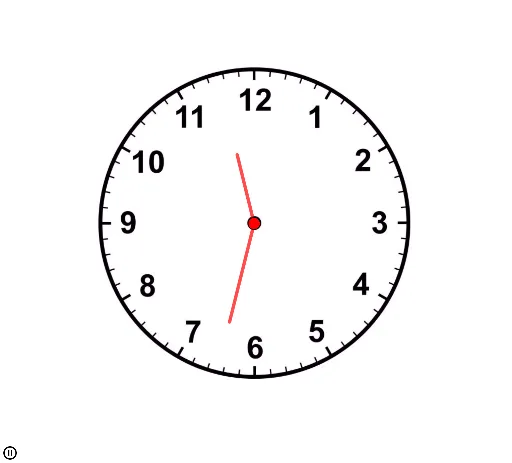
This example demonstrates the construction and working principle of a 12-hour analog clock. It involves core mathematical concepts such as rotation, angle calculations, and properties of circles. Key GeoGebra commands and objects used in the construction include Intersect, Circle, Rotate, and Segment, as summarized. It is suitable for middle school and above students learning geometric constructions, function graphs, and transformations, as well as for teaching clock principles in physics.
GeoGebra Commands & Parameters
Intersect(xAxis, yAxis) → ACircle(A, 4.3) → cIntersect(c, yAxis, 2) → BRotate(B, (-α), A) → B'Rotate(A, (-α), A) → A'Segment(B', A') → f'Rotate(B, (-(α / 12)), A) → B'_1Rotate(A, (-(α / 12)), A) → A'_1Segment(B'_1, A'_1) → f'_1Circle(A, 3) → dIntersect(d, f'_1, 1) → ESegment(A, E) → f