
What is a Radian? Exploratory Student Investigation
Loading the math board and drawing, please wait…
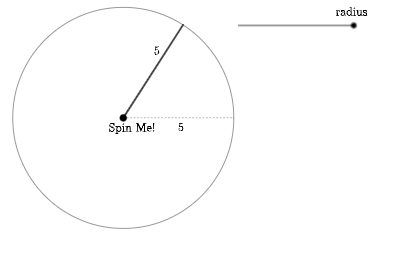
① This interactive GeoGebra example visually demonstrates the definition of a radian: when the arc length equals the radius, the subtended central angle is 1 radian, making the relationship between angle and arc length intuitive. ② Core mathematical concepts include radian measure, central angles, arc length, trigonometric functions (sine, cosine), and conversion between degrees and radians, forming a foundation for trigonometry. ③ Construction highlights: using GeoGebra commands such as Ray, Circle, CircleArc, Rotate, Intersect, and Angle, the applet builds a unit circle, radius, arc, and angle, with draggable points or sliders to dynamically change the angle and observe the radian value; key objects include points A, B, C, D, circle c, arc d, and angles α, β. ④ Suitable for high school or pre-university students as an inquiry-based learning tool, and for teachers to demonstrate in class, helping learners grasp the geometric meaning of radians versus degrees.
GeoGebra Commands & Parameters
Ray((0, 0), (1, 0)) → iIntersect(f, eq1, 1) → BIntersect(g, eq1, 1) → CIntersect(h, eq1, 1) → DIntersect(p, eq1, 1) → EIntersect(q, eq1, 1) → FIntersect(s, eq1, 1) → GIntersect(eq1, i, 1) → HRotate(A, π / 2, B) → A'CircleArc(B, A, A') → cPoint(c) → ISegment(B, I) → jCircleArc(A, H, B) → dPoint(d) → JLine(A, J) → kOrthogonalLine(J, k) → lCircleArc(A, J, B) → eCircle(J, r - e) → tIntersect(t, l, 1) → KSegment(J, K) → mCircle(L, r) → c_1Point(c_1) → MRotate(M, 1, L) → M'CircleArc(L, M, M') → d_1Segment(L, M) → nSegment(L, M') → aAngle(M, L, M') → αAngle(A, B, I) → βSegment(A, H) → bSegment(A, B) → f_1Angle(J, A, B) → γCircle(N, r) → e_1Circle(O, r) → g_1Circle(P, r) → h_1Circle(Q, r) → k_1Circle(R, r) → p_1Point(p_1) → SPoint(h_1) → TPoint(k_1) → UPoint(g_1) → VPoint(e_1) → WRotate(U, (1 * rad), Q) → U'Rotate(V, (1 * rad), O) → V'Rotate(S, (1 * rad), R) → S'Rotate(T, (1 * rad), P) → T'Rotate(W, (1 * rad), N) → W'CircleArc(Q, U, U') → q_1CircleArc(O, V, V') → r_1CircleArc(R, S, S') → s_1CircleArc(P, T, T') → t_1CircleArc(N, W, W') → c_2Angle(V, O, V') → δAngle(U, Q, U') → εAngle(W, N, W') → ζAngle(S, R, S') → ηAngle(T, P, T') → θSegment(R, S) → i_1Segment(R, S') → j_1Segment(P, T) → l_1Segment(P, T') → m_1Segment(N, W) → n_1Segment(N, W') → a_1Segment(Q, U) → b_1Segment(Q, U') → f_2Segment(O, V) → g_2Segment(O, V') → h_2
AI Drawing Prompt Reference
Draw a unit circle to demonstrate the relationship between arc length and central angle when they are equal, representing 1 radian. Include draggable points or sliders to dynamically change the angle and observe the changes in arc length and angle. Use arcs and line segments to represent the arc length and angle, and label key points, circles, and angles for a clear understanding of the conversion between radians and degrees.
The prompt above was compiled from the original drawing commands and is for reference only.