
Alternate Exterior Angles: Thin Slice Task 3
Loading the math board and drawing, please wait…
In collections
Parallel Lines and Related Angles: Guided Exploration
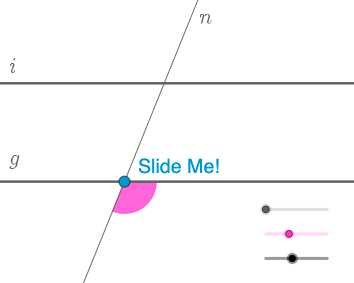
This example demonstrates the invariance of alternate exterior angle relationships when two lines are cut by transversals, using a thin-slice style dynamic geometry setup to visually and numerically verify the angle equality. The key concepts are line and angle geometry, measurement of corresponding/alternate exterior angles, the alternate exterior angles theorem (angle relationship under a transversal), and geometric construction for reliable angle tracking. Construction highlights: Point and Line define the baseline points and lines; Ray and Angle create and measure the exterior angles (e.g., α, β, γ) that form the alternate pair; Rotate and Translate drive dynamic changes of the configuration to test that the relationship stays constant; Circle, Intersect, and Segment determine reference geometry and intersection points; CircleArc and CircleSector provide clear angle marking/visualization. Objects such as A, B, f, g, α, β, B′, B′′, and several auxiliary points (e.g., J, i) support the construction. Suitable for middle and early high school geometry lessons and for students practicing proof by dynamic visualization and measurement.
GeoGebra Commands & Parameters
Point(y = 0) → ALine(A, B) → fRotate(B, α, A) → B'Angle(B, A, B') → γLine(A, B') → gRotate(B', β, A) → B''Angle(B', A, B'') → δLine(A, B'') → hCircle(A, a) → cIntersect(c, h, 2) → CLine(C, g) → iCircle(C, A) → dCircle(A, C) → eIntersect(e, h, 2) → JSegment(A, C) → jCircle(A, (0.3 * j)) → kCircle(C, (0.3 * j)) → pIntersect(p, h) → N, OIntersect(k, h) → P, QIntersect(k, g) → T, UIntersect(p, i, 2) → VIntersect(p, i, 1) → WCircle(C, j / 2) → g_1Circle(A, j / 2) → h_1Intersect(g_1, i, 2) → DIntersect(g_1, i, 1) → EIntersect(g_1, h, 2) → HIntersect(g_1, h) → I, ZIntersect(h_1, h) → A_1, B_1Intersect(h_1, g) → E_1, F_1Point(j) → G_1Vector(A, G_1) → uSegment(A, G_1) → lRay(A, A_1) → mRay(C, H) → nVector(A, G_1) → vSegment(G_1, C) → sCircleArc(C, N, O) → rPoint(r) → FRotate(F, (-δ), C) → F'Angle(F', C, F) → εSegment(A, C) → bCircleSector(A, P, U) → d_1Translate(d_1, v) → e_1CircleArc(C, W, V) → f_1Point(f_1) → GRotate(G, (-(pi - ε)), C) → G'Angle(G', C, G) → ζCircleSector(C, G', G) → k_1CircleArc(A, P, U) → qSegment(A, C) → t
AI Drawing Prompt Reference
This graphic demonstrates the invariance of alternate exterior angle relationships when two lines are cut by transversals. Key objects include points A and B, rays and angles (such as α, β, γ), rotation and translation operations, circles and intersection points (like J, N, O, P, Q, T, U, V, W). The construction sequence starts by defining baseline points A and B, drawing lines f and g, then rotating to create points B' and B'', measuring angles γ and δ. Next, circles and intersections determine reference geometry and intersection points. Subsequent constructions include arcs, sectors, vectors, and rotations to verify angle equality. Overall, it's a dynamic geometric graphic used to visually demonstrate the alternate exterior angles theorem, suitable for middle and early high school geometry lessons.
The prompt above was compiled from the original drawing commands and is for reference only.