
Addition of Angles: Dynamic Demonstration of Angle Summation
Loading the math board and drawing, please wait…
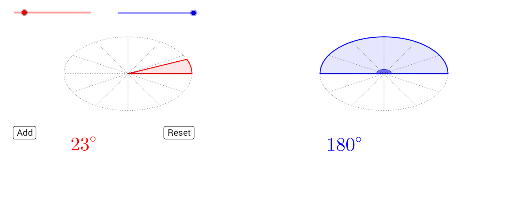
This GeoGebra example dynamically demonstrates the addition of multiple angles (α, β, γ, δ, ε, ζ, η, θ, ι, κ, λ, μ, ν, etc.) through continuous rotation, visually illustrating the geometric meaning of angle summation. The core mathematical concepts involve angle measurement, rotation, and addition, closely tied to trigonometric functions and geometry. The construction uses commands such as Circle to create a reference circle, Rotate to rotate segments or points generating different angles, Angle to label angle sizes, and Segment and CircleSector to construct angle sides and sector regions. Slider animations control the rotation process, updating angle values in real time. This resource is suitable for middle and high school mathematics (geometry and trigonometry), helping students intuitively grasp how angles combine, and can also be extended to explore periodic properties or cross-disciplinary connections with percentages and normal distributions.
GeoGebra Commands & Parameters
Circle(A, B) → cCircle(C, D) → dRotate(B, a°, A) → B'Angle(B, A, B') → αRotate(D, b°, C) → D'Angle(D, C, D') → βRotate(D, 30°, C) → D'_1Angle(D, C, D'_1) → γRotate(D'_1, 30°, C) → EAngle(D'_1, C, E) → δRotate(E, 30°, C) → E'Angle(E, C, E') → εRotate(E', 30°, C) → E''Angle(E', C, E'') → ζRotate(E'', 30°, C) → E'''Angle(E'', C, E''') → ηRotate(E''', 30°, C) → FAngle(E''', C, F) → θRotate(F, 30°, C) → F'Angle(F, C, F') → ιRotate(F', 30°, C) → F''Angle(F', C, F'') → κRotate(F'', 30°, C) → F'''Angle(F'', C, F''') → λRotate(F''', 30°, C) → GAngle(F''', C, G) → μRotate(G, 30°, C) → G'Angle(G, C, G') → νRotate(B, 30°, A) → B'_1Angle(B, A, B'_1) → ξRotate(B'_1, 30°, A) → HAngle(B'_1, A, H) → οRotate(H, 30°, A) → H'Angle(H, A, H') → ρRotate(H', 30°, A) → H''Angle(H', A, H'') → σRotate(H'', 30°, A) → H'''Angle(H'', A, H''') → τRotate(H''', 30°, A) → IAngle(H''', A, I) → υRotate(I, 30°, A) → I'Angle(I, A, I') → ϕRotate(I', 30°, A) → I''Angle(I', A, I'') → χRotate(I'', 30°, A) → I'''Angle(I'', A, I''') → ψRotate(I''', 30°, A) → JAngle(I''', A, J) → ωRotate(J, 30°, A) → J'Angle(J, A, J') → α_1Segment(A, B) → fSegment(A, B'_1) → gSegment(A, H) → hSegment(A, H') → iSegment(A, H'') → jSegment(A, H''') → kSegment(A, I) → lSegment(A, I') → mSegment(A, I'') → nSegment(A, I''') → pSegment(A, J) → qSegment(A, J') → rSegment(C, D) → sSegment(C, D'_1) → tSegment(C, E) → eSegment(C, E') → f_1Segment(C, E'') → g_1Segment(C, E''') → h_1Segment(C, F) → i_1Segment(C, F') → j_1Segment(C, F'') → k_1Segment(C, F''') → l_1Segment(C, G) → m_1Segment(C, G') → n_1CircleSector(A, B, B') → c_1CircleSector(C, D, D') → d_1Circle(K, L) → e_1Segment(K, L) → p_1Rotate(L, 30°, K) → L'Angle(L, K, L') → β_1Rotate(L', 30°, K) → L''Angle(L', K, L'') → γ_1Rotate(L'', 30°, K) → L'''Angle(L'', K, L''') → δ_1Rotate(L''', 30°, K) → MAngle(L''', K, M) → ε_1Rotate(M, 30°, K) → M'Angle(M, K, M') → ζ_1Rotate(M', 30°, K) → M''Angle(M', K, M'') → η_1Rotate(M'', 30°, K) → M'''Angle(M'', K, M''') → θ_1Rotate(M''', 30°, K) → NAngle(M''', K, N) → ι_1Rotate(N, 30°, K) → N'Angle(N, K, N') → κ_1Rotate(N', 30°, K) → N''Angle(N', K, N'') → λ_1Rotate(N'', 30°, K) → N'''Angle(N'', K, N''') → μ_1Segment(K, L') → q_1Segment(K, L'') → r_1Segment(K, L''') → s_1Segment(K, M) → t_1Segment(K, M') → a_1Segment(K, M'') → b_1Segment(K, M''') → f_2Segment(K, N) → g_2Segment(K, N') → h_2Segment(K, N'') → i_2Segment(K, N''') → j_2Rotate(L, (a + b)°, K) → L'_1Angle(L, K, L'_1) → ν_1CircleSector(K, L, L'_1) → c_2Circle(K, L) → d_2