
A Rhombus is Like a Squashed Square
Loading the math board and drawing, please wait…
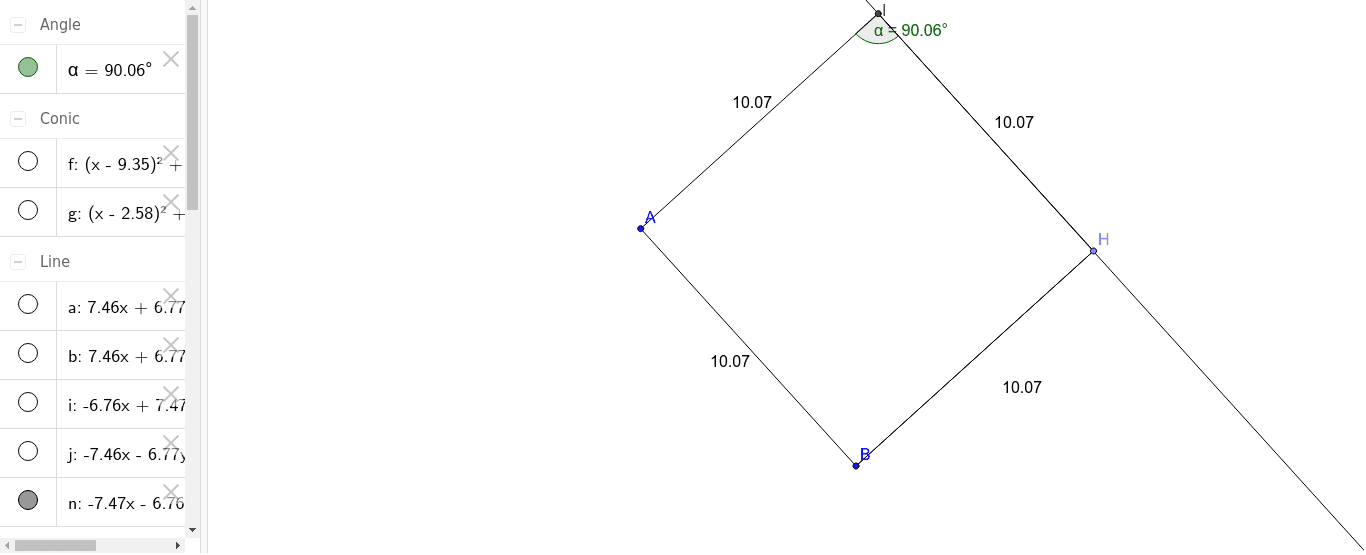
This example illustrates the relationship between a rhombus and a square. Key mathematical concepts include the definition of a rhombus, the properties of a square, and the differences between them. Using GeoGebra commands such as Line, Segment, and Point, a rhombus is constructed and its similarities and differences from a square are observed. Suitable for middle school and above students to learn about geometric shapes and transformations.
GeoGebra Commands & Parameters
Line(A, B) → aLine(C, a) → bSegment(D, E) → cPoint(Circle[F, c]) → GSegment(F, G) → dSegment(B, A) → eCircle(B, Segment[B, A]) → fCircle(A, Segment[B, A]) → gPoint(f) → HSegment(B, H) → hLine(A, h) → iLine(H, e) → jSegment(B, H) → kIntersect(g, i, 2) → ISegment(A, I) → lSegment(I, H) → mAngle(A, I, H) → αOrthogonalLine(I, l) → n
AI Drawing Prompt Reference
Draw a rhombus to illustrate its similarity to a square. Start with a horizontal line and another line intersecting it to form two sides. On one side, pick a point and draw a circle centered at that point with radius equal to the other side's length. Choose a point on this circle and connect it to the center to form the third side. Then, draw two circles centered at the two vertices of the first side, each with radius equal to the side length. On one of these circles, select a point, connect it to the adjacent vertex, and draw a line through this point parallel to the opposite side, intersecting the other circle to get the fourth vertex. Finally, connect all vertices to complete the rhombus, mark an interior angle, and draw a perpendicular line from one vertex to a side to show the difference from a square.
The prompt above was compiled from the original drawing commands and is for reference only.