
5-Compound Cube
Loading the math board and drawing, please wait…
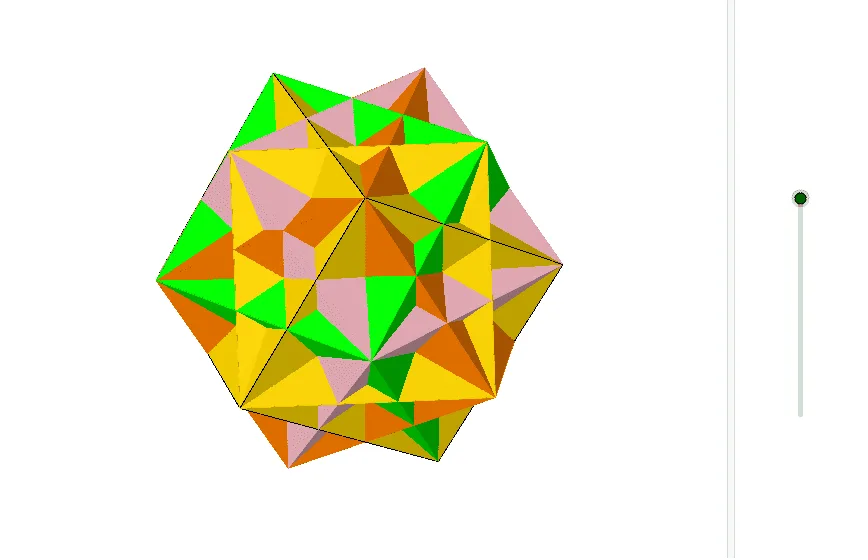
This example demonstrates a complex solid figure composed of multiple geometric shapes, specifically a combination of a pentagon compound and a cube. The core mathematical concepts involved include polygons, solid geometry, geometric transformations, and integral calculus. The construction utilizes GeoGebra commands such as Point, Rotate, Dodecahedron, Prism, and involves numerous points and faces like α, A, A', B, a, C, D, E, F, G, H, I, J, K, L, M, N, O, P, Q, R, S, faceAA'BCD, faceADHNI, etc. It is suitable for high school and above, focusing on the construction and properties of complex geometric solids and the application of geometric transformations.
GeoGebra Commands & Parameters
Point(xAxis) → ARotate(A, 72°) → A'Point(Circle[((A * (1 - sqrt(5))) + (A' * (3 + sqrt(5)))) / 4, (Distance[A, A'] * sqrt(10 + (2 * sqrt(5))) / 4), Segment[A, A']]) → BDodecahedron(A, A', B) → a, C, L, M, N, O, P, Q, R, S, faceAA'BCD, faceADHNI, D, faceAA'EJI, faceA'BFKE, faceBCGLF, faceCDHMG, faceHMRSN, faceIJOSN, faceEJOPK, faceFKPQL, faceGLQRM, faceOPQRS, E, edgeAD, edgeAA', edgeA'B, edgeBC, edgeCD, edgeAI, edgeDH, edgeHN, edgeIN, edgeIJ, F, edgeEJ, edgeA'E, edgeEK, edgeFK, edgeBF, edgeFL, edgeGL, edgeCG, edgeGM, edgeHM, G, edgeMR, edgeRS, edgeNS, edgeOS, edgeJO, edgeOP, edgeKP, edgePQ, edgeLQ, edgeQR, H, I, J, KPrism(R, H, I, O, L) → b, T, edgeHR, edgeHI, edgeIO, edgeOR, edgeLR, edgeHT, edgeIU, edgeOV, edgeLT, edgeTU, U, edgeUV, edgeLV, V, faceHIOR, faceHRLT, faceHIUT, faceIOVU, faceLROV, faceLTUVRotate(b, α) → b'Rotate(b, (2 * α)) → b'_1Rotate(b, (3 * α)) → b'_2Rotate(b, (4 * α)) → b'_3
AI Drawing Prompt Reference
Draw a complex solid composed of a regular dodecahedron and five rotated prisms. Start with a dodecahedron having a pentagonal base and symmetric vertices. Then construct a prism using one vertex, an adjacent vertex, and an opposite vertex of the dodecahedron as reference points, forming a quadrilateral base with rectangular side faces. Rotate this prism around the central axis of the dodecahedron by 72, 144, 216, and 288 degrees, resulting in five identical prisms evenly distributed around the dodecahedron. The final figure shows a symmetric interweaving of the dodecahedron and prisms, highlighting geometric transformations and solid geometry.
The prompt above was compiled from the original drawing commands and is for reference only.