
3D Vector Addition and Transformation Animation
Loading the math board and drawing, please wait…
In collections
Congruence (CO) Cluster
Congruence (Vol 2)
CCSS High School: Geometry (Congruence) Volume 2
CCSS High School: Geometry (Congruence) Volume 2
CCSS High School: Geometry (Congruence) Volume 2
Geometry (Congruence) Volume 2
CCSS High School: Geometry (Congruence) Volume 2
CCSS High School: Geometry (Congruence) Volume 2
CCSS High School: Geometry (Congruence) Volume 2
CCSS High School: Geometry (Congruence) Volume 2
CCSS High School: Geometry (Congruence) Volume 2
CCSS High School: Geometry (Congruence) Volume 2
CCSS High School: Geometry (Congruence) Volume 2
Gail LeBlancCCSS High School: Geometry (Congruence) Volume 2
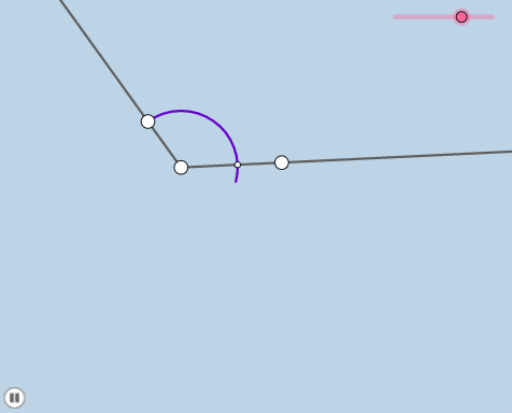
This example demonstrates vector addition and dynamic transformations in three-dimensional space. Key math concepts include 3D vectors, addition, rotation, scaling, etc. GeoGebra commands and objects used in construction are Ray, Rotate, Vector, Translate, Dilate, etc. Suitable for high school and above students studying solid geometry and vector operations, or university-level physics teaching.
GeoGebra Commands & Parameters
Ray(A, B) → fRotate(B, (o * π / 180), A) → B'Angle(B, A, B') → βRay(A, B') → gPoint(g) → CCircle(A, C) → cIntersect(c, f, 1) → DRotate(D, If[0 < a ≤ 1, ((a * 2) * π), (2 * π)], A) → D'Rotate(C, If[0 < a ≤ 1, (((-a) * 2) * π), (-2 * π)], A) → C'CircleArc(A, C', C) → dRay(E, F) → hDilate(A, If[1 < a ≤ 2, 2 - a, 0], E) → A'Vector(A, A') → uTranslate(c, u) → c'Translate(A, u) → A'_1Intersect(c', h, 1) → GCircle(C, D) → eRotate(D, If[2 < a ≤ 3, (((-(a - 2)) * 2) * π), (-2 * π)], C) → C'_1CircleArc(C, C'_1, D) → kDilate(C, If[3 < a ≤ 4, 4 - a, 0], G) → C'_2Vector(C, C'_2) → vTranslate(e, v) → e'Translate(C, v) → C'_3Intersect(e', c') → H, I, ,Dilate(E, If[5 < a ≤ 6, 6 - a, 0], I) → E'Vector(E, E') → wSegment(E, E') → iRay(E, I) → jCircle(I, 5) → pIntersect(p, j, 2) → JDistance(A, C) → bCircle(A, (0.5 * b)) → qIntersect(q, f, 1) → KRotate(K, If[6.5 < a ≤ 7.5, (((a - 6.5) * o) * π / 180), (o * π / 180)], A) → K'CircleSector(A, K, K') → rDilate(A, If[8 < a ≤ 9, 9 - a, 0], E) → A'_2Vector(A, A'_2) → mTranslate(r, m) → r'Line(E, f) → nLine(E, g) → sPoint(s) → LPoint(n) → MAngle(L, E, I) → γRotate(r', If[9 < a ≤ 10, ((a - 9) * γ), γ], E) → r''Ray(E, I) → lIntersect(p, l, 2) → NRay(I, N) → t