
2D to 3D: What's Going On?
Loading the math board and drawing, please wait…
In collections
Cross Section to Surface of Revolution (Intro)
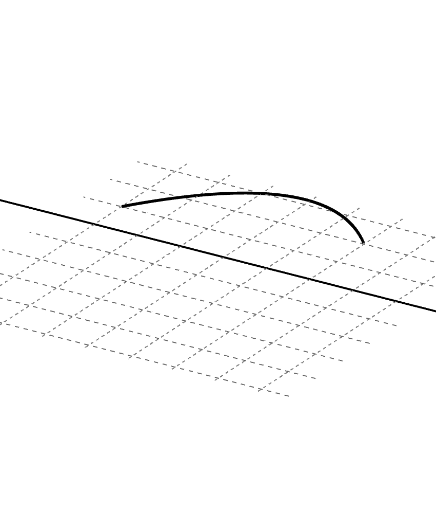
This example demonstrates the conversion of 2D geometric shapes into 3D solids and explores the effects of rotation. Key mathematical concepts include geometric transformations, rotation, and 3D modeling. Construction involves using GeoGebra commands such as Min, Max, FitPoly, Rotate, Surface, etc. Suitable for middle school students to practice geometric transformations and solid geometry.
GeoGebra Commands & Parameters
Min({x(A), x(B), x(C)}) → aMax({x(A), x(B), x(C)}) → bFitPoly({A, B, C}) → fRotate(g, n, xAxis) → g_1Surface(g, n, xAxis) → cPoint(xAxis) → DPoint(xAxis) → ELine(D, E) → h
AI Drawing Prompt Reference
Draw a 2D triangle ABC and convert it into a 3D solid. First, find the minimum and maximum x-coordinates of triangle ABC. Then fit a polynomial curve through the points. Next, rotate this curve around the x-axis to form a 3D solid. Finally, add two points D and E on the x-axis and draw a line h connecting these two points.
The prompt above was compiled from the original drawing commands and is for reference only.