
Wordless Pythagorean Proof via Hinged Dissection
Loading the math board and drawing, please wait…
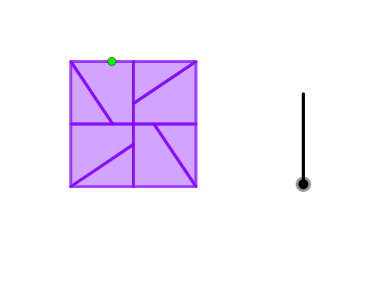
This example demonstrates a wordless proof of the Pythagorean Theorem using a hinged dissection: geometric pieces of a right triangle are cut and then recombined (by rotation and reflection) so that the areas of the constructed squares match in a visually compelling way. It centers on the area relationship behind a² + b² = c², using the invariance of area under rearrangement and geometric equivalence of polygonal regions. The construction relies on commands and objects such as Intersect and Point to generate key vertices, Polygon to define the dissection pieces, and Midpoint/Centroid to obtain structural reference points. Lines are built with Line and OrthogonalLine to enforce right angles, while LineBisector and AngularBisector provide symmetry/angle constraints. Circle and Angle are used to locate circle-based and angle-based positions, and If controls conditional steps in the construction. The dynamic rearrangement is driven by Rotate and Mirror applied to the polygonal pieces so that the hinged motion preserves the intended area correspondence. Suitable for middle school to early high school geometry and for classroom demonstrations focused on visual reasoning and geometric dissection proofs.
GeoGebra Commands & Parameters
Intersect(xAxis, yAxis) → APoint(xAxis) → BPolygon(A, B, 4) → poly1, f, g, h, i, C, DPoint(h) → EMidpoint(h) → FMidpoint(i) → GMidpoint(f) → HMidpoint(g) → ICentroid(poly1) → JLine(E, B) → jOrthogonalLine(D, j) → kOrthogonalLine(C, j) → lOrthogonalLine(D, l) → mOrthogonalLine(A, m) → nLine(F, H) → pLine(G, I) → qIntersect(l, p) → KIntersect(j, q) → LIntersect(m, q) → NPolygon(D, F, J, N) → q1, d_1, f_1, j_1, n_2Line(C, B) → rIntersect(k, r) → OLineBisector(D, O) → sAngularBisector(k, m) → t, eIntersect(s, t) → PCircle(J, Segment[P, D]) → e_1Line(D, B) → p_1Line(A, C) → q_1Intersect(e_1, p_1) → Q, RIntersect(e_1, q_1) → S, TOrthogonalLine(Q, q) → r_1Intersect(q, r_1) → ULineBisector(Q, D) → s_1LineBisector(U, N) → t_1Intersect(t_1, s_1) → VAngle(Q, V, D) → αIf(0 ≤ o ≤ 1, Polygon[Rotate[D, (o * (-α)), V], Rotate[F, (o * (-α)), V], Rotate[J, (o * (-α)), V], Rotate[N, (o * (-α)), V]]) → q2Polygon(F, K, C) → t2, c, f_2, k_1If(0 ≤ o ≤ 1, Rotate[N, (o * (-α)), V]) → NNIf(0 ≤ o ≤ 1, Rotate[F, (o * (-α)), V]) → FFIf(0 ≤ o ≤ 1, Rotate[J, (o * (-α)), V]) → JJIf(0 ≤ o ≤ 1, Rotate[D, (o * (-α)), V]) → DDCircle(NN, Segment[K, F]) → c_1Rotate(If[0 ≤ o ≤ 1, Polygon[Rotate[D, (o * (-α)), V], Rotate[G, (o * (-α)), V], Rotate[N, (o * (-α)), V]]], (o * π), NN) → t3Rotate(If[0 ≤ o ≤ 1, Rotate[G, (o * (-α)), V]], (o * π), NN) → GGMirror(K, J) → K'Polygon(A, G, J, K') → q3, a, g_1, j_2, k'Rotate(Rotate[If[0 ≤ o ≤ 1, Polygon[Rotate[A, (o * (-α)), V], Rotate[G, (o * (-α)), V], Rotate[J, (o * (-α)), V], Rotate[K', (o * (-α)), V]]], (o * π), NN], ((-o) * π), GG) → q4Rotate(Rotate[If[0 ≤ o ≤ 1, Rotate[J, (o * (-α)), V]], (o * π), NN], ((-o) * π), GG) → MRotate(Rotate[If[0 ≤ o ≤ 1, Rotate[K', (o * (-α)), V]], (o * π), NN], ((-o) * π), GG) → WPolygon(A, K', H) → t1, h_1, a_1, bRotate(Rotate[Rotate[If[0 ≤ o ≤ 1, Polygon[Rotate[A, (o * (-α)), V], Rotate[K', (o * (-α)), V], Rotate[H, (o * (-α)), V]]], (o * π), NN], ((-o) * π), GG], (o * π), W) → t4Rotate(Rotate[Rotate[If[0 ≤ o ≤ 1, Rotate[A, (o * (-α)), V]], (o * π), NN], ((-o) * π), GG], (o * π), W) → ZRotate(Rotate[Rotate[If[0 ≤ o ≤ 1, Rotate[H, (o * (-α)), V]], (o * π), NN], ((-o) * π), GG], (o * π), W) → A_1Polygon(B, H, J, L) → q5, b_1, h_2, j_3, l_1Rotate(Rotate[Rotate[Rotate[If[0 ≤ o ≤ 1, Polygon[Rotate[B, (o * (-α)), V], Rotate[H, (o * (-α)), V], Rotate[J, (o * (-α)), V], Rotate[L, (o * (-α)), V]]], (o * π), NN], ((-o) * π), GG], (o * π), W], ((-o) * π), A_1) → q6Rotate(Rotate[Rotate[Rotate[If[0 ≤ o ≤ 1, Rotate[J, (o * (-α)), V]], (o * π), NN], ((-o) * π), GG], (o * π), W], ((-o) * π), A_1) → B_1Rotate(Rotate[Rotate[Rotate[If[0 ≤ o ≤ 1, Rotate[L, (o * (-α)), V]], (o * π), NN], ((-o) * π), GG], (o * π), W], ((-o) * π), A_1) → C_1Polygon(L, I, B) → t5, b_2, l_2, i_1Rotate(Rotate[Rotate[Rotate[Rotate[If[0 ≤ o ≤ 1, Polygon[Rotate[L, (o * (-α)), V], Rotate[I, (o * (-α)), V], Rotate[B, (o * (-α)), V]]], (o * π), NN], ((-o) * π), GG], (o * π), W], ((-o) * π), A_1], (o * π), C_1) → t6Rotate(Rotate[Rotate[Rotate[Rotate[If[0 ≤ o ≤ 1, Rotate[I, (o * (-α)), V]], (o * π), NN], ((-o) * π), GG], (o * π), W], ((-o) * π), A_1], (o * π), C_1) → D_1Polygon(I, C, K, J) → q7, i_2, c_2, k_2, j_4Rotate(Rotate[Rotate[Rotate[Rotate[Rotate[If[0 ≤ o ≤ 1, Polygon[Rotate[I, (o * (-α)), V], Rotate[C, (o * (-α)), V], Rotate[K, (o * (-α)), V], Rotate[J, (o * (-α)), V]]], (o * π), NN], ((-o) * π), GG], (o * π), W], ((-o) * π), A_1], (o * π), C_1], ((-o) * π), D_1) → q8Rotate(Rotate[Rotate[Rotate[Rotate[Rotate[If[0 ≤ o ≤ 1, Rotate[K, (o * (-α)), V]], (o * π), NN], ((-o) * π), GG], (o * π), W], ((-o) * π), A_1], (o * π), C_1], ((-o) * π), D_1) → E_1Polygon(K, F, C) → t7, c_3, k_3, f_3Rotate(Rotate[Rotate[Rotate[Rotate[Rotate[Rotate[If[0 ≤ o ≤ 1, Polygon[Rotate[K, (o * (-α)), V], Rotate[F, (o * (-α)), V], Rotate[C, (o * (-α)), V]]], (o * π), NN], ((-o) * π), GG], (o * π), W], ((-o) * π), A_1], (o * π), C_1], ((-o) * π), D_1], (o * π), E_1) → t8
AI Drawing Prompt Reference
Draw a right triangle, cut it into several polygonal pieces, and then rearrange them by rotation and reflection to form a拼图 of two right triangles, demonstrating the area equality of the Pythagorean theorem. Key objects include the right triangle, the cut polygonal pieces, transformation points for rotation and reflection, and related line segments and circles. Construction order: first draw the right triangle, then cut out the pieces, then rearrange the pieces via rotation and reflection so that the areas of the two right triangles match, illustrating geometric equivalence.
The prompt above was compiled from the original drawing commands and is for reference only.