
Why PQRS is a Rhombus When ABCD is a Rectangle?
Loading the math board and drawing, please wait…
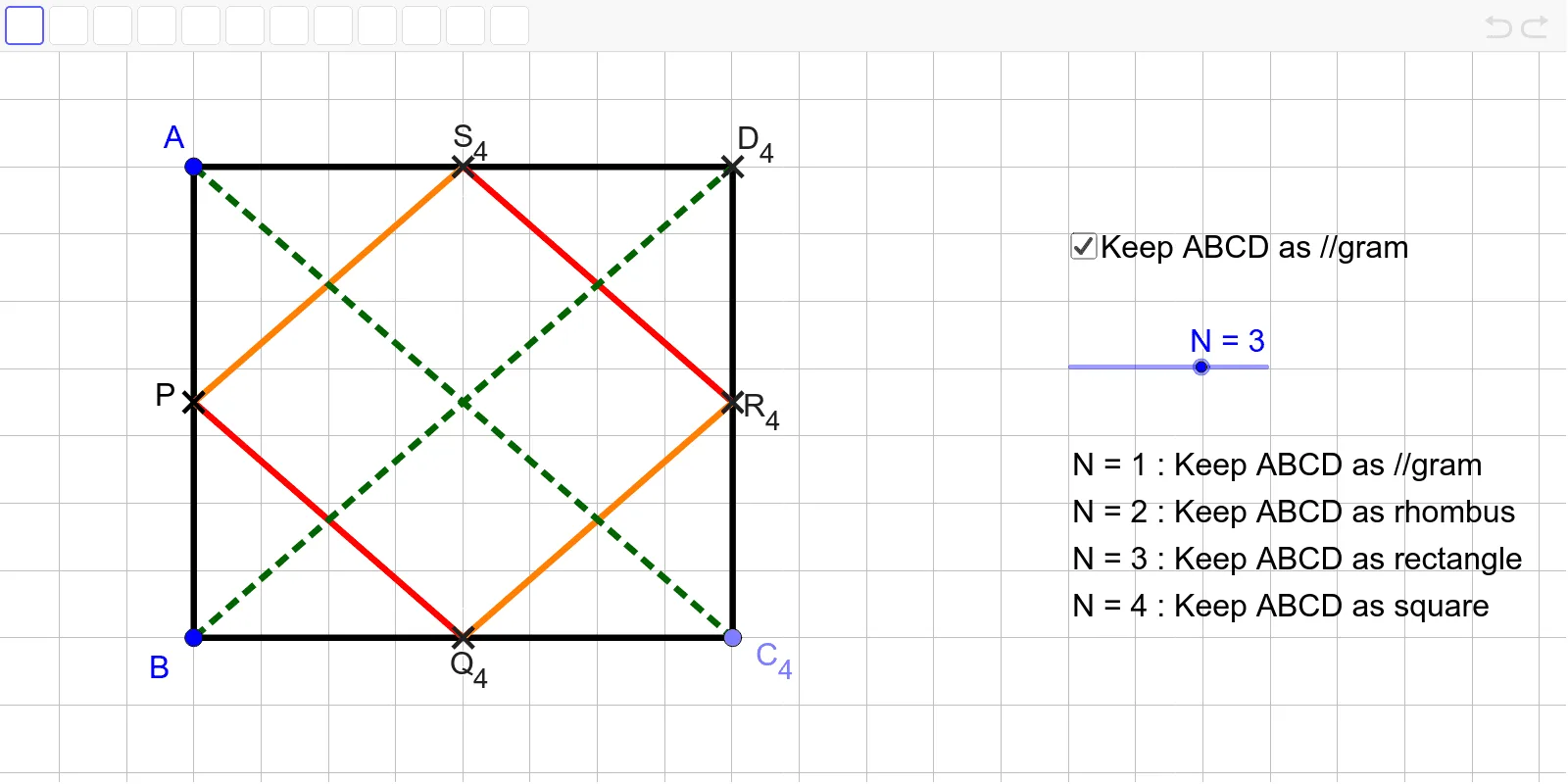
This example demonstrates why PQRS becomes a rhombus when ABCD is a rectangle, focusing on the properties of diagonals in rectangles and rhombuses, and the use of coordinate geometry. Key concepts include the bisecting and perpendicular nature of rectangle diagonals, equal side lengths in rhombuses, and GeoGebra commands like Segment, Midpoint, Intersect, and OrthogonalLine. Suitable for high school students and teachers exploring geometric relationships and coordinate methods.
GeoGebra Commands & Parameters
Segment(A, B) → a_1Segment(B, C) → b_1Segment(C, D) → c_1Segment(D, A) → d_1Midpoint(A, B) → PMidpoint(B, C) → QMidpoint(C, D) → RMidpoint(D, A) → SSegment(P, Q) → e_1Segment(Q, R) → f_1Segment(R, S) → g_1Segment(S, P) → h_1Segment(A, C) → i_1Segment(B, D) → j_1Angle(P, S, R) → w_1Angle(R, Q, P) → y_1Angle(Q, P, S) → x_1Angle(S, R, Q) → z_1Line(A, b_1) → l_1Line(C, a_1) → l_2Intersect(l_1, l_2) → D_2Segment(A, D_2) → d_2Segment(D_2, C) → c_2Segment(B, D_2) → j_2Midpoint(C, D_2) → R_2Midpoint(A, D_2) → S_2Segment(Q, R_2) → f_2Segment(R_2, S_2) → g_2Segment(S_2, P) → h_2Angle(P, S_2, R_2) → w_2Angle(S_2, R_2, Q) → z_2Angle(R_2, Q, P) → y_2Angle(Q, P, S_2) → x_2Circle(B, A) → l_3Point(l_3) → C_3Segment(B, C_3) → b_3Circle(C_3, Segment[C_3, B]) → l_4Circle(A, Segment[A, B]) → l_5Intersect(l_4, l_5, 2) → D_3Segment(C_3, D_3) → c_3Segment(A, D_3) → d_3Midpoint(B, C_3) → Q_3Midpoint(C_3, D_3) → R_3Midpoint(D_3, A) → S_3Segment(P, Q_3) → e_3Segment(S_3, R_3) → g_3Segment(S_3, P) → h_3Segment(R_3, Q_3) → f_3Segment(B, D_3) → j_3Segment(A, C_3) → i_3Angle(Q_3, P, S_3) → x_3Angle(R_3, Q_3, P) → y_3Angle(S_3, R_3, Q_3) → z_3Angle(P, S_3, R_3) → w_3OrthogonalLine(B, a_1) → l_6Point(l_6) → C_4Segment(B, C_4) → b_4OrthogonalLine(C_4, b_4) → l_7Line(A, b_4) → l_8Intersect(l_7, l_8) → D_4Segment(A, D_4) → d_4Segment(D_4, C_4) → c_4Midpoint(B, C_4) → Q_4Midpoint(C_4, D_4) → R_4Midpoint(D_4, A) → S_4Segment(P, Q_4) → e_4Segment(S_4, R_4) → g_4Segment(S_4, P) → h_4Segment(R_4, Q_4) → f_4Segment(A, C_4) → i_4Segment(B, D_4) → j_4Angle(P, S_4, R_4) → w_4Angle(S_4, R_4, Q_4) → z_4Angle(R_4, Q_4, P) → y_4Angle(Q_4, P, S_4) → x_4Circle(B, A) → l_9OrthogonalLine(B, a_1) → l_{10}Intersect(l_9, l_{10}, 2) → C_5Segment(B, C_5) → b_5OrthogonalLine(C_5, b_5) → l_{11}OrthogonalLine(A, a_1) → l_{12}Intersect(l_{11}, l_{12}) → D_5Segment(C_5, D_5) → c_5Segment(D_5, A) → d_5Midpoint(B, C_5) → Q_5Midpoint(C_5, D_5) → R_5Midpoint(D_5, A) → S_5Segment(P, Q_5) → e_5Segment(S_5, R_5) → g_5Segment(R_5, Q_5) → f_5Segment(S_5, P) → h_5Segment(A, C_5) → i_5Segment(B, D_5) → j_5Angle(P, S_5, R_5) → w_5Angle(Q_5, P, S_5) → x_5Angle(R_5, Q_5, P) → y_5Angle(S_5, R_5, Q_5) → z_5
AI Drawing Prompt Reference
Draw a rectangle ABCD, then connect its diagonals AC and BD, which intersect at point D. Next, find the midpoints P, Q, R, and S of sides AB, BC, CD, and DA, respectively. Connect these midpoints to form quadrilateral PQRS. Observe that PQRS is a rhombus because the diagonals AC and BD are perpendicular and bisect each other.
The prompt above was compiled from the original drawing commands and is for reference only.