
When PQRS Becomes a Rhombus
Loading the math board and drawing, please wait…
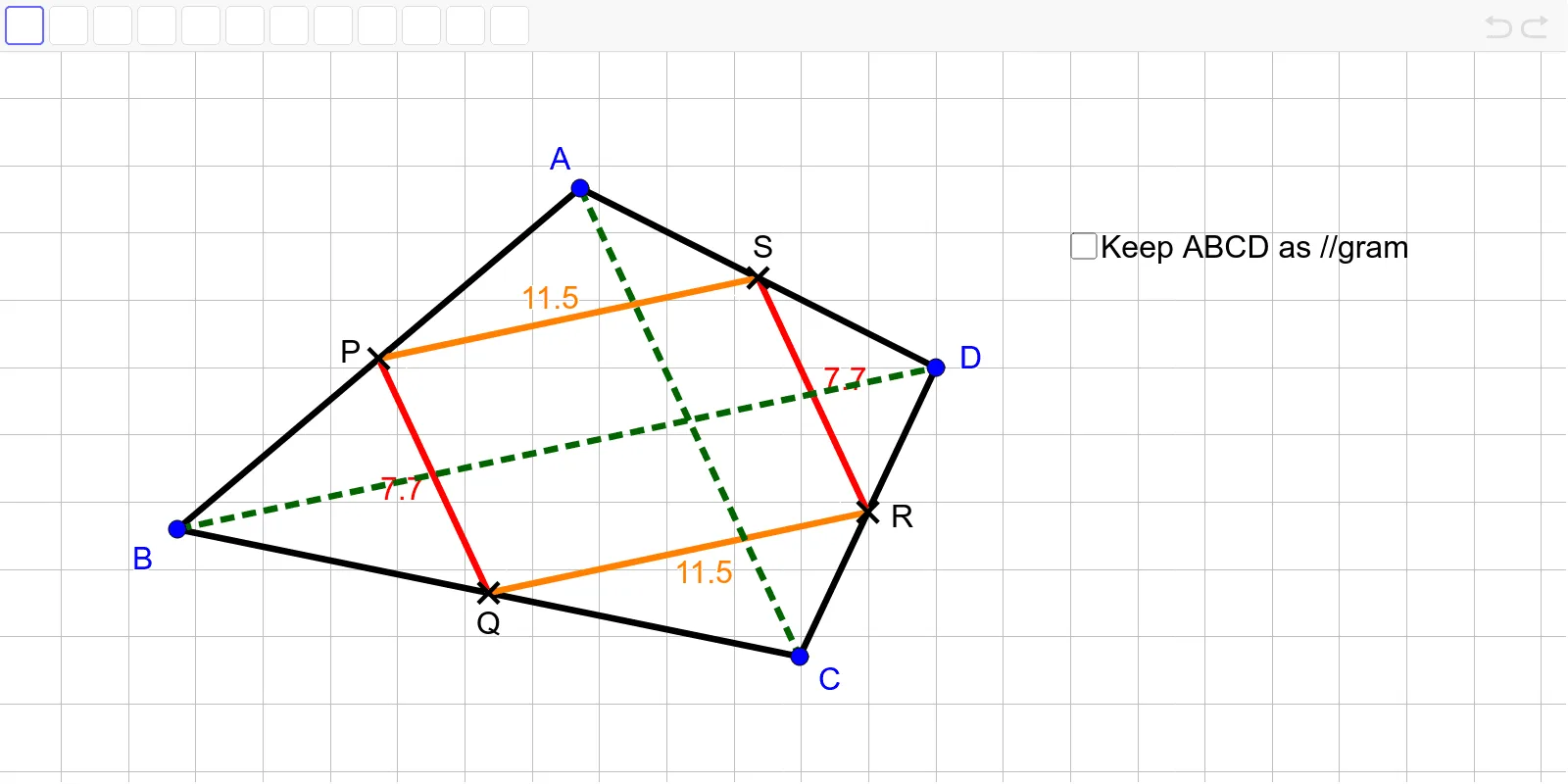
This example demonstrates how to adjust points to make quadrilateral PQRS a rhombus. Key mathematical concepts include the properties of a rhombus, midpoints, angles, and lines. GeoGebra commands such as Segment, Midpoint, Angle, and Line are used in the construction. Suitable for middle school and above students to learn about rhombus properties and geometric construction.
GeoGebra Commands & Parameters
Segment(A, B) → a_1Segment(B, C) → b_1Segment(C, D) → c_1Segment(D, A) → d_1Midpoint(A, B) → PMidpoint(B, C) → QMidpoint(C, D) → RMidpoint(D, A) → SSegment(P, Q) → e_1Segment(Q, R) → f_1Segment(R, S) → g_1Segment(S, P) → h_1Segment(A, C) → i_1Segment(B, D) → j_1Angle(P, S, R) → w_1Angle(R, Q, P) → y_1Angle(Q, P, S) → x_1Angle(S, R, Q) → z_1Line(A, b_1) → l_1Line(C, a_1) → l_2Intersect(l_1, l_2) → D_2Segment(A, D_2) → d_2Segment(D_2, C) → c_2Segment(B, D_2) → j_2Midpoint(C, D_2) → R_2Midpoint(A, D_2) → S_2Segment(Q, R_2) → f_2Segment(R_2, S_2) → g_2Segment(S_2, P) → h_2Angle(P, S_2, R_2) → w_2Angle(S_2, R_2, Q) → z_2Angle(R_2, Q, P) → y_2Angle(Q, P, S_2) → x_2Circle(B, A) → l_3Point(l_3) → C_3Segment(B, C_3) → b_3Circle(C_3, Segment[C_3, B]) → l_4Circle(A, Segment[A, B]) → l_5Intersect(l_4, l_5, 2) → D_3Segment(C_3, D_3) → c_3Segment(A, D_3) → d_3Midpoint(B, C_3) → Q_3Midpoint(C_3, D_3) → R_3Midpoint(D_3, A) → S_3Segment(P, Q_3) → e_3Segment(S_3, R_3) → g_3Segment(S_3, P) → h_3Segment(R_3, Q_3) → f_3Segment(B, D_3) → j_3Segment(A, C_3) → i_3Angle(Q_3, P, S_3) → x_3Angle(R_3, Q_3, P) → y_3Angle(S_3, R_3, Q_3) → z_3Angle(P, S_3, R_3) → w_3OrthogonalLine(B, a_1) → l_6Point(l_6) → C_4Segment(B, C_4) → b_4OrthogonalLine(C_4, b_4) → l_7Line(A, b_4) → l_8Intersect(l_7, l_8) → D_4Segment(A, D_4) → d_4Segment(D_4, C_4) → c_4Midpoint(B, C_4) → Q_4Midpoint(C_4, D_4) → R_4Midpoint(D_4, A) → S_4Segment(P, Q_4) → e_4Segment(S_4, R_4) → g_4Segment(S_4, P) → h_4Segment(R_4, Q_4) → f_4Segment(A, C_4) → i_4Segment(B, D_4) → j_4Angle(P, S_4, R_4) → w_4Angle(S_4, R_4, Q_4) → z_4Angle(R_4, Q_4, P) → y_4Angle(Q_4, P, S_4) → x_4Circle(B, A) → l_9OrthogonalLine(B, a_1) → l_{10}Intersect(l_9, l_{10}, 2) → C_5Segment(B, C_5) → b_5OrthogonalLine(C_5, b_5) → l_{11}OrthogonalLine(A, a_1) → l_{12}Intersect(l_{11}, l_{12}) → D_5Segment(C_5, D_5) → c_5Segment(D_5, A) → d_5Midpoint(B, C_5) → Q_5Midpoint(C_5, D_5) → R_5Midpoint(D_5, A) → S_5Segment(P, Q_5) → e_5Segment(S_5, R_5) → g_5Segment(R_5, Q_5) → f_5Segment(S_5, P) → h_5Segment(A, C_5) → i_5Segment(B, D_5) → j_5Angle(P, S_5, R_5) → w_5Angle(Q_5, P, S_5) → x_5Angle(R_5, Q_5, P) → y_5Angle(S_5, R_5, Q_5) → z_5
AI Drawing Prompt Reference
Draw a quadrilateral PQRS to form a rhombus. First, connect points P, Q, R, and S to form the quadrilateral. Then, find the midpoints of the diagonals PQ, QR, RS, and SP to ensure the diagonals bisect each other. Next, draw diagonals AC and BD, and their intersection is point D. Adjust the positions of the points to make all sides of PQRS equal, forming a rhombus. Finally, ensure the diagonals are perpendicular and bisect each other.
The prompt above was compiled from the original drawing commands and is for reference only.