
w Defined by Basis Vectors u and v
Loading the math board and drawing, please wait…
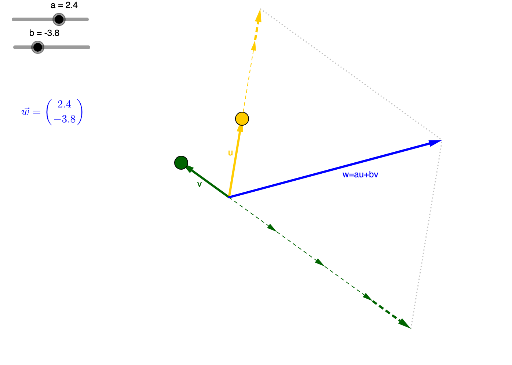
This example demonstrates how the vector w is defined as a linear combination of the basis vectors u and v. Key mathematical concepts include linear combinations of vectors. Construction highlights the use of the Vector, Segment, If, and Sequence commands in GeoGebra. Suitable for high school mathematics education and learning vector concepts.
GeoGebra Commands & Parameters
Vector(A, B) → uVector(A, C) → vVector(A, C') → zVector(A, A') → wVector(A, B') → cSegment(B', A') → dSegment(C', A') → eIf(a > 0, floor(a), abs(ceil(a))) → anrIf(b > 0, floor(b), abs(ceil(b))) → bnrSequence(Vector[If[a > 0, Vector[A + (i * u), A + ((i + 1) * u)], Vector[A - (i * u), A - ((i + 1) * u)]]], i, 0, anr - 1) → asIf(a > 0, Vector[A + (anr * u), B'], Vector[A - (anr * u), B']) → alastSequence(Vector[If[b > 0, Vector[A + (i * v), A + ((i + 1) * v)], Vector[A - (i * v), A - ((i + 1) * v)]]], i, 0, bnr - 1) → bsIf(b > 0, Vector[A + (bnr * v), C'], Vector[A - (bnr * v), C']) → blast