
Volume of Rotation with Shell Method: Two Curves
Loading the math board and drawing, please wait…
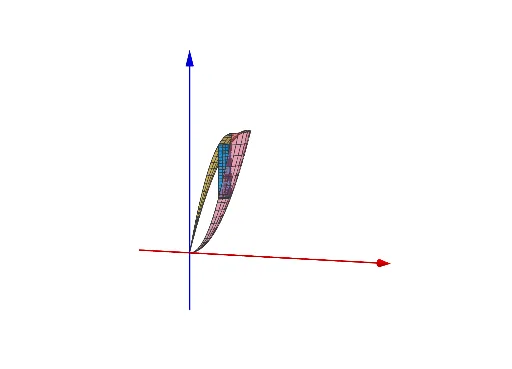
This example demonstrates the volume of a solid of revolution formed by rotating the region between two curves, using the shell method (cylindrical shells). It highlights how the total volume can be assembled from infinitesimal shell contributions, emphasizing the geometric meaning of the definite integral. The core ideas include solids of revolution, the shell method, integration bounds determined by special points (notably the intersection of the two curves), and the role of symmetry in simplifying the construction. In GeoGebra, the rotation surface is created with the Surface command, while the underlying curves and key geometric/measurement objects (e.g., a, l1, b, d, f, e, g, dd, h, c, i) are used to define radii, heights, and the relevant interval structure. Suitable for high school to early college calculus instruction and for conceptual practice with volume-from-geometry problems.
GeoGebra Commands & Parameters
Surface((r * cos(t)), (r * sin(t)), r^(2), r, 0, 2, t, 0, a) → l1Surface((r * cos(t)), (r * sin(t)), (4 * r) - r^(2), r, 0, 2, t, 0, a) → bSurface((d * cos(t)), (d * sin(t)), z, z, d^(2), (4 * d) - d^(2), t, 0, a) → gSurface((dd * cos(t)), (dd * sin(t)), z, z, dd^(2), (4 * dd) - dd^(2), t, 0, a) → hSurface((r * cos(t)), (r * sin(t)), r^(2), r, dd, d, t, 0, a) → cSurface((r * cos(t)), (r * sin(t)), (4 * r) - r^(2), r, dd, d, t, 0, a) → i
AI Drawing Prompt Reference
Draw a solid of revolution formed by rotating the region between two curves. The curves intersect on the x-axis, creating a closed region. Rotate this region around the x-axis to form a solid. The solid can be thought of as made of cylindrical shells, with each shell's radius and height determined by the curves. Construct it by first drawing the two curves, then identifying the intersection point as the start of the rotation axis, and finally assembling the shells to represent the volume.
The prompt above was compiled from the original drawing commands and is for reference only.