
Volume of Pyramids (Method 1)
Loading the math board and drawing, please wait…
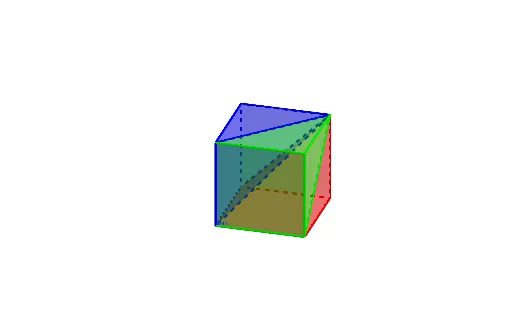
This example demonstrates the calculation of a pyramid's volume through geometric construction. Key math concepts include volume formulas, geometric construction techniques, and spatial visualization. The construction uses GeoGebra commands like Cube, Pyramid, Line, Rotate, and objects such as points A, B, C, D, E, F, G, H, and faces like faceABCD. It is suitable for middle school students and above learning solid geometry volume calculations, or for educational demonstrations.
GeoGebra Commands & Parameters
Cube(A, B, C) → cube, D, faceCDHG_1, faceEFGH, edgeAD_1, edgeAB_1, edgeBC_1, edgeCD_1, edgeAE_1, edgeDH_1, edgeEH_1, edgeEF_1, E, edgeBF_1, edgeFG_1, edgeCG_1, edgeGH_1, F, G, H, faceABCD_1, faceADHE_1, faceABFE, faceBCGFPyramid(A, B, C, D, F) → Pyr1, faceABCD, edgeAF_1, edgeBF, edgeCF_1, edgeDF_1, faceABF, faceBCF, faceCDF_1, faceADF_1, edgeAB, edgeBC, edgeCD_2, edgeAD_2Pyramid(A, E, H, D, F) → Pyr2, faceADHE, edgeAF, edgeEF, edgeFH_1, edgeDF_2, faceAEF, faceEFH, faceDFH_1, faceADF, edgeAE, edgeEH, edgeDH_2, edgeADPyramid(D, C, G, H, F) → Pyr3, faceCDHG, edgeDF, edgeCF, edgeFG, edgeFH, faceCDF, faceCFG, faceFGH, faceDFH, edgeCD, edgeCG, edgeGH, edgeDHLine(A, D) → ax2Line(C, D) → ax3Rotate(Pyr2, (-fold_unfold), ax2) → Rot2Rotate(Pyr3, fold_unfold, ax3) → Rot3
AI Drawing Prompt Reference
Draw a cube first. Using its bottom face vertices and one top vertex, construct a pyramid whose base coincides with the cube's bottom face and apex is above. Then build two additional pyramids using vertices from the cube's side and top faces, so that together they partition the cube. Finally, rotate these two extra pyramids outward about two edges of the cube's bottom face, unfolding them to visually show that the sum of the three pyramid volumes equals the cube's volume, thereby deriving the pyramid volume formula.
The prompt above was compiled from the original drawing commands and is for reference only.