
Volume of Cylinder by Cynthia Tan
Loading the math board and drawing, please wait…
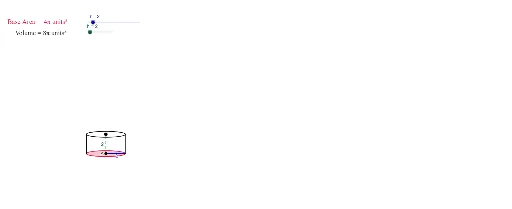
This example demonstrates how to calculate the volume of a cylinder by changing its base radius and height. Key mathematical concepts include the cylinder volume formula and geometric construction. It uses Circle, Point, Line, Intersect, Ellipse, Segment, Rotate, Vector, Translate, and OrthogonalLine commands in GeoGebra. Suitable for middle school and above students learning solid geometry.
GeoGebra Commands & Parameters
Circle(A, r) → cPoint(c) → BLine(B, A) → aIntersect(c, a) → C, DPoint(c) → ELine(E, A) → bPoint(b) → FPoint(b) → GEllipse(B, D, G) → dPoint(Circle[A, h]) → HSegment(A, H) → eRotate(A, 90°, A) → A'Rotate(H, 90°, A) → H'Segment(A', H') → e'Vector(A, H') → uTranslate(d, u) → d'OrthogonalLine(B, e) → fOrthogonalLine(H, e) → gIntersect(d', f) → I, JIntersect(d', g) → K, LSegment(B, I) → iSegment(H, K) → jSegment(A, D) → kOrthogonalLine(D, k) → lIntersect(d', l) → N, OSegment(O, D) → m
AI Drawing Prompt Reference
Draw a cylinder by first creating a circle as the base, then drawing a line from the center to a point on the circumference, finding the other intersection of this line with the circle, drawing an ellipse, then drawing a perpendicular line from the center to the ellipse, rotating the center and points on the ellipse, drawing the rotated line segments, constructing perpendicular lines to these segments, and finally drawing perpendicular line segments to ensure all segments and the circle form a cylinder.
The prompt above was compiled from the original drawing commands and is for reference only.