
Interior Angles of Regular Polygons
Loading the math board and drawing, please wait…
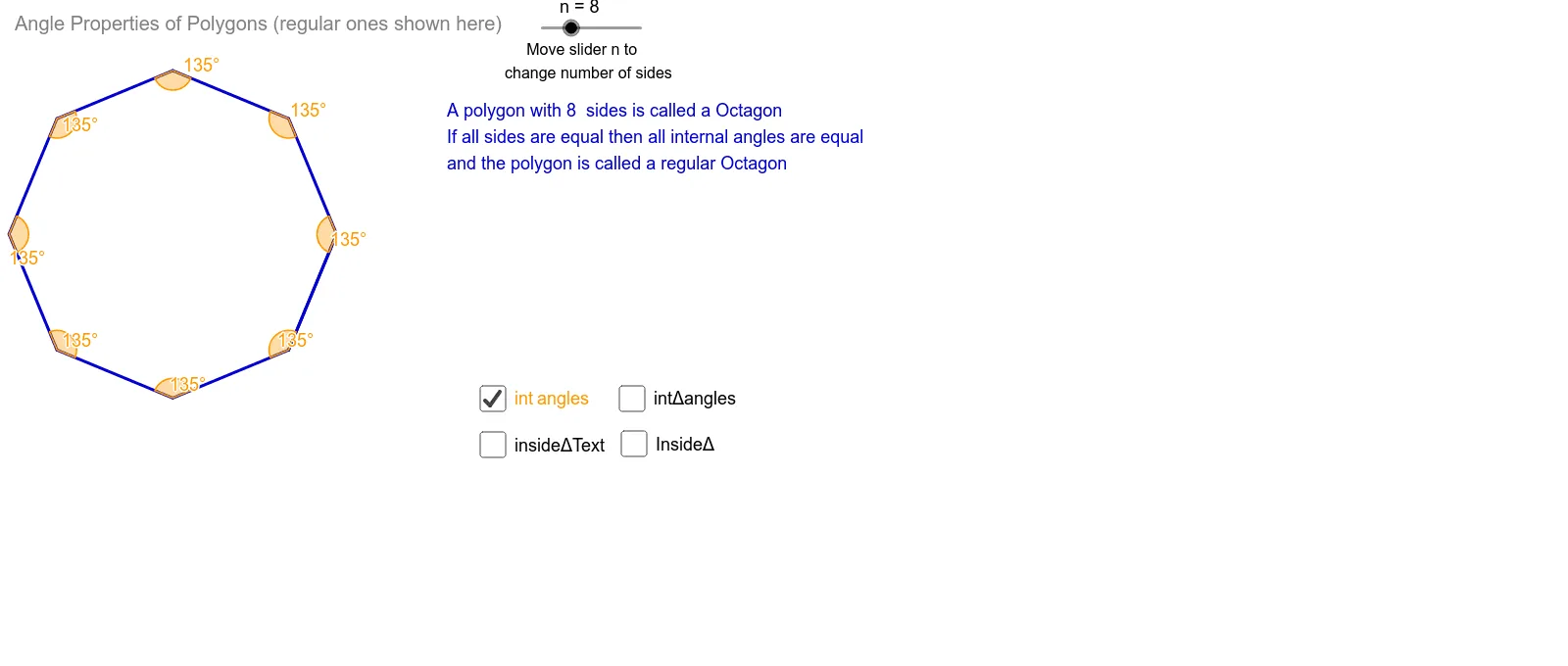
This GeoGebra example dynamically demonstrates how the interior angles of regular polygons change as the number of sides increases. The core mathematical concepts include the sum of interior angles formula (n-2)×180° and each interior angle being (n-2)×180°/n, along with the relationship between interior and exterior angles (supplementary). The construction uses commands such as Intersect, Segment, Ray, Sequence, and Angle to build polygon vertices, edges, rays, and angle objects. A slider n controls the number of sides, generating a list of polygons from triangle to icosagon (PolygonNamelist3to20), and computes both internal angles (InternalAnglesPolygon) and external angles (ExternalAnglesPolygon) with distinct color coding. This is suitable for middle school geometry classes to visually explore the angle formula, and also useful for high school review or math lab activities, allowing students to drag the slider and observe angle changes to foster inductive reasoning.
GeoGebra Commands & Parameters
Intersect(xAxis, yAxis) → ASegment(A, P) → aSegment((3.9999999999999933; 15°), (4; 30°)) → cSegment(C, D) → dRay(C, B) → bRay(B, C) → eSequence(Segment[(r; i°), (r; (i - 360 / n)°)], i, 0, 360, 360 / n) → EdgesofPolygonSequence(Ray[(r; i°), (r; (i - 360 / n)°)], i, 0, 360, 360 / n) → RaysofEdgesSequence(Angle[Element[RaysofEdges, i], Element[RaysofEdges, i + 1]], i, 1, n, 1) → ExternalAnglesPolygonSequence(Angle[Element[RaysofEdges, i], Element[RaysofEdges, i + 1]], i, 1, n, 1) → ExternalAnglesAngle(Element[RaysofEdges, 1], Element[RaysofEdges, 2]) → γAngle(Element[RaysofEdges, 2], Element[RaysofEdges, 3]) → δAngle(Element[RaysofEdges, 5], Element[RaysofEdges, 6]) → ηAngle(Element[RaysofEdges, 3], Element[RaysofEdges, 4]) → εAngle(Element[RaysofEdges, 4], Element[RaysofEdges, 5]) → ζAngle(Element[RaysofEdges, 6], Element[RaysofEdges, 7]) → θAngle(Element[RaysofEdges, 7], Element[RaysofEdges, 8]) → ιAngle(Element[RaysofEdges, 8], Element[RaysofEdges, 9]) → κAngle(Element[RaysofEdges, 9], Element[RaysofEdges, 10]) → λAngle(Element[RaysofEdges, 10], Element[RaysofEdges, 11]) → μAngle(Element[RaysofEdges, 11], Element[RaysofEdges, 12]) → νAngle(Element[RaysofEdges, 12], Element[RaysofEdges, 13]) → ξAngle(Element[RaysofEdges, 13], Element[RaysofEdges, 14]) → οAngle(Element[RaysofEdges, 14], Element[RaysofEdges, 15]) → ρAngle(Element[RaysofEdges, 15], Element[RaysofEdges, 16]) → σAngle(Element[RaysofEdges, 16], Element[RaysofEdges, 17]) → τAngle(Element[RaysofEdges, 17], Element[RaysofEdges, 18]) → υAngle(Element[RaysofEdges, 18], Element[RaysofEdges, 19]) → φAngle(Element[RaysofEdges, 19], Element[RaysofEdges, 20]) → χAngle(Element[RaysofEdges, 20], Element[RaysofEdges, 1]) → βSequence((r; i°), i, 0, 360, 360 / n) → VerticesPolygonSequence(Angle[(r; (i + (360 * 2 / n))°), (r; (i + 360 / n)°), (r; i°)], i, 0, 360, 360 / n) → InternalAnglesPolygonAngle(Element[VerticesPolygon, 3], Element[VerticesPolygon, 2], Element[VerticesPolygon, 1]) → α_1Angle(Element[VerticesPolygon, 4], Element[VerticesPolygon, 3], Element[VerticesPolygon, 2]) → β_2Angle(Element[VerticesPolygon, 5], Element[VerticesPolygon, 4], Element[VerticesPolygon, 3]) → ψAngle(Element[VerticesPolygon, 6], Element[VerticesPolygon, 5], Element[VerticesPolygon, 4]) → ωAngle(Element[VerticesPolygon, 7], Element[VerticesPolygon, 6], Element[VerticesPolygon, 5]) → β_1Angle(Element[VerticesPolygon, 8], Element[VerticesPolygon, 7], Element[VerticesPolygon, 6]) → γ_1Angle(Element[VerticesPolygon, 9], Element[VerticesPolygon, 8], Element[VerticesPolygon, 7]) → δ_1Angle(Element[VerticesPolygon, 10], Element[VerticesPolygon, 9], Element[VerticesPolygon, 8]) → ε_1Angle(Element[VerticesPolygon, 11], Element[VerticesPolygon, 10], Element[VerticesPolygon, 9]) → ζ_4Angle(Element[VerticesPolygon, 13], Element[VerticesPolygon, 12], Element[VerticesPolygon, 11]) → η_1Angle(Element[VerticesPolygon, 12], Element[VerticesPolygon, 11], Element[VerticesPolygon, 10]) → θ_1Angle(Element[VerticesPolygon, 2], Element[VerticesPolygon, 1], Element[VerticesPolygon, n]) → ι_1Angle(Element[VerticesPolygon, 14], Element[VerticesPolygon, 13], Element[VerticesPolygon, 12]) → κ_1Angle(Element[VerticesPolygon, 15], Element[VerticesPolygon, 14], Element[VerticesPolygon, 13]) → λ_1Angle(Element[VerticesPolygon, 16], Element[VerticesPolygon, 15], Element[VerticesPolygon, 14]) → μ_1Angle(Element[VerticesPolygon, 17], Element[VerticesPolygon, 16], Element[VerticesPolygon, 15]) → ν_1Angle(Element[VerticesPolygon, 18], Element[VerticesPolygon, 17], Element[VerticesPolygon, 16]) → ξ_1Angle(Element[VerticesPolygon, 19], Element[VerticesPolygon, 18], Element[VerticesPolygon, 17]) → ο_1Angle(Element[VerticesPolygon, 20], Element[VerticesPolygon, 19], Element[VerticesPolygon, 18]) → ρ_1Angle(Element[VerticesPolygon, 1], Element[VerticesPolygon, 20], Element[VerticesPolygon, 19]) → σ_1Sequence(Segment[(r; 0°), (r; (i + 360 / n)°)], i, 360 / n, 360, 360 / n) → InsideTrianglesAngle(Element[VerticesPolygon, 2], Element[VerticesPolygon, 1], Element[VerticesPolygon, 3]) → Δu_2Angle(Element[VerticesPolygon, 3], Element[VerticesPolygon, 2], Element[VerticesPolygon, 1]) → ΔuAngle(Element[VerticesPolygon, 1], Element[VerticesPolygon, n], Element[VerticesPolygon, n - 1]) → Δφ_1Angle(Element[VerticesPolygon, 3], Element[VerticesPolygon, 1], Element[VerticesPolygon, 4]) → Δχ_1Angle(Element[VerticesPolygon, 4], Element[VerticesPolygon, 1], Element[VerticesPolygon, 5]) → Δψ_1Angle(Element[VerticesPolygon, 5], Element[VerticesPolygon, 1], Element[VerticesPolygon, 6]) → Δω_1Angle(Element[VerticesPolygon, 6], Element[VerticesPolygon, 1], Element[VerticesPolygon, 7]) → Δα_2Angle(Element[VerticesPolygon, 7], Element[VerticesPolygon, 1], Element[VerticesPolygon, 8]) → Δγ_2Angle(Element[VerticesPolygon, 8], Element[VerticesPolygon, 1], Element[VerticesPolygon, 9]) → Δδ_2Angle(Element[VerticesPolygon, 9], Element[VerticesPolygon, 1], Element[VerticesPolygon, 10]) → Δε_2Angle(Element[VerticesPolygon, 10], Element[VerticesPolygon, 1], Element[VerticesPolygon, 11]) → Δζ_2Angle(Element[VerticesPolygon, 11], Element[VerticesPolygon, 1], Element[VerticesPolygon, 12]) → Δη_2Angle(Element[VerticesPolygon, 12], Element[VerticesPolygon, 1], Element[VerticesPolygon, 13]) → Δθ_2Angle(Element[VerticesPolygon, 13], Element[VerticesPolygon, 1], Element[VerticesPolygon, 14]) → Δι_2Angle(Element[VerticesPolygon, 14], Element[VerticesPolygon, 1], Element[VerticesPolygon, 15]) → Δκ_2Angle(Element[VerticesPolygon, 15], Element[VerticesPolygon, 1], Element[VerticesPolygon, 16]) → Δλ_2Angle(Element[VerticesPolygon, 16], Element[VerticesPolygon, 1], Element[VerticesPolygon, 17]) → Δμ_2Angle(Element[VerticesPolygon, 17], Element[VerticesPolygon, 1], Element[VerticesPolygon, 18]) → Δν_2Angle(Element[VerticesPolygon, 18], Element[VerticesPolygon, 1], Element[VerticesPolygon, 19]) → Δξ_2Angle(Element[VerticesPolygon, 19], Element[VerticesPolygon, 1], Element[VerticesPolygon, 20]) → Δο_2Angle(Element[VerticesPolygon, 1], Element[VerticesPolygon, 3], Element[VerticesPolygon, 2]) → Δu_3Angle(Element[VerticesPolygon, 4], Element[VerticesPolygon, 3], Element[VerticesPolygon, 1]) → Δσ_2Angle(Element[VerticesPolygon, 1], Element[VerticesPolygon, 4], Element[VerticesPolygon, 3]) → Δτ_2Angle(Element[VerticesPolygon, 1], Element[VerticesPolygon, 5], Element[VerticesPolygon, 4]) → Δυ_2Angle(Element[VerticesPolygon, 1], Element[VerticesPolygon, 6], Element[VerticesPolygon, 5]) → Δφ_2Angle(Element[VerticesPolygon, 1], Element[VerticesPolygon, 7], Element[VerticesPolygon, 6]) → Δχ_2Angle(Element[VerticesPolygon, 1], Element[VerticesPolygon, 8], Element[VerticesPolygon, 7]) → Δψ_2Angle(Element[VerticesPolygon, 1], Element[VerticesPolygon, 9], Element[VerticesPolygon, 8]) → Δω_2Angle(Element[VerticesPolygon, 1], Element[VerticesPolygon, 10], Element[VerticesPolygon, 9]) → Δα_3Angle(Element[VerticesPolygon, 1], Element[VerticesPolygon, 11], Element[VerticesPolygon, 10]) → Δβ_3Angle(Element[VerticesPolygon, 1], Element[VerticesPolygon, 12], Element[VerticesPolygon, 11]) → Δγ_3Angle(Element[VerticesPolygon, 1], Element[VerticesPolygon, 13], Element[VerticesPolygon, 12]) → Δδ_3Angle(Element[VerticesPolygon, 1], Element[VerticesPolygon, 14], Element[VerticesPolygon, 13]) → Δε_3Angle(Element[VerticesPolygon, 1], Element[VerticesPolygon, 16], Element[VerticesPolygon, 15]) → Δη_3Angle(Element[VerticesPolygon, 1], Element[VerticesPolygon, 17], Element[VerticesPolygon, 16]) → Δθ_3Angle(Element[VerticesPolygon, 1], Element[VerticesPolygon, 18], Element[VerticesPolygon, 17]) → Δι_3Angle(Element[VerticesPolygon, 1], Element[VerticesPolygon, 19], Element[VerticesPolygon, 18]) → Δκ_3Angle(Element[VerticesPolygon, 1], Element[VerticesPolygon, 20], Element[VerticesPolygon, 19]) → Δλ_3Angle(Element[VerticesPolygon, 5], Element[VerticesPolygon, 4], Element[VerticesPolygon, 1]) → Δμ_3Angle(Element[VerticesPolygon, 7], Element[VerticesPolygon, 6], Element[VerticesPolygon, 1]) → Δξ_3Angle(Element[VerticesPolygon, 8], Element[VerticesPolygon, 7], Element[VerticesPolygon, 1]) → Δο_3Angle(Element[VerticesPolygon, 9], Element[VerticesPolygon, 8], Element[VerticesPolygon, 1]) → Δρ_3Angle(Element[VerticesPolygon, 10], Element[VerticesPolygon, 9], Element[VerticesPolygon, 1]) → Δσ_3Angle(Element[VerticesPolygon, 11], Element[VerticesPolygon, 10], Element[VerticesPolygon, 1]) → Δτ_3Angle(Element[VerticesPolygon, 12], Element[VerticesPolygon, 11], Element[VerticesPolygon, 1]) → Δυ_3Angle(Element[VerticesPolygon, 13], Element[VerticesPolygon, 12], Element[VerticesPolygon, 1]) → Δφ_3Angle(Element[VerticesPolygon, 14], Element[VerticesPolygon, 13], Element[VerticesPolygon, 1]) → Δχ_3Angle(Element[VerticesPolygon, 15], Element[VerticesPolygon, 14], Element[VerticesPolygon, 1]) → Δψ_3Angle(Element[VerticesPolygon, 16], Element[VerticesPolygon, 15], Element[VerticesPolygon, 1]) → Δω_3Angle(Element[VerticesPolygon, 17], Element[VerticesPolygon, 16], Element[VerticesPolygon, 1]) → Δα_4Angle(Element[VerticesPolygon, 18], Element[VerticesPolygon, 17], Element[VerticesPolygon, 1]) → Δβ_4Angle(Element[VerticesPolygon, 19], Element[VerticesPolygon, 18], Element[VerticesPolygon, 1]) → Δγ_4Angle(Element[VerticesPolygon, 20], Element[VerticesPolygon, 19], Element[VerticesPolygon, 1]) → Δδ_4Angle(Element[VerticesPolygon, 7], Element[VerticesPolygon, 6], Element[VerticesPolygon, 1]) → Δζ_5Angle(Element[VerticesPolygon, 6], Element[VerticesPolygon, 5], Element[VerticesPolygon, 1]) → Δτ_1Angle(Element[VerticesPolygon, 1], Element[VerticesPolygon, 15], Element[VerticesPolygon, 14]) → Δζ_1
AI Drawing Prompt Reference
Draw a regular polygon with a variable number of sides controlled by a slider, ranging from triangle to icosagon. The polygon is centered at the origin with vertices evenly spaced on a circle. Extend rays from each vertex along the edges outward to form exterior angles. Mark each interior and exterior angle with arcs, using distinct color sets for interior vs exterior angles. Include horizontal and vertical axes, and a segment from the center to one vertex. As the slider changes, all angles and side count update together, visually demonstrating the interior angle sum formula.
The prompt above was compiled from the original drawing commands and is for reference only.