
Angle Properties of Polygons: Interior, Exterior, and Dynamic Exploration
Loading the math board and drawing, please wait…
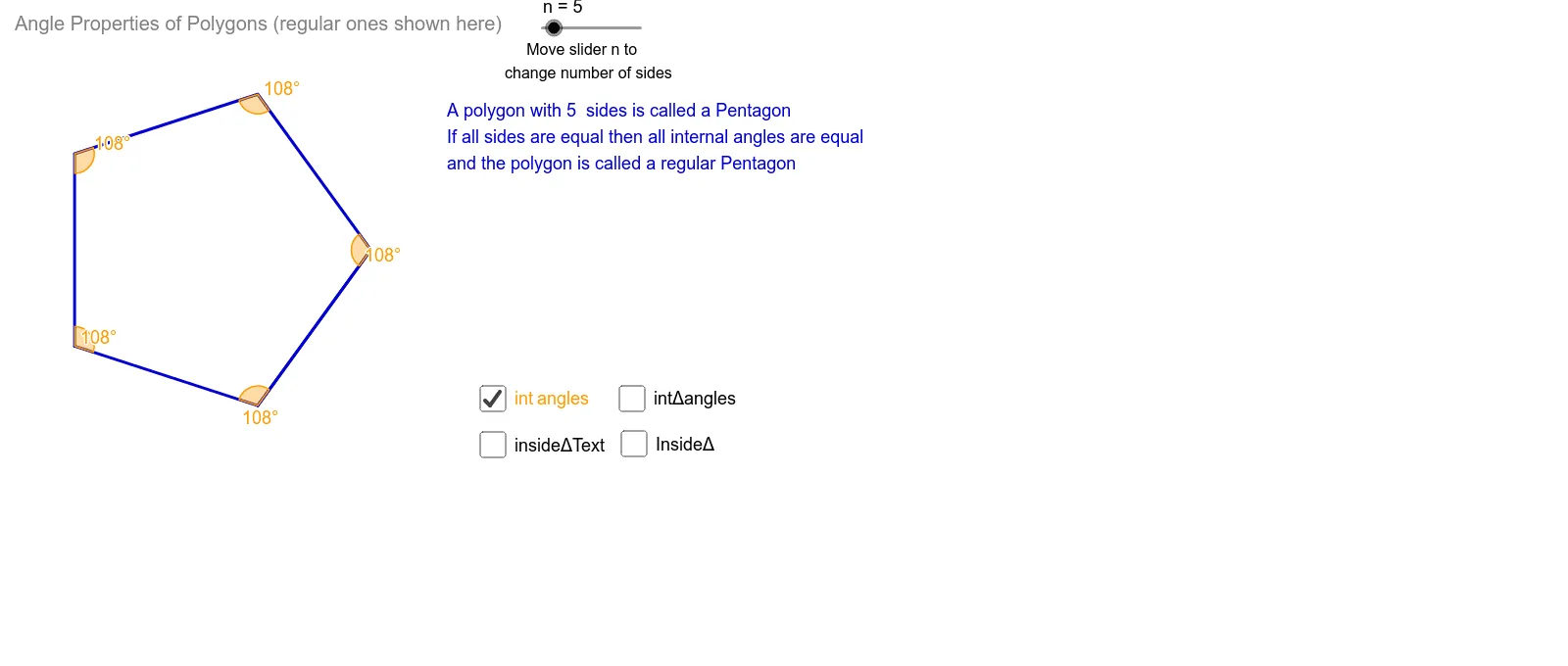
① This GeoGebra example dynamically demonstrates the angle properties of polygons with 3 to 20 sides, showing that the sum of interior angles and exterior angles follow fixed rules regardless of the number of sides. ② Core mathematical concepts include the interior angle sum formula (n-2)×180°, the constant exterior angle sum of 360°, the supplementary relationship between interior and exterior angles, and angle characteristics of regular versus general polygons. ③ Construction highlights: using commands such as Intersect, Segment, Ray, Sequence, and Angle to build polygon vertices, edges, rays, and exterior angles; a slider n controls the number of sides, generating vertex lists (VerticesPolygon), edge lists (EdgesofPolygon), interior angle lists (InternalAnglesPolygon), and exterior angle lists (ExternalAnglesPolygon) with live updates. ④ Suitable for middle and high school geometry classes, ideal for verifying formulas, exploring angle relationships, and serving as an interactive teaching or self-study tool.
GeoGebra Commands & Parameters
Intersect(xAxis, yAxis) → ASegment(A, P) → aSegment((3.9999999999999933; 15°), (4; 30°)) → cSegment(C, D) → dRay(C, B) → bRay(B, C) → eSequence(Segment[(r; i°), (r; (i - 360 / n)°)], i, 0, 360, 360 / n) → EdgesofPolygonSequence(Ray[(r; i°), (r; (i - 360 / n)°)], i, 0, 360, 360 / n) → RaysofEdgesSequence(Angle[Element[RaysofEdges, i], Element[RaysofEdges, i + 1]], i, 1, n, 1) → ExternalAnglesPolygonSequence(Angle[Element[RaysofEdges, i], Element[RaysofEdges, i + 1]], i, 1, n, 1) → ExternalAnglesAngle(Element[RaysofEdges, 1], Element[RaysofEdges, 2]) → γAngle(Element[RaysofEdges, 2], Element[RaysofEdges, 3]) → δAngle(Element[RaysofEdges, 5], Element[RaysofEdges, 6]) → ηAngle(Element[RaysofEdges, 3], Element[RaysofEdges, 4]) → εAngle(Element[RaysofEdges, 4], Element[RaysofEdges, 5]) → ζAngle(Element[RaysofEdges, 6], Element[RaysofEdges, 7]) → θAngle(Element[RaysofEdges, 7], Element[RaysofEdges, 8]) → ιAngle(Element[RaysofEdges, 8], Element[RaysofEdges, 9]) → κAngle(Element[RaysofEdges, 9], Element[RaysofEdges, 10]) → λAngle(Element[RaysofEdges, 10], Element[RaysofEdges, 11]) → μAngle(Element[RaysofEdges, 11], Element[RaysofEdges, 12]) → νAngle(Element[RaysofEdges, 12], Element[RaysofEdges, 13]) → ξAngle(Element[RaysofEdges, 13], Element[RaysofEdges, 14]) → οAngle(Element[RaysofEdges, 14], Element[RaysofEdges, 15]) → ρAngle(Element[RaysofEdges, 15], Element[RaysofEdges, 16]) → σAngle(Element[RaysofEdges, 16], Element[RaysofEdges, 17]) → τAngle(Element[RaysofEdges, 17], Element[RaysofEdges, 18]) → υAngle(Element[RaysofEdges, 18], Element[RaysofEdges, 19]) → φAngle(Element[RaysofEdges, 19], Element[RaysofEdges, 20]) → χAngle(Element[RaysofEdges, 20], Element[RaysofEdges, 1]) → βSequence((r; i°), i, 0, 360, 360 / n) → VerticesPolygonSequence(Angle[(r; (i + (360 * 2 / n))°), (r; (i + 360 / n)°), (r; i°)], i, 0, 360, 360 / n) → InternalAnglesPolygonAngle(Element[VerticesPolygon, 3], Element[VerticesPolygon, 2], Element[VerticesPolygon, 1]) → α_1Angle(Element[VerticesPolygon, 4], Element[VerticesPolygon, 3], Element[VerticesPolygon, 2]) → β_2Angle(Element[VerticesPolygon, 5], Element[VerticesPolygon, 4], Element[VerticesPolygon, 3]) → ψAngle(Element[VerticesPolygon, 6], Element[VerticesPolygon, 5], Element[VerticesPolygon, 4]) → ωAngle(Element[VerticesPolygon, 7], Element[VerticesPolygon, 6], Element[VerticesPolygon, 5]) → β_1Angle(Element[VerticesPolygon, 8], Element[VerticesPolygon, 7], Element[VerticesPolygon, 6]) → γ_1Angle(Element[VerticesPolygon, 9], Element[VerticesPolygon, 8], Element[VerticesPolygon, 7]) → δ_1Angle(Element[VerticesPolygon, 10], Element[VerticesPolygon, 9], Element[VerticesPolygon, 8]) → ε_1Angle(Element[VerticesPolygon, 11], Element[VerticesPolygon, 10], Element[VerticesPolygon, 9]) → ζ_4Angle(Element[VerticesPolygon, 13], Element[VerticesPolygon, 12], Element[VerticesPolygon, 11]) → η_1Angle(Element[VerticesPolygon, 12], Element[VerticesPolygon, 11], Element[VerticesPolygon, 10]) → θ_1Angle(Element[VerticesPolygon, 2], Element[VerticesPolygon, 1], Element[VerticesPolygon, n]) → ι_1Angle(Element[VerticesPolygon, 14], Element[VerticesPolygon, 13], Element[VerticesPolygon, 12]) → κ_1Angle(Element[VerticesPolygon, 15], Element[VerticesPolygon, 14], Element[VerticesPolygon, 13]) → λ_1Angle(Element[VerticesPolygon, 16], Element[VerticesPolygon, 15], Element[VerticesPolygon, 14]) → μ_1Angle(Element[VerticesPolygon, 17], Element[VerticesPolygon, 16], Element[VerticesPolygon, 15]) → ν_1Angle(Element[VerticesPolygon, 18], Element[VerticesPolygon, 17], Element[VerticesPolygon, 16]) → ξ_1Angle(Element[VerticesPolygon, 19], Element[VerticesPolygon, 18], Element[VerticesPolygon, 17]) → ο_1Angle(Element[VerticesPolygon, 20], Element[VerticesPolygon, 19], Element[VerticesPolygon, 18]) → ρ_1Angle(Element[VerticesPolygon, 1], Element[VerticesPolygon, 20], Element[VerticesPolygon, 19]) → σ_1Sequence(Segment[(r; 0°), (r; (i + 360 / n)°)], i, 360 / n, 360, 360 / n) → InsideTrianglesAngle(Element[VerticesPolygon, 2], Element[VerticesPolygon, 1], Element[VerticesPolygon, 3]) → Δu_2Angle(Element[VerticesPolygon, 3], Element[VerticesPolygon, 2], Element[VerticesPolygon, 1]) → ΔuAngle(Element[VerticesPolygon, 1], Element[VerticesPolygon, n], Element[VerticesPolygon, n - 1]) → Δφ_1Angle(Element[VerticesPolygon, 3], Element[VerticesPolygon, 1], Element[VerticesPolygon, 4]) → Δχ_1Angle(Element[VerticesPolygon, 4], Element[VerticesPolygon, 1], Element[VerticesPolygon, 5]) → Δψ_1Angle(Element[VerticesPolygon, 5], Element[VerticesPolygon, 1], Element[VerticesPolygon, 6]) → Δω_1Angle(Element[VerticesPolygon, 6], Element[VerticesPolygon, 1], Element[VerticesPolygon, 7]) → Δα_2Angle(Element[VerticesPolygon, 7], Element[VerticesPolygon, 1], Element[VerticesPolygon, 8]) → Δγ_2Angle(Element[VerticesPolygon, 8], Element[VerticesPolygon, 1], Element[VerticesPolygon, 9]) → Δδ_2Angle(Element[VerticesPolygon, 9], Element[VerticesPolygon, 1], Element[VerticesPolygon, 10]) → Δε_2Angle(Element[VerticesPolygon, 10], Element[VerticesPolygon, 1], Element[VerticesPolygon, 11]) → Δζ_2Angle(Element[VerticesPolygon, 11], Element[VerticesPolygon, 1], Element[VerticesPolygon, 12]) → Δη_2Angle(Element[VerticesPolygon, 12], Element[VerticesPolygon, 1], Element[VerticesPolygon, 13]) → Δθ_2Angle(Element[VerticesPolygon, 13], Element[VerticesPolygon, 1], Element[VerticesPolygon, 14]) → Δι_2Angle(Element[VerticesPolygon, 14], Element[VerticesPolygon, 1], Element[VerticesPolygon, 15]) → Δκ_2Angle(Element[VerticesPolygon, 15], Element[VerticesPolygon, 1], Element[VerticesPolygon, 16]) → Δλ_2Angle(Element[VerticesPolygon, 16], Element[VerticesPolygon, 1], Element[VerticesPolygon, 17]) → Δμ_2Angle(Element[VerticesPolygon, 17], Element[VerticesPolygon, 1], Element[VerticesPolygon, 18]) → Δν_2Angle(Element[VerticesPolygon, 18], Element[VerticesPolygon, 1], Element[VerticesPolygon, 19]) → Δξ_2Angle(Element[VerticesPolygon, 19], Element[VerticesPolygon, 1], Element[VerticesPolygon, 20]) → Δο_2Angle(Element[VerticesPolygon, 1], Element[VerticesPolygon, 3], Element[VerticesPolygon, 2]) → Δu_3Angle(Element[VerticesPolygon, 4], Element[VerticesPolygon, 3], Element[VerticesPolygon, 1]) → Δσ_2Angle(Element[VerticesPolygon, 1], Element[VerticesPolygon, 4], Element[VerticesPolygon, 3]) → Δτ_2Angle(Element[VerticesPolygon, 1], Element[VerticesPolygon, 5], Element[VerticesPolygon, 4]) → Δυ_2Angle(Element[VerticesPolygon, 1], Element[VerticesPolygon, 6], Element[VerticesPolygon, 5]) → Δφ_2Angle(Element[VerticesPolygon, 1], Element[VerticesPolygon, 7], Element[VerticesPolygon, 6]) → Δχ_2Angle(Element[VerticesPolygon, 1], Element[VerticesPolygon, 8], Element[VerticesPolygon, 7]) → Δψ_2Angle(Element[VerticesPolygon, 1], Element[VerticesPolygon, 9], Element[VerticesPolygon, 8]) → Δω_2Angle(Element[VerticesPolygon, 1], Element[VerticesPolygon, 10], Element[VerticesPolygon, 9]) → Δα_3Angle(Element[VerticesPolygon, 1], Element[VerticesPolygon, 11], Element[VerticesPolygon, 10]) → Δβ_3Angle(Element[VerticesPolygon, 1], Element[VerticesPolygon, 12], Element[VerticesPolygon, 11]) → Δγ_3Angle(Element[VerticesPolygon, 1], Element[VerticesPolygon, 13], Element[VerticesPolygon, 12]) → Δδ_3Angle(Element[VerticesPolygon, 1], Element[VerticesPolygon, 14], Element[VerticesPolygon, 13]) → Δε_3Angle(Element[VerticesPolygon, 1], Element[VerticesPolygon, 16], Element[VerticesPolygon, 15]) → Δη_3Angle(Element[VerticesPolygon, 1], Element[VerticesPolygon, 17], Element[VerticesPolygon, 16]) → Δθ_3Angle(Element[VerticesPolygon, 1], Element[VerticesPolygon, 18], Element[VerticesPolygon, 17]) → Δι_3Angle(Element[VerticesPolygon, 1], Element[VerticesPolygon, 19], Element[VerticesPolygon, 18]) → Δκ_3Angle(Element[VerticesPolygon, 1], Element[VerticesPolygon, 20], Element[VerticesPolygon, 19]) → Δλ_3Angle(Element[VerticesPolygon, 5], Element[VerticesPolygon, 4], Element[VerticesPolygon, 1]) → Δμ_3Angle(Element[VerticesPolygon, 7], Element[VerticesPolygon, 6], Element[VerticesPolygon, 1]) → Δξ_3Angle(Element[VerticesPolygon, 8], Element[VerticesPolygon, 7], Element[VerticesPolygon, 1]) → Δο_3Angle(Element[VerticesPolygon, 9], Element[VerticesPolygon, 8], Element[VerticesPolygon, 1]) → Δρ_3Angle(Element[VerticesPolygon, 10], Element[VerticesPolygon, 9], Element[VerticesPolygon, 1]) → Δσ_3Angle(Element[VerticesPolygon, 11], Element[VerticesPolygon, 10], Element[VerticesPolygon, 1]) → Δτ_3Angle(Element[VerticesPolygon, 12], Element[VerticesPolygon, 11], Element[VerticesPolygon, 1]) → Δυ_3Angle(Element[VerticesPolygon, 13], Element[VerticesPolygon, 12], Element[VerticesPolygon, 1]) → Δφ_3Angle(Element[VerticesPolygon, 14], Element[VerticesPolygon, 13], Element[VerticesPolygon, 1]) → Δχ_3Angle(Element[VerticesPolygon, 15], Element[VerticesPolygon, 14], Element[VerticesPolygon, 1]) → Δψ_3Angle(Element[VerticesPolygon, 16], Element[VerticesPolygon, 15], Element[VerticesPolygon, 1]) → Δω_3Angle(Element[VerticesPolygon, 17], Element[VerticesPolygon, 16], Element[VerticesPolygon, 1]) → Δα_4Angle(Element[VerticesPolygon, 18], Element[VerticesPolygon, 17], Element[VerticesPolygon, 1]) → Δβ_4Angle(Element[VerticesPolygon, 19], Element[VerticesPolygon, 18], Element[VerticesPolygon, 1]) → Δγ_4Angle(Element[VerticesPolygon, 20], Element[VerticesPolygon, 19], Element[VerticesPolygon, 1]) → Δδ_4Angle(Element[VerticesPolygon, 7], Element[VerticesPolygon, 6], Element[VerticesPolygon, 1]) → Δζ_5Angle(Element[VerticesPolygon, 6], Element[VerticesPolygon, 5], Element[VerticesPolygon, 1]) → Δτ_1Angle(Element[VerticesPolygon, 1], Element[VerticesPolygon, 15], Element[VerticesPolygon, 14]) → Δζ_1
AI Drawing Prompt Reference
Draw a polygon with a variable number of sides from 3 to 20, demonstrating its interior and exterior angle properties. Start by drawing a point A at the intersection of the x-axis and y-axis, then draw a side a from point A. Next, draw another side c, and sides d and e. Use the sequence command to draw all sides and exterior angles of the polygon, and generate the interior angles. Finally, adjust the number of sides n to dynamically show the changes in interior and exterior angles.
The prompt above was compiled from the original drawing commands and is for reference only.