
Visualizing Why HCF Determines Squares Fitting a Rectangle
Loading the math board and drawing, please wait…
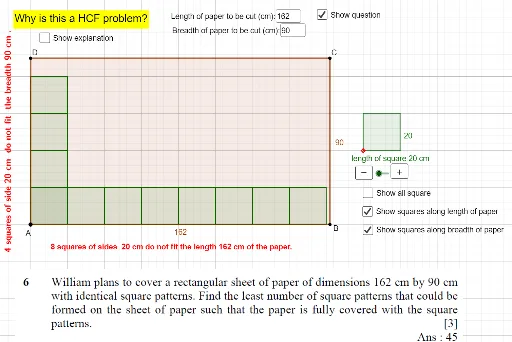
This interactive GeoGebra activity demonstrates why the highest common factor (HCF) of a rectangle's length and breadth gives the side length of the largest square that can tile the rectangle perfectly. It visualizes the relationship between factors, common factors, and square tiling. The construction uses Textfield and InputBox for user input of length and breadth, Polygon to draw the rectangle, Sequence and If to generate and arrange square grids, and RotateText for labeling. Key objects include pic1, A, l, b, s, B, C, D, q1, a, b_1, c, d, E, q2, e, f, g, h, l1, l2, i, j, k, l3, sqfitlength, sqfitbreadth, text2, text3, text4, m, text5, n, text7, text1, button1, button2, and isGCD. Suitable for upper primary and middle school students learning factors and HCF, and for teachers to illustrate the concept geometrically before formal number theory.
GeoGebra Commands & Parameters
Textfield(l) → InputBox1Textfield(b) → InputBox2Polygon(A, B, C, D) → q1, a, b_1, c, dPolygon(E, (x(E) + s, y(E)), (x(E) + s, y(E) + s), (x(E), y(E) + s)) → q2, e, f, g, hSequence(Sequence[Polygon[(u, v), (u + s, v), (u + s, v + s), (u, v + s)], u, 0, l - s, s], v, 0, b - s, s) → l1Sequence(Sequence[Polygon[(u, v), (u + s, v), (u + s, v + s), (u, v + s)], u, 0, l - s, s], v, 0, 0, s) → l2Sequence(Sequence[Polygon[(u, v), (u + s, v), (u + s, v + s), (u, v + s)], u, 0, 0, s], v, 0, b - s, s) → l3If(l / s - floor(l / s) ≟ 0, true, false) → sqfitlengthIf(b / s - floor(b / s) ≟ 0, true, false) → sqfitbreadthRotateText(text2, 90°) → text3If(s ≟ GCD[l, b], true, false) → isGCD
AI Drawing Prompt Reference
Draw a rectangle with adjustable length and breadth via two input fields. Inside the rectangle, tile it completely with squares whose side length equals the greatest common factor (HCF) of the length and breadth, starting from the top-left corner. Also, draw a single square of that side length at the top-left corner, and label its side length. Display text indicating whether this side length equals the HCF and whether the length and breadth are divisible by it. Add a rotated label explaining that the HCF determines the largest square that fits the rectangle.
The prompt above was compiled from the original drawing commands and is for reference only.