
Visualizing the n-th Tetrahedral Number
Loading the math board and drawing, please wait…
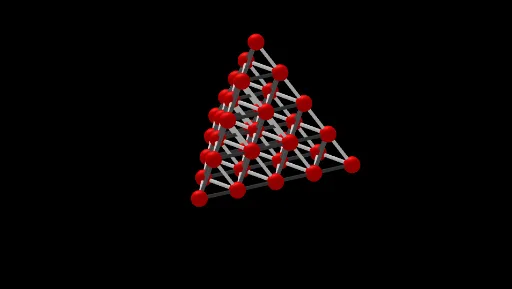
This GeoGebra example dynamically illustrates the n-th tetrahedral number, a polyhedral number representing the total number of spheres needed to form a tetrahedral stack. The formula is T_n = n(n+1)(n+2)/6, which can be seen as the sum of the first n triangular numbers. The construction uses parametric curves, sequences, and point objects to build layered arrays of points, showing how each layer corresponds to a triangular number. Key commands include Sequence, Join, and Point, along with multiple lists (L1 to L7) and auxiliary objects (O, n, h, E, p, q, r, etc.) to generate the 3D-like point arrangement. Text objects display the formula and current value. A slider for n allows real-time exploration of how the tetrahedral number grows. This resource is suitable for high school or early college students studying sequences, series, polyhedral numbers, and parametric construction, and can be used for interactive math experiments or classroom demonstrations.
GeoGebra Commands & Parameters
Sequence(Sequence[Sequence[E + (i * p) + (j * ((-p) + q)) + (k * ((-q) + r_1)), k, 0, j], j, 0, i], i, 0, n) → L1Sequence(Sequence[Sequence[Segment[Element[Element[Element[L1, i], j], k], Element[Element[Element[L1, i], j], k + 1]], k, 1, j], j, 1, i], i, 1, n + 1) → L2Sequence(Sequence[Sequence[Segment[Element[Element[Element[L1, i], j], k], Element[Element[Element[L1, i], j + 1], k]], k, 1, j], j, 1, i], i, 1, n + 1) → L3Sequence(Sequence[Sequence[Segment[Element[Element[Element[L1, i], j], k], Element[Element[Element[L1, i], j + 1], k + 1]], k, 1, j], j, 1, i], i, 1, n + 1) → L4Sequence(Sequence[Sequence[Segment[Element[Element[Element[L1, i], j], k], Element[Element[Element[L1, i + 1], j], k]], k, 1, j], j, 1, i], i, 1, n + 1) → L5Sequence(Sequence[Sequence[Segment[Element[Element[Element[L1, i], j], k], Element[Element[Element[L1, i + 1], j + 1], k]], k, 1, j], j, 1, i], i, 1, n) → L6Sequence(Sequence[Sequence[Segment[Element[Element[Element[L1, i], j], k], Element[Element[Element[L1, i + 1], j + 1], k + 1]], k, 1, j], j, 1, i], i, 1, n + 1) → L7Join(L1) → l1Join(l1) → l3Sequence(Sphere[Element[l3, i], r], i, 1, Length[l3]) → l2Point(l3) → A