
Visualizing Solids of Revolution and Volumes by Lila Roberts
Loading the math board and drawing, please wait…
In collections
Visualizing Solids of Revolution and Volumes
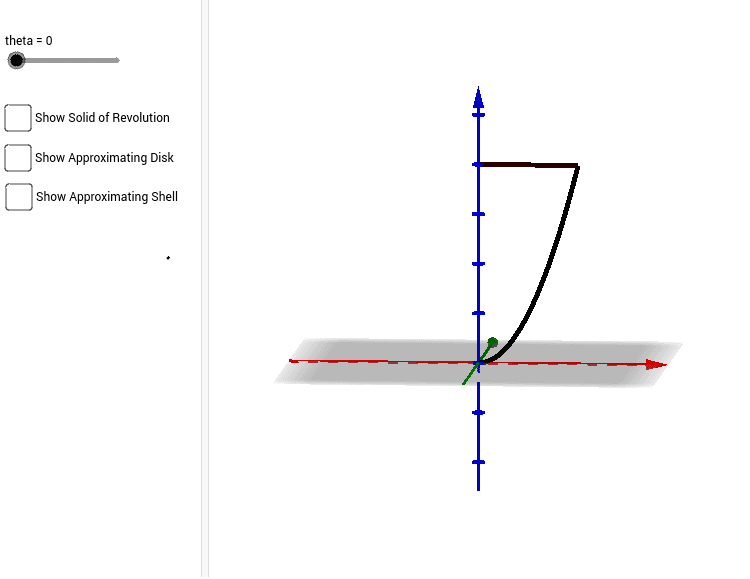
This GeoGebra applet visualizes the solid of revolution generated by revolving the region bounded by the y-axis, y=4, and f(x)=x^2 around the y-axis. Key mathematical concepts include solids of revolution and volume calculation. Constructed using commands like CurveCartesian, Surface, and Polygon. Suitable for high school math education and learning.
GeoGebra Commands & Parameters
CurveCartesian(t, 0, t^(2), t, 0, 2) → aCurveCartesian(t, 0, 4, t, 0, 2) → bSurface((t * cos(s)), (t * sin(s)), t^(2), t, 0, 2, s, 0, theta) → eCurveCartesian((t * cos(theta)), (t * sin(theta)), 4, t, 0, 2) → dSurface((t * cos(s)), (t * sin(s)), 4, t, 0, 2, s, 0, theta) → cPolygon((0.5, 0, 0.5^(2)), (0.7, 0, 0.5^(2)), (0.7, 0, 4), (0.5, 0, 4)) → poly1, h, i, j, kSurface((0.5 * cos(s)), (0.5 * sin(s)), t^(2), t, 0.5, 2, s, 0, theta) → fSurface((0.7 * cos(s)), (0.7 * sin(s)), t^(2), t, 0.5, 2, s, 0, theta) → gPolygon(((0.5 * cos(theta)), (0.5 * sin(theta)), 0.5^(2)), ((0.7 * cos(theta)), (0.7 * sin(theta)), 0.5^(2)), ((0.7 * cos(theta)), (0.7 * sin(theta)), 4), ((0.5 * cos(theta)), (0.5 * sin(theta)), 4)) → poly2, l, m, n, pSurface((r * cos(s)), (r * sin(s)), 4, r, 0.5, 0.7, s, 0, theta) → oSurface((r * cos(s)), (r * sin(s)), 0.5^(2), r, 0.5, 0.7, s, 0, theta) → qPolygon((0, 0, 2), (sqrt(2), 0, 2), (sqrt(2), 0, 2.2), (0, 0, 2.2)) → poly3, r, s, t, a_1Polygon((0, 0, 2), ((sqrt(2) * cos(theta)), sin(theta), 2), ((sqrt(2) * cos(theta)), sin(theta), 2.2), (0, 0, 2.2)) → poly4, b_1, c_1, d_1, e_1Surface((t * cos(s)), (t * sin(s)), 2, t, 0, sqrt(2), s, 0, theta) → uSurface((t * cos(s)), (t * sin(s)), 2.2, t, 0, sqrt(2), s, 0, theta) → vSurface((sqrt(2) * cos(s)), (sqrt(2) * sin(s)), t, t, 2, 2.2, s, 0, theta) → wCurveCartesian((t * cos(theta)), (t * sin(theta)), t^(2), t, 0, 2) → g_1