
Linear Cross-Section Exercise with Riemann Sums
Loading the math board and drawing, please wait…
This example demonstrates how linear cross-sections (secant-style slices) approximate the area under a curve and how those slices can be rotated to visualize the resulting surface. It connects the geometric idea of dividing an interval into n parts with the calculus concept behind upper and lower sums (Upper/Lower Sum and Riemann Sum). The construction emphasizes quadratic (and related) functions, the role of secant lines in creating piecewise linear approximations, and the refinement controlled by the partition parameter n. In GeoGebra, Min/Max are used to determine boundary values or extrema needed for the construction, FitPoly provides polynomial fitting for the curve/shape, Rotate generates the surface from the cross-section geometry, and Point/Line create the key vertices and line segments used as secant lines and interval partitions. The interactive linkage between the function, the sliced cross-sections, and the Surface makes it suitable for teaching introductory calculus, integration approximation, and solid-geometry style visual modeling.
GeoGebra Commands & Parameters
Min({x(A), x(B), x(C)}) → aMax({x(A), x(B), x(C)}) → bFitPoly({A, B, C}) → fRotate(g, n, xAxis) → g_1Surface(g, n, xAxis) → cPoint(xAxis) → DPoint(xAxis) → ELine(D, E) → h
AI Drawing Prompt Reference
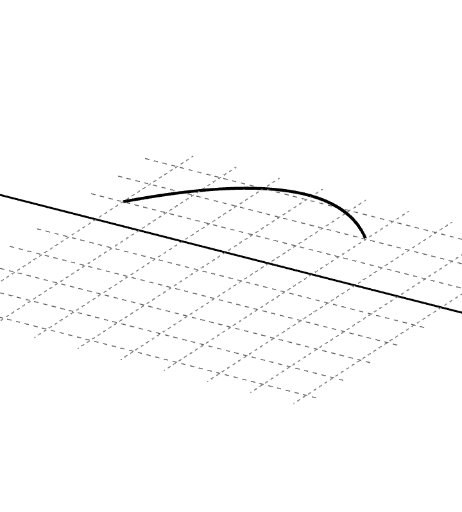
Draw a 3D coordinate system with three points on the x-axis. Fit a quadratic polynomial curve through these points as the target curve. Place two additional points on the x-axis and connect them with a line segment as a secant line. Rotate this secant line around the x-axis to generate a surface of revolution, and also sweep it along the x-axis to create another surface. The figure illustrates how linear slices approximate the area under the curve and how rotating these slices visualizes the solid, demonstrating the concept of Riemann sums and integral approximation.
The prompt above was compiled from the original drawing commands and is for reference only.