
Visualizing Solids of Revolution and Volumes by Lila Roberts (2)
Loading the math board and drawing, please wait…
In collections
Visualizing Solids of Revolution and Volumes
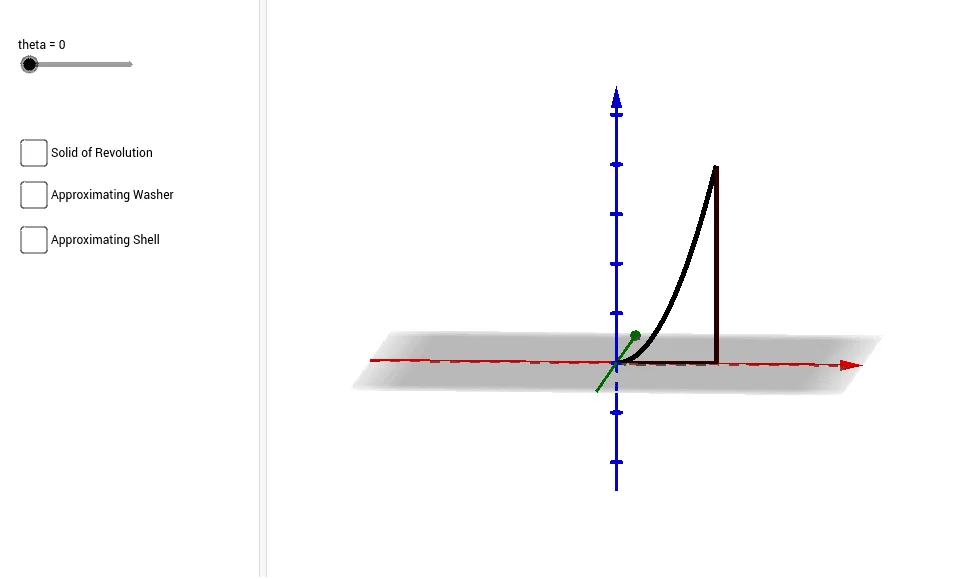
This example demonstrates the solid of revolution generated by revolving the region bounded by f(x)=x², the x-axis, and x=4. It covers core math concepts like volume of solids, integration, and coordinate geometry. Construction uses GeoGebra commands such as CurveCartesian, Polygon, Surface, curverev, and washerpolyrev to visualize 3D shapes and washer method. Ideal for high school and calculus students learning volume calculations and 3D graphing.
GeoGebra Commands & Parameters
CurveCartesian(t, 0, t^(2), t, 0, 2) → fncurvePolygon((1, 0, 0), (1.2, 0, 0), (1.2, 0, 1), (1, 0, 1)) → shellpoly, h, i, j, kSurface((t * cos(s)), (t * sin(s)), t^(2), t, 0, 2, s, 0, theta) → curverevPolygon((1, 0, 1), (2, 0, 1), (2, 0, 1.2), (1, 0, 1.2)) → washerpoly, r, s, t, a_1Polygon((cos(theta), sin(theta), 0), ((1.2 * cos(theta)), (1.2 * sin(theta)), 0), ((1.2 * cos(theta)), (1.2 * sin(theta)), 1), (cos(theta), sin(theta), 1)) → shellpolyrev, l, m, n, pPolygon((cos(theta), sin(theta), 1), ((2 * cos(theta)), (2 * sin(theta)), 1), ((2 * cos(theta)), (2 * sin(theta)), 1.2), (cos(theta), sin(theta), 1.2)) → washerpolyrev, b_1, c_1, d_1, e_1CurveCartesian((t * cos(theta)), (t * sin(theta)), t^(2), t, 0, 2) → fncurverevCurveCartesian(2, 0, t, t, 0, 4) → vertcurveCurveCartesian((2 * cos(theta)), (2 * sin(theta)), t, t, 0, 4) → vertcurverevCurveCartesian(t, 0, 0, t, 0, 2) → horizaxisCurveCartesian((t * cos(theta)), (t * sin(theta)), 0, t, 0, 2) → horizaxisrevSurface((t * cos(s)), (t * sin(s)), 0, t, 0, 2, s, 0, theta) → horizaxisrev_1Surface((2 * cos(s)), (2 * sin(s)), t, t, 0, 4, s, 0, theta) → verticalrevSurface(cos(s), sin(s), t^(2), t, 0, 1, s, 0, theta) → fSurface((1.2 * cos(s)), (1.2 * sin(s)), t^(2), t, 0, 1, s, 0, theta) → gSurface((r * cos(s)), (r * sin(s)), 0, r, 0.5, 0.7, s, 0, theta) → oSurface(cos(s), sin(s), t, t, 1, 1.2, s, 0, theta) → wSurface((t * cos(s)), (t * sin(s)), 1, t, 1, 1.2, s, 0, theta) → vSurface((t * cos(s)), (t * sin(s)), 1.2, t, 1, 2, s, 0, theta) → uSurface((t * cos(s)), (t * sin(s)), 0, t, 1, 1.2, s, 0, theta) → shellaxisrevSurface((r * cos(s)), (r * sin(s)), 1, r, 1, 1.2, s, 0, theta) → qSurface((2 * cos(s)), (2 * sin(s)), t, t, 1, 1.2, s, 0, theta) → b