
Kuen Surface Construction with Parametric Equations
Loading the math board and drawing, please wait…
In collections
geometriadinamica.es
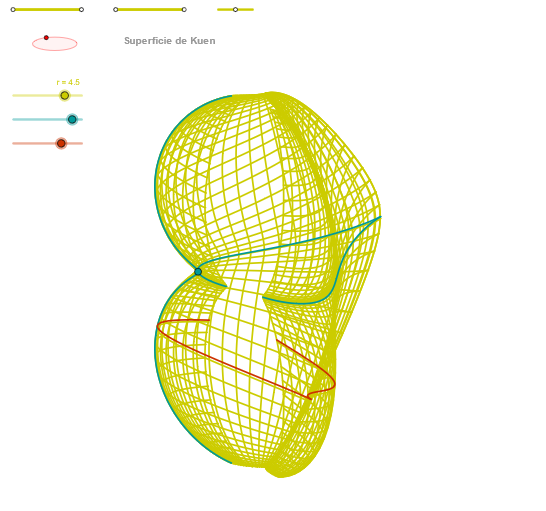
This example demonstrates the construction of the famous Kuen surface, a classic smooth surface discovered by the German mathematician Kuen in 1884. The core mathematical concepts include parametric representation of surfaces, curve and surface integrals, curve parameterization and discretization. Construction details: Use CurveCartesian to define parametric curves, Sequence to generate surface mesh points, Segment to construct line segments, Point to place key points, Ellipse to draw elliptical cross-sections, and Circle, Intersect, Angle for auxiliary geometric constructions. Finally, calculate the surface area through integration. Suitable for advanced mathematics, analytic geometry, and calculus courses, as well as mathematical modeling competition training, helping students understand the geometric meaning of parametric surfaces and multiple integrals.
GeoGebra Commands & Parameters
Segment(Q5, Q6) → p5Point(p5) → P5Segment(Q3, Q4) → p2Point(p2) → P3Segment(P3, Q4) → p4Point(p4) → P4Segment(Q1, Q2) → p1Point(p1) → P1Segment(P1, Q2) → p3Point(p3) → P2OrthogonalLine(C, yAxis) → zz1Circle(C, 0.62) → zz0Intersect(zz0, zz1, 1) → ZZ1Intersect(zz0, zz1, 2) → ZZ2Ellipse(ZZ1, ZZ2, 0.65) → zElipse1Intersect(zElipse1, zz1) → ZZ5, ZZ6Point(zElipse1) → XYAngle(ZZ6, C, XY) → zAngRotOrthogonalLine(C, xAxis) → zz2Intersect(zz0, zz2, 2) → ZZ3Intersect(zz0, zz2, 1) → ZZ4Ellipse(ZZ3, ZZ4, 0.65) → zElipse2Intersect(zElipse2, zz2) → ZZ7, ZZ8Point(zElipse2) → ZAngle(ZZ8, C, Z) → zAngIncCurveCartesian((r / 1.5 * ((((2 * cos(u)) + (u * sin(u))) / (1 + u^(2)) * sin(zAngRot)) + ((2 * (((-u) * cos(u)) + sin(u)) / (1 + u^(2))) * cos(zAngRot)))), (r / 1.5 * (((((-((2 * cos(u)) + (u * sin(u))))) / (1 + u^(2)) * cos(zAngRot)) * sin(zAngInc)) + (((2 * (((-u) * cos(u)) + sin(u)) / (1 + u^(2))) * sin(zAngRot)) * sin(zAngInc)))), u, u1, u2) → curva1Segment(ZZ5, ZZ6) → zz4Segment(ZZ7, ZZ8) → zz3Intersect(zElipse2, zElipse1, 1) → zPunto1Intersect(zElipse2, zElipse1, 4) → zPunto2Segment(zPunto1, zPunto2) → zSeg2CurveCartesian((r / 1.5 * (((((2 * cosh(v)) * cos(α)) + (α * sin(α))) / ((cosh(v))^(2) + α^(2)) * sin(zAngRot)) + (((2 * cosh(v)) * (((-α) * cos(α)) + sin(α)) / ((cosh(v))^(2) + α^(2))) * cos(zAngRot)))), (r / 1.5 * (((((-(((2 * cosh(v)) * cos(α)) + (α * sin(α))))) / ((cosh(v))^(2) + α^(2)) * cos(zAngRot)) * sin(zAngInc)) + ((((2 * cosh(v)) * (((-α) * cos(α)) + sin(α)) / ((cosh(v))^(2) + α^(2))) * sin(zAngRot)) * sin(zAngInc)) + ((v - ((2 * sinh(v)) * cosh(v))) / ((cosh(v))^(2) + α^(2)) * cos(zAngInc)))), v, v1, v2) → curva2CurveCartesian((r / 1.5 * (((((2 * cosh(β)) * cos(u)) + (u * sin(u))) / ((cosh(β))^(2) + u^(2)) * sin(zAngRot)) + (((2 * cosh(β)) * (((-u) * cos(u)) + sin(u)) / ((cosh(β))^(2) + u^(2))) * cos(zAngRot)))), (r / 1.5 * (((((-(((2 * cosh(β)) * cos(u)) + (u * sin(u))))) / ((cosh(β))^(2) + u^(2)) * cos(zAngRot)) * sin(zAngInc)) + ((((2 * cosh(β)) * (((-u) * cos(u)) + sin(u)) / ((cosh(β))^(2) + u^(2))) * sin(zAngRot)) * sin(zAngInc)) + ((β - ((2 * sinh(β)) * cosh(β))) / ((cosh(β))^(2) + u^(2)) * cos(zAngInc)))), u, u1, u2) → aSequence(CurveCartesian[(r / 1.5 * (((((2 * cosh(v)) * cos(u)) + (u * sin(u))) / ((cosh(v))^(2) + u^(2)) * sin(zAngRot)) + (((2 * cosh(v)) * (((-u) * cos(u)) + sin(u)) / ((cosh(v))^(2) + u^(2))) * cos(zAngRot)))), (r / 1.5 * (((((-(((2 * cosh(v)) * cos(u)) + (u * sin(u))))) / ((cosh(v))^(2) + u^(2)) * cos(zAngRot)) * sin(zAngInc)) + ((((2 * cosh(v)) * (((-u) * cos(u)) + sin(u)) / ((cosh(v))^(2) + u^(2))) * sin(zAngRot)) * sin(zAngInc)) + ((v - ((2 * sinh(v)) * cosh(v))) / ((cosh(v))^(2) + u^(2)) * cos(zAngInc)))), u, u1, u2], v, v1, v2, paso) → list3Sequence(CurveCartesian[(r / 1.5 * (((((2 * cosh(v)) * cos(u)) + (u * sin(u))) / ((cosh(v))^(2) + u^(2)) * sin(zAngRot)) + (((2 * cosh(v)) * (((-u) * cos(u)) + sin(u)) / ((cosh(v))^(2) + u^(2))) * cos(zAngRot)))), (r / 1.5 * (((((-(((2 * cosh(v)) * cos(u)) + (u * sin(u))))) / ((cosh(v))^(2) + u^(2)) * cos(zAngRot)) * sin(zAngInc)) + ((((2 * cosh(v)) * (((-u) * cos(u)) + sin(u)) / ((cosh(v))^(2) + u^(2))) * sin(zAngRot)) * sin(zAngInc)) + ((v - ((2 * sinh(v)) * cosh(v))) / ((cosh(v))^(2) + u^(2)) * cos(zAngInc)))), v, v1, v2], u, u1, u2, paso) → list1
AI Drawing Prompt Reference
Create a Kuen surface as a smooth 3D surface defined by parametric equations. Use two parameter directions to build the surface orientation controlled by a rotation angle and an inclination angle. Construct auxiliary geometry by drawing a base circle and an orthogonal line to obtain intersection points, then form elliptical cross-sections from those intersection curves. Find additional intersection points between the two ellipses, connect boundary key points with line segments for structure cues, and generate a surface mesh by sampling the two-parameter parametric surface with sequences over specified parameter ranges. Render the resulting discretized points/curves to visualize the enclosed Kuen surface for later surface-area integration.
The prompt above was compiled from the original drawing commands and is for reference only.