
Visualizing Complex Roots of Unity: Uniform Distribution on the Unit Circle and
Loading the math board and drawing, please wait…
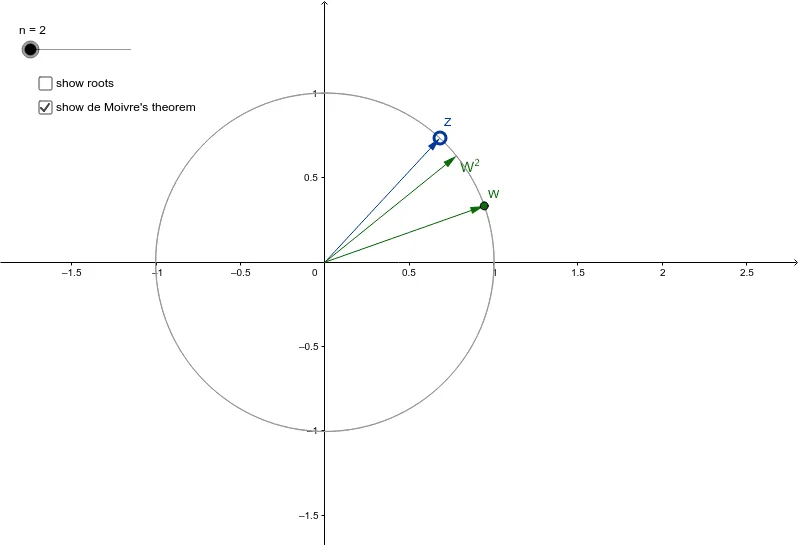
This GeoGebra example dynamically visualizes the complex roots of unity (solutions to z^n=1) on the complex plane. It demonstrates the geometric distribution of these roots as vertices of a regular n-gon inscribed in the unit circle, and explores their multiplicative structure. Core concepts include polar form of complex numbers, Euler's formula, and the cyclic group of roots. Construction uses commands like Sequence to generate n equally spaced points, Circle for the unit circle, Vector to connect origin to each root, and Intersect for finding intersections. Objects include n (slider controlling number of roots), O (origin), Z (point on unit circle), Roots, ZCircle, ZVector, WCircle, W, WLabels, WVectors, RootsLabels, RootsVectors, ShowRoots, ShowMultiplications, W_1, W_2, and WCircles. Suitable for high school to undergraduate mathematics, this tool helps students understand the polygon arrangement of roots and their closure under multiplication, and can be used to explore properties of nth roots of unity.
GeoGebra Commands & Parameters
Intersect(xAxis, yAxis) → OSequence((Z^(1 / n) * exp((((i * 2) * 3.141592653589793) * k / n))), k, 0, n - 1) → RootsCircle(O, Z) → ZCircleVector(O, Z) → ZVectorCircle(O, abs(ZVector)^(1 / n)) → WCirclePoint(WCircle) → WSequence(Text["W^{" + (k) + "}", W^(k), n > 0, n > 0], k, 2, n) → WLabelsSequence(Vector[O, W^(k)], k, 1, n) → WVectorsSequence(Text["W_{" + (k) + "}", Element[Roots, k], n > 0, n > 0], k, 1, n) → RootsLabelsSequence(Vector[O, Element[Roots, k]], k, 1, n) → RootsVectorsSequence(Circle[O, abs(W^(k))], k, 2, n - 1) → WCircles