
Visualizing Roots of Unity: Rotational Symmetry and Geometric Construction in th
Loading the math board and drawing, please wait…
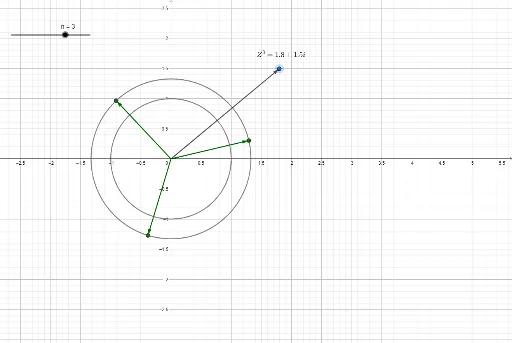
This GeoGebra example dynamically illustrates the distribution and geometric significance of roots of unity in the complex plane. Roots of unity are the n complex solutions to z^n=1, which lie uniformly on the unit circle and form the vertices of a regular n-gon, demonstrating the rotational symmetry of complex multiplication. Core mathematical concepts include complex numbers, the unit circle, solving polynomial equations, geometric mean, and coordinates of regular polygons. Construction highlights: using Vector and Sequence commands to generate vectors from the origin to each root, with a slider n controlling the number of roots; objects include vectors v, sequences a, b, u, angle θ, radius r, equation eq1, roots θ_k, r_k, point P, and possibly extensions to random experiments and fractal geometry. Suitable for high school to university students learning complex numbers, trigonometric identities, polynomial factorization, or symmetry applications, and for exploring fractal pattern generation.
GeoGebra Commands & Parameters
Vector((a, b)) → uSequence(Vector[((r_{k} * cos(θ / n + (((2 * π) * k)) / n)), (r_{k} * sin(θ / n + (((2 * π) * k)) / n)))], k, n - 1, 0) → V_{-}Sequence(Vector[((r_{k} * cos(θ / n + (((2 * π) * k)) / n)), (r_{k} * sin(θ / n + (((2 * π) * k)) / n)))], k, 0, n - 1) → V_{+}
AI Drawing Prompt Reference
Draw a unit circle in the complex plane and illustrate the n-th roots of unity. Use a slider to control n, and draw vectors from the origin to each root, which are evenly spaced on the circle, forming a regular n-gon. Include an angle parameter to rotate the starting position of the roots. The figure should show the unit circle, vectors from the center to each root, and angle markers, demonstrating the rotational symmetry of complex multiplication.
The prompt above was compiled from the original drawing commands and is for reference only.