
Finding Roots of Complex Numbers: Geometric Construction on the Unit Circle
Loading the math board and drawing, please wait…
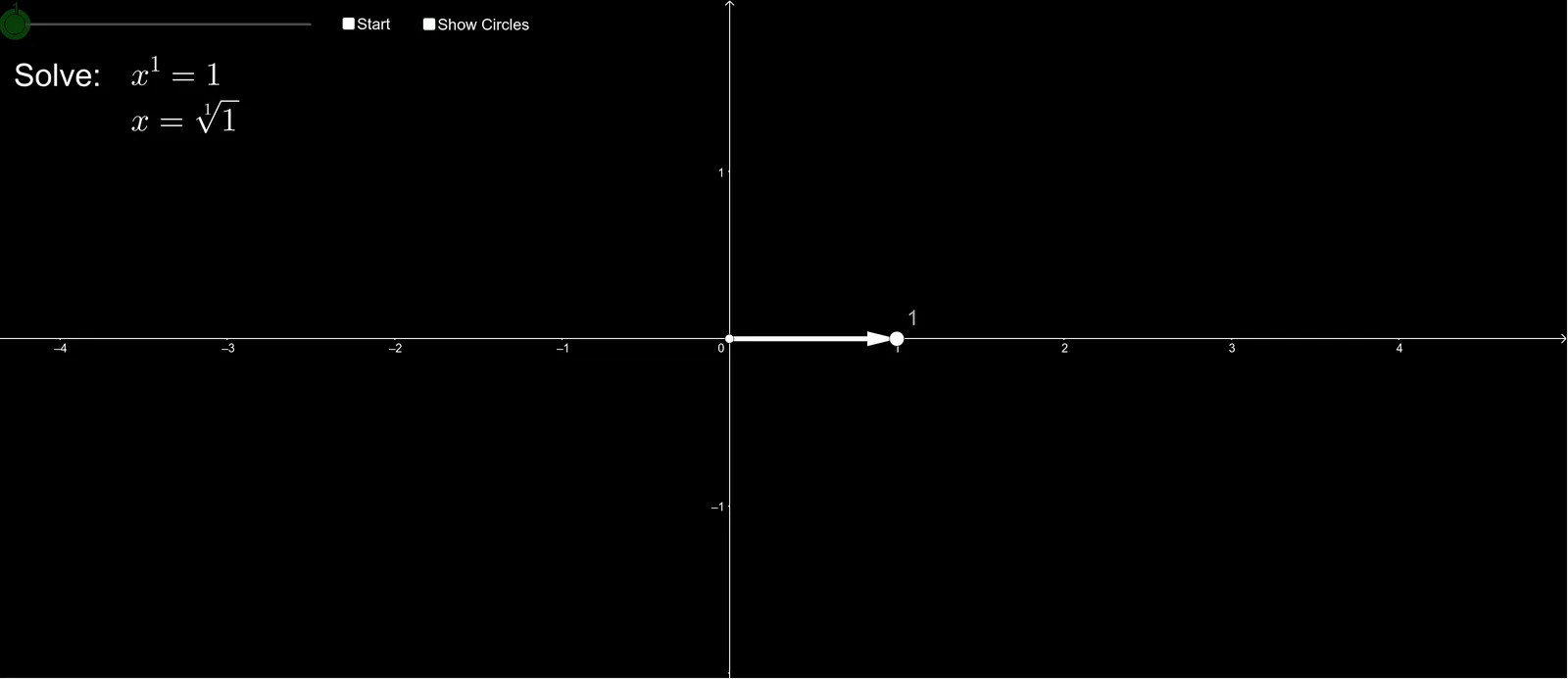
This GeoGebra example dynamically demonstrates the geometric meaning of extracting roots of complex numbers, showing how to locate the n-th roots on the unit circle using inscribed regular polygons. Core mathematical concepts include polar representation of complex numbers, De Moivre's theorem, roots of unity, and the correspondence between complex multiplication and rotation. Construction highlights: using commands such as Point, Sequence, Vector, and Circle to build complex vectors, the unit circle, root vectors, and the circle containing all roots; sliders n and k control the number and index of roots; circle intersections (InterCircles) determine root positions; text objects explain the process. Suitable for high school to undergraduate courses on complex numbers, complex plane geometry, or mathematical experimentation, helping students intuitively grasp the uniform distribution of roots on the unit circle.
GeoGebra Commands & Parameters
Point(xAxis) → aSequence(Vector[(0, 0), Element[Roots, i]], i, 1, n) → RootVecVector(a) → uCircle(O, a) → ZCircleCircle(O, abs(u)^(1 / n)) → RootsCirclePoint(RootsCircle) → wSequence(Circle[O, abs(w^(j))], j, 2, n - 1) → InterCircles
AI Drawing Prompt Reference
Draw a unit circle with n equally spaced points representing the n-th roots. The center is at the origin, with n controlled by a slider. Connect the points with lines to show the uniform distribution of roots. Add text labels to explain the geometric meaning.
The prompt above was compiled from the original drawing commands and is for reference only.