
Visualizing Complex Roots of Unity: Points and Vector Multiplication on the Unit
Loading the math board and drawing, please wait…
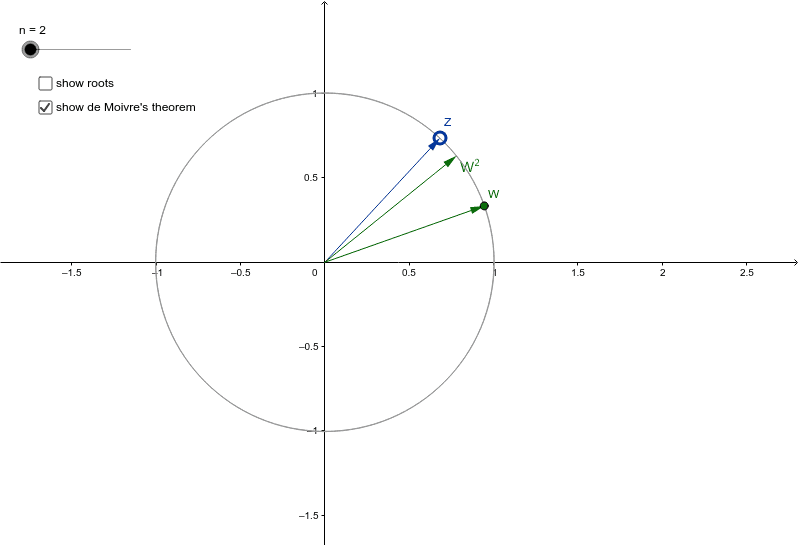
This GeoGebra example dynamically visualizes the complex roots of unity (the n solutions to z^n=1) on the complex plane. It demonstrates how these roots are evenly spaced on the unit circle, illustrating key concepts such as polar representation of complex numbers, Euler's formula, and the geometric interpretation of complex multiplication as rotation. The construction uses commands like Sequence to generate the n roots, Circle to draw the unit circle, Vector to represent the position vectors from the origin to each root, and Intersect/Point to mark key locations. A slider n controls the number of roots, allowing users to observe how the arrangement changes with n, and additional objects (W_1, W_2) show the effect of multiplying roots, reinforcing the rotational nature of complex multiplication. This resource is ideal for high school to undergraduate mathematics education, serving as a powerful tool for teaching complex equations, root properties, and geometric transformations in the complex plane.
GeoGebra Commands & Parameters
Intersect(xAxis, yAxis) → OSequence((Z^(1 / n) * exp((((i * 2) * 3.141592653589793) * k / n))), k, 0, n - 1) → RootsCircle(O, Z) → ZCircleVector(O, Z) → ZVectorCircle(O, abs(ZVector)^(1 / n)) → WCirclePoint(WCircle) → WSequence(Text["W^{" + (k) + "}", W^(k), n > 0, n > 0], k, 2, n) → WLabelsSequence(Vector[O, W^(k)], k, 1, n) → WVectorsSequence(Text["W_{" + (k) + "}", Element[Roots, k], n > 0, n > 0], k, 1, n) → RootsLabelsSequence(Vector[O, Element[Roots, k]], k, 1, n) → RootsVectorsSequence(Circle[O, abs(W^(k))], k, 2, n - 1) → WCircles